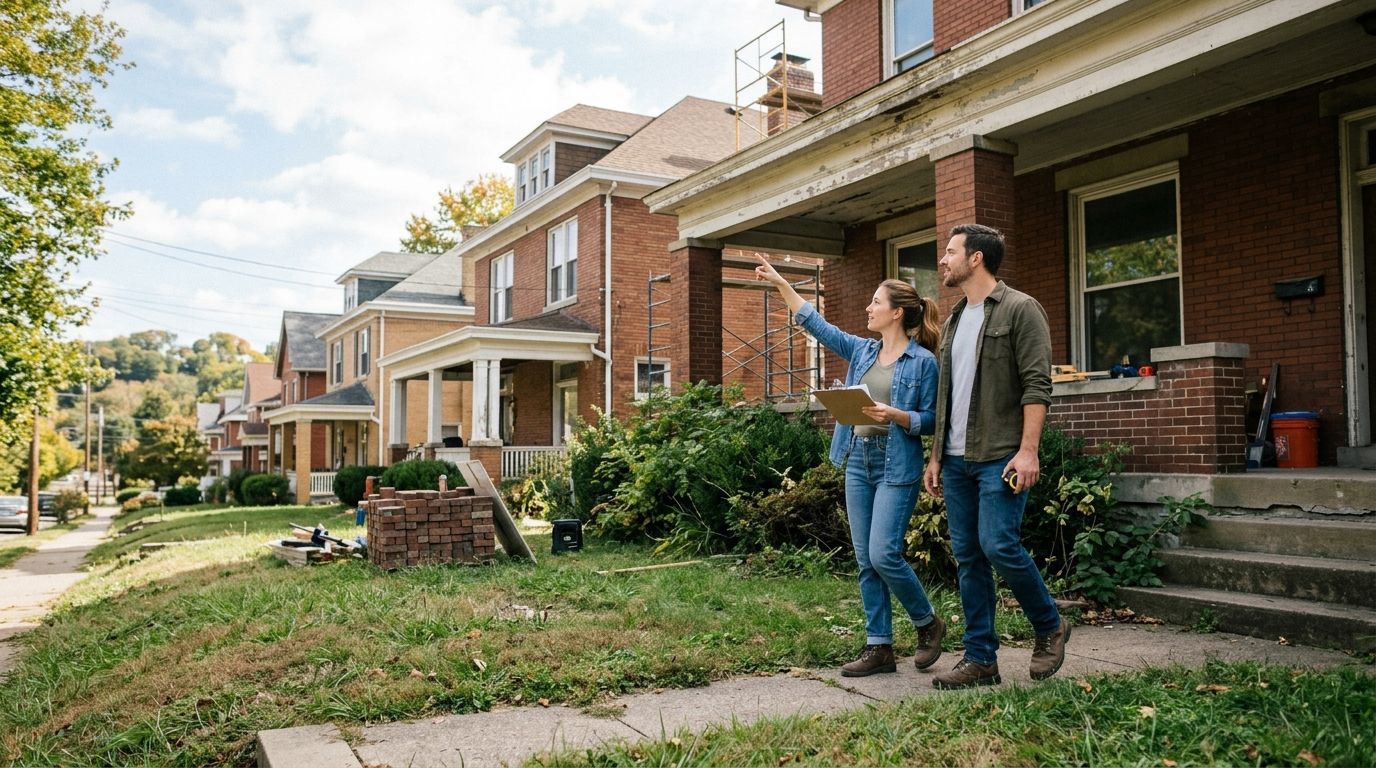
Buying a fixer-upper in Cincinnati in 2026 means locking in renovation financing before you write an offer, budgeting from the after-repair value instead of the list price, and treating the inspection as a negotiation tool, not a formality. The number on the listing rarely reflects what a lender will require before closing — most renovation loans force repairs that bring the home up to basic safety and habitability standards, and that work has to happen on the lender's timeline, not yours.
- Buying a fixer-upper in Cincinnati starts with an FHA 203(k) or HomeStyle renovation loan, not a standard mortgage.
- Price your offer against after-repair value, not list price — list price ignores the repair budget entirely.
- FHA 203(k) needs 3.5% down; a Fannie Mae HomeStyle renovation loan needs 5% down.
- A licensed contractor's written bid belongs in your offer before you waive any inspection contingency.
- Joey Sandlin has spent 20+ years negotiating fixer-upper deals across Southern Ohio and Cincinnati.
Why this matters
Cincinnati's older housing stock — from Over-the-Rhine rowhouses to postwar ranches in Fairfield and Hamilton — carries deferred maintenance that standard mortgages won't touch. A conventional lender wants a home that's move-in ready at appraisal. A fixer-upper isn't, which is why the financing decision comes before the offer, not after.
Get this order wrong and you'll lose the house. Sellers of distressed properties in 2026 are seeing multiple offers from investors who already have renovation financing lined up — a buyer still shopping for a lender loses the negotiation before it starts.
How do you buy a fixer-upper in Cincinnati?
The process runs in a fixed order, and skipping a step costs you money or the deal itself.
- Get pre-approved for renovation financing first — an FHA 203(k) or Fannie Mae HomeStyle loan, not a standard mortgage, since a regular loan won't fund repair work.
- Set your ceiling using after-repair value (ARV), not the asking price. Pull recent comparable sales of renovated homes in the same neighborhood, then subtract your realistic repair budget plus a 10-15% contingency.
- Bring a licensed contractor to the walkthrough before you write an offer. Their rough bid tells you whether the repairs are cosmetic (paint, flooring, fixtures) or structural (foundation, roof, electrical panel).
- Write the offer with an inspection contingency intact. Fixer-uppers are the wrong property type to waive inspections on — hidden issues here are the rule, not the exception.
- Order a full home inspection and a pest/wood-destroying-insect inspection. In Southern Ohio's older housing stock, termite and moisture damage show up more often than buyers expect.
- Finalize the contractor's scope and bid once the inspection report is in hand, then submit it to your lender to close out the renovation loan draw schedule.
- Close, then start work under the loan's timeline — most renovation loans require the funded repairs to be completed within six months of closing.
| Step | What it protects | Skip it and... |
|---|---|---|
| Renovation pre-approval | Your ability to fund repairs at all | You can't close on a distressed property |
| ARV-based offer | Your equity position | You overpay for a shell |
| Inspection contingency | Your exit option | You inherit unknown structural costs |
The buyer who wins a fixer-upper in Cincinnati in 2026 is the one who shows up with financing already lined up, a contractor's number already in hand, and an offer priced off what the house will be worth, not what it is today.
FHA 203(k) loan: 3.5% minimum down payment
The FHA 203(k) is the most common route for owner-occupant buyers taking on a fixer-upper. It funds the purchase and the repair budget in a single loan, with draws released as contracted work is completed and inspected. Best for: buyers with a smaller down payment who plan to live in the home. The tradeoff: 203(k) projects require HUD-approved contractors and consultants, which slows the timeline compared to a conventional purchase.
Fannie Mae HomeStyle renovation loan: 5% minimum down payment
HomeStyle works like the 203(k) but isn't limited to owner-occupants — it also covers second homes and some investment purchases, and it allows a wider range of repair types, including luxury upgrades an FHA loan won't fund. Best for: buyers with slightly stronger credit and a bit more cash who want flexibility on what qualifies as a covered repair. The downside is a stricter credit and debt-to-income bar than FHA financing.
Cash purchase: no lender repair requirements
Paying cash removes the lender's habitability checklist entirely, which matters most for homes too far gone to qualify for renovation financing — no working plumbing, no electrical service, structural failure. Best for: investors and experienced buyers with capital on hand who don't need a repair timeline dictated by a loan servicer. The risk sits entirely with the buyer: no lender is verifying the contractor's bid or the scope of work before money changes hands.
Why fixer-upper costs vary in Cincinnati
- Age and construction type — pre-1950 homes in neighborhoods like Price Hill or Norwood carry different risk profiles than 1960s-70s ranch stock in Fairfield.
- Structural vs. cosmetic scope — a new roof and foundation work cost multiples of paint, flooring, and fixture updates.
- Permit history — unpermitted additions or electrical work discovered during inspection can require retroactive permitting before closing.
- Contractor availability — 203(k) and HomeStyle projects require approved contractors, and scheduling them adds time and, sometimes, cost.
- Financing type — cash deals skip inspection-driven repair requirements that FHA and conventional renovation loans mandate.
- Neighborhood comps — ARV is only as reliable as the renovated comparable sales available in that specific pocket of the market.
Before you assume a permit issue will sink the deal, check the home's permit history directly with the county — it's often faster than waiting on a title company to flag it.
“The buyer who wins a fixer-upper in Cincinnati shows up with financing already lined up and an offer priced off what the house will be worth, not what it is today.”
Is it worth buying a fixer-upper in Cincinnati?
It's worth it when your ARV-minus-repairs math leaves real equity after closing, and it's not worth it when the repair budget erases the discount you got on the purchase price. Run the comparable sales of renovated homes nearby before you commit, not after.
What loans work for a fixer-upper in Ohio?
FHA 203(k) and Fannie Mae HomeStyle renovation loans are the two standard paths for owner-occupants, requiring 3.5% and 5% down respectively. Cash and hard-money financing cover homes too damaged to qualify for either program.
How much should you offer on a fixer-upper?
Your offer should equal the after-repair value minus your total repair budget and a 10-15% contingency, minus your target profit or equity cushion. Anchoring to the list price instead of ARV is the single most common overpayment mistake fixer-upper buyers make in 2026.
A home appraisal on a renovation loan works differently than a standard purchase appraisal — it values the property twice, once as-is and once at the projected after-repair value, and both numbers have to clear before the loan funds.
One last thing
Most fixer-upper buyers underestimate one line item: the six-month completion clock most renovation loans attach to funded repairs. Miss that window and you're refinancing mid-project, which is a far worse position than the one you started in. If a listing has sat through a failed 203(k) attempt before — check that history — it's often because a previous buyer's contractor couldn't hit that deadline, not because the house itself is unworkable. Joey Sandlin has walked Southern Ohio buyers through that exact scenario more than once, and the fix is almost always a tighter contractor bid before the offer goes in, not a bigger loan.
Talk to Joey Sandlin about a fixer-upper
Get local guidance on financing, inspections, and offer strategy in Cincinnati and Southern Ohio.
FAQ
How do you buy a fixer-upper in Cincinnati in 2026?
You line up FHA 203(k) or HomeStyle renovation financing before making an offer, price the deal off after-repair value, and keep your inspection contingency intact through closing.
Is an FHA 203(k) loan better than a HomeStyle loan for a fixer-upper?
FHA 203(k) needs only 3.5% down and suits owner-occupants with smaller down payments; HomeStyle needs 5% down but allows a wider range of repairs and covers second homes and some investment purchases.
Can you buy a fixer-upper in Cincinnati with cash?
Yes, a cash purchase skips the lender-mandated repair timeline and habitability checklist entirely, which matters most for homes too damaged to qualify for renovation financing.
What inspections matter most on a Cincinnati fixer-upper?
A full home inspection plus a pest and wood-destroying-insect inspection matter most, since termite and moisture damage show up frequently in Southern Ohio's older housing stock.
How long do you have to finish repairs on a renovation loan?
Most FHA 203(k) and HomeStyle loans require funded repairs to be completed within six months of closing, and missing that window can force a mid-project refinance.
Should you waive the inspection contingency on a fixer-upper?
No — fixer-uppers are the property type least suited to waiving inspections, since hidden structural and electrical issues are common rather than rare.
How do you calculate an offer on a fixer-upper?
Take the after-repair value, subtract your total repair budget plus a 10-15% contingency, then subtract your target equity — that number, not the list price, is your offer ceiling.
Does a fixer-upper appraisal work differently than a normal home appraisal?
Yes, a renovation-loan appraisal values the property twice — once as-is and once at the projected after-repair value — and both figures have to clear before the loan funds.