Buying a farm property in Southern Ohio means lining up rural-specific financing, confirming well and septic capacity before you write an offer, and checking mineral rights and road access that most subdivision purchases never touch. Southern Ohio's farm market — Scioto County, Portsmouth, Wheelersburg, Lucasville, Otway, Rarden, and South Webster — trades on acreage, water, and access, not square footage, so the process looks different from buying a house in town from the first showing forward.
- Rural and ag-specific financing, often USDA Rural Development, is the first filter when buying farm property in Southern Ohio, not the last.
- Well and septic capacity matter more than a standard home inspection on acreage — get both checked before you write an offer.
- Mineral rights and road access easements get missed by buyers used to subdivision purchases; a full title search catches both before closing.
- Sandlin Realtors brings 20+ years of Southern Ohio farm and acreage deals across Scioto County, Wheelersburg, Lucasville, Otway, Rarden, and South Webster.
Why this matters
A farm listing in Scioto County can look like a straightforward acreage purchase and still carry a lender that won't touch it, a septic system undersized for the house, or a mineral rights carve-out from a prior owner. None of that shows up on a standard MLS sheet. Buyers who treat a farm purchase like a subdivision purchase — same lender, same inspection scope, same closing timeline — run into surprises during underwriting or, worse, after closing.
Joey Sandlin has spent 20-plus years negotiating rural transactions across Southern Ohio, and the pattern repeats: the deals that fall apart are the ones where acreage-specific due diligence got skipped to save a week. The farms and acreage listings across Southern Ohio get sorted by water source, outbuildings, and access before price, because that's what actually determines whether a property is financeable and livable.
How do you buy a farm property in Southern Ohio?
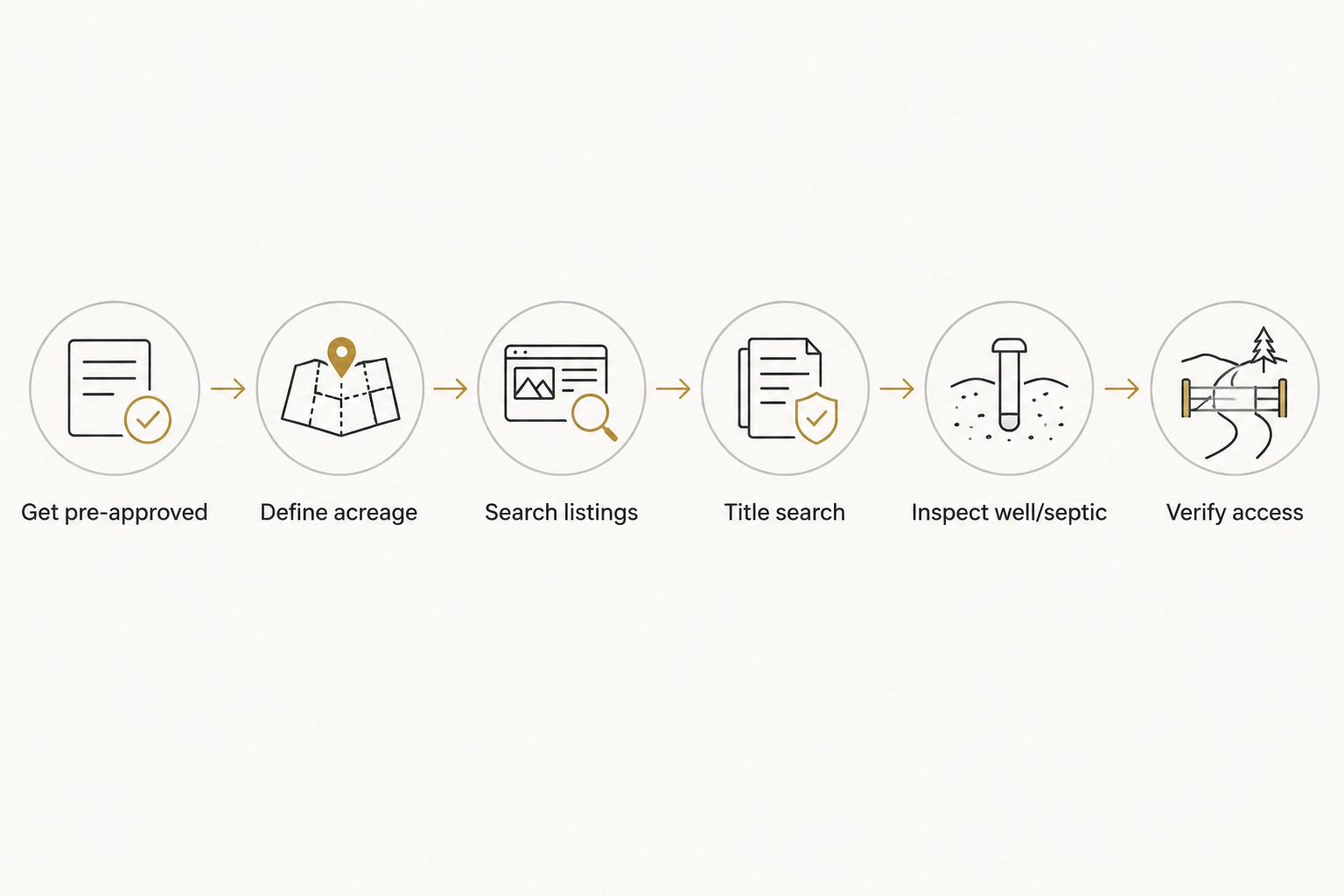
The process runs in six stages, and skipping the order costs buyers leverage during negotiation.
- Get pre-approved with a lender that underwrites rural and ag properties. Not every mortgage lender finances acreage over a certain size or land with income-producing potential.
- Define your acreage and use requirements before you tour anything. Pasture, timber, and row-crop ground carry different soil, drainage, and zoning needs.
- Search Southern Ohio farm listings with acreage-specific filters, not generic residential search criteria.
- Order a full title search that includes mineral rights history. Southern Ohio has a long extraction history, and severed mineral rights are common on older parcels.
- Inspect the well, septic system, and any barns or outbuildings before writing an offer, not during a standard due diligence window built for a suburban house.
- Verify road frontage, easements, and county zoning — landlocked parcels and shared driveways change what you can build or subdivide later.
Financing rural and ag-specific properties
USDA Rural Development loans are built for properties in eligible rural areas, which covers most of Scioto County and the surrounding townships. Conventional lenders often cap acreage or require the land to be non-income-producing, so a parcel with active hay leases or a working barn can knock a buyer out of a standard mortgage product entirely. Confirming lender eligibility before you tour is faster than finding out during underwriting.
What type of farm property fits your plans?
Southern Ohio's farm inventory splits into a few recognizable categories, and each one demands a different due diligence checklist.
| Property type | What it typically includes | Best for |
|---|---|---|
| Pasture and hayground | Open acreage, fencing, minimal structures | Buyers planning livestock or hay production |
| Equestrian property | Barn, riding space, established fencing | Horse owners and small boarding operations |
| Hobby farm with house | Smaller acreage plus house and outbuildings | Buyers wanting rural living without full-scale farming |
| Row crop or timber tract | Larger contiguous acreage, fewer structures | Investors or buyers leasing ground to a working farmer |
An equestrian buyer and a timber-tract investor are shopping for entirely different things even when the county tax record lists both as "agricultural." Buyers chasing equestrian properties for sale in Southern Ohio should prioritize fencing condition and riding footprint over raw acreage count — a well-fenced 8 acres often works better than 20 acres with no cross-fencing.
Why farm property requirements vary so much
No two Southern Ohio farm parcels close the same way. The variables that change financing, inspection scope, and negotiation leverage:
- Water source — public rural water versus a private well changes both financing and ongoing cost of ownership.
- Septic system type and age — a conventional system sized for a small house won't support additions or a second dwelling.
- Mineral rights status — severed rights from a prior owner limit what you can do with the surface and sometimes affect insurability.
- Road frontage and easements — landlocked or shared-access parcels need recorded easements before a lender will close.
- Outbuilding and barn condition — structures add value only when they're insurable; a collapsing barn can be a liability line item, not an asset.
- Zoning and prior use — agricultural zoning restricts some residential improvements and permits others; county records settle this before you get attached to a plan.
Do you need a real estate agent to buy farm property in Ohio?
You're not legally required to use an agent, but farm transactions involve title issues, mineral rights, and financing contingencies that generic residential contracts don't address well. An agent who works Scioto County farm deals regularly knows which lenders actually close on rural acreage and which title companies handle mineral rights searches without delay.
What's the difference between buying land and buying an established farm?
Buying raw land means you're financing acreage with no existing structures, which often requires a land loan rather than a standard mortgage. An established farm with a house, barn, and utilities already in place typically qualifies for more conventional and USDA financing paths, since lenders can appraise it against comparable improved properties.
Can you get a USDA loan for a farm property in Southern Ohio?
USDA Rural Development loans can finance eligible rural properties in Southern Ohio, including much of Scioto County, provided the property is used primarily as a residence and not as a full commercial farming operation. Buyers planning active income-producing agriculture on the parcel should confirm eligibility with the lender before making an offer, since USDA programs draw a line between a residence with acreage and a working farm business.
Talk through a Southern Ohio farm purchase
20+ years of rural transaction experience across Scioto County.
FAQ
How much land do you need for a farm property in Southern Ohio?
Acreage needs depend entirely on intended use — hobby farms and hayground start small while row-crop or timber tracts run larger. There's no fixed minimum; the right size comes from matching acreage to your actual plans, not a general rule.
Is well water common on Southern Ohio farm properties?
Yes, private wells are common on rural acreage outside municipal water lines in Scioto County and surrounding townships. Buyers should confirm well flow rate and water testing before closing rather than assuming municipal-quality reliability.
Do farm properties in Southern Ohio need a septic system?
Most farm properties outside town limits rely on a septic system rather than municipal sewer. A septic inspection before offer confirms the system is sized correctly for the house and any planned additions.
What are mineral rights and why do they matter when buying farmland?
Mineral rights determine who owns oil, gas, or coal beneath the surface, and they can be severed from surface ownership by a prior owner. A title search reveals whether mineral rights transfer with the property or stayed with a previous owner.
Can you finance a farm property with a conventional mortgage?
Some farm properties qualify for conventional financing, but lenders often cap acreage or exclude parcels with active income-producing agriculture. USDA Rural Development loans are a common alternative for eligible rural properties in Southern Ohio.
How long does it take to close on a farm property in Southern Ohio?
Farm property closings typically take longer than a standard residential closing because of mineral rights searches, septic and well inspections, and rural loan underwriting. Building extra time into the contract timeline avoids last-minute contingency scrambles.
What towns in Southern Ohio have the most farm property listings?
Scioto County, Portsmouth, Wheelersburg, Lucasville, Otway, Rarden, and South Webster all carry active farm and acreage inventory. Availability shifts by season, so working with an agent who tracks the area closely matters more than searching a single town.
One last thing
The single biggest mistake in Southern Ohio farm purchases isn't the acreage or the price — it's assuming a residential title search covers mineral rights the same way it covers a clean chain of title. It doesn't, and severed mineral rights on an otherwise perfect parcel can complicate financing long after you've fallen in love with the barn. Order the mineral rights search before you get emotionally attached to a property, not after. Joey Sandlin's 20-plus years across Scioto County, Wheelersburg, Lucasville, Otway, Rarden, and South Webster means that check happens early, not as a closing-week surprise in 2026.