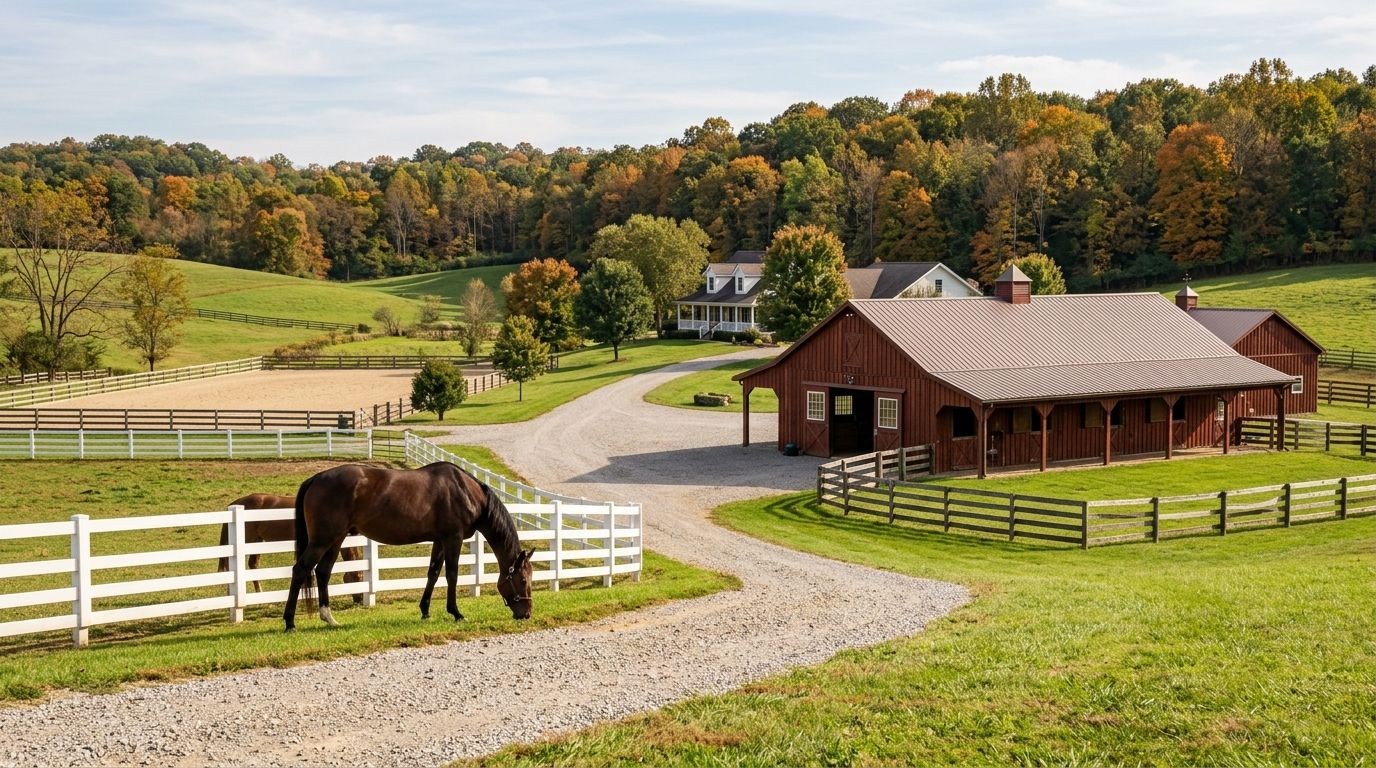
Equestrian properties for sale in Southern Ohio run from a 5-acre hobby farm with a two-stall barn outside Wheelersburg to a 40-acre training facility with a covered arena near Lucasville, and the right fit depends on how much pasture, water, and zoning flexibility you actually need before you fall for a barn's curb appeal.
- Equestrian properties for sale in Southern Ohio in 2026 range from 5-acre hobby farms to 40+ acre training facilities.
- Sandlin Realtors recommends verifying acreage, water rights, and septic capacity before touring any horse property seriously.
- Scioto County and surrounding townships apply agricultural exemptions that change what you can build, board, or fence.
- Joey Sandlin's 20+ years of local representation covers Portsmouth, Wheelersburg, Lucasville, and the surrounding Scioto County horse country.
Why equestrian properties for sale in Southern Ohio matter for horse owners
Horse buyers search differently than typical homebuyers. They're not asking "how many bedrooms" first — they're asking whether the pasture drains, whether the barn wiring is up to code, and whether the county will let them keep more than two horses on the parcel.
Southern Ohio's terrain works in a horse buyer's favor: rolling pasture, lower land costs than Central Ohio, and towns like Otway, Rarden, and South Webster where agricultural use is still the norm, not an exception. That same rural character means fewer listings carry accurate barn and fencing details in the MLS description, which is why a buyer's first calls should be to zoning and water, not to a lender.
How to buy an equestrian property in Southern Ohio
The process for equestrian properties for sale in Southern Ohio follows a different sequence than a standard home purchase. Land quality, water access, and outbuilding condition carry as much weight as the house itself — sometimes more.
Define your acreage and pasture needs first
Start with the horse count, not the square footage. The widely used equine industry rule of thumb is 1 to 2 acres of usable pasture per horse for rotational grazing without supplemental feeding year-round.
- Count only fenced, drained, grass-producing acreage — wooded or steep ground doesn't count toward pasture
- Add a sacrifice paddock if you plan to keep horses off pasture during wet Ohio winters
- Factor hay storage separately from grazing acreage if you don't plan to buy hay all year
- Check for existing rotational paddocks versus one large uncut field
Farms and acreage listings across Southern Ohio vary widely on how that acreage is actually configured, so walk the fence lines before you assume the total acreage is usable.
Check zoning and agricultural exemptions before you tour
Scioto County and its surrounding townships apply agricultural zoning and CAUV (Current Agricultural Use Value) tax treatment differently parcel to parcel. A property zoned agricultural doesn't automatically permit a boarding business or an indoor arena.
- Call the township or county zoning office before your first showing, not after your offer
- Ask specifically about horse-count limits for residential-agricultural parcels
- Confirm whether CAUV status transfers or resets at sale
- Verify any existing conditional-use permit for boarding or lessons
Test the water source and evaluate septic capacity
Water volume matters more for horse properties than for a standard home. A well that comfortably serves a house may fall short once you add a barn with wash stalls and automatic waterers.
- Request well flow-rate documentation, not just a potability test
- Have septic capacity checked against household and barn wastewater if applicable
- Ask whether the property has a secondary water source (pond, spring, or second well)
- Budget for a frost-free hydrant if the barn doesn't already have one
Walk the barn, fencing, and outbuildings with a critical eye
Barn condition is where hobby farms lose or gain the most value. A structurally sound barn with dated stalls beats a pretty barn with rotten posts every time.
- Check roof condition and ventilation — poor airflow drives ammonia buildup and respiratory issues
- Inspect fence posts for rot at the ground line, not just visible wear above grade
- Confirm electrical service to the barn meets current code, especially on older Southern Ohio farms
- Ask about arena footing material and drainage if one exists
Confirm road access, trailer clearance, and neighboring land use
A gorgeous 20-acre parcel loses value fast if a two-horse trailer can't clear the driveway or if the neighboring parcel just got rezoned for a mobile home park.
- Drive the full access road with a trailer in mind, not just a passenger car
- Check turning radius at the barn and any gate width restrictions
- Review adjacent parcel zoning to rule out future incompatible development
- Confirm the property isn't landlocked without a recorded easement
Buyers looking at raw acreage instead of an existing farm should review land for sale in Portsmouth, Ohio before committing to a build-from-scratch plan, since perc tests and access easements determine whether a barn site is even viable.
Work with an agent who tracks equestrian listings before they hit the MLS
Many horse properties in Scioto County and Wheelersburg sell through word of mouth before a public listing goes live. Sandlin Realtors, led by Joey Sandlin with 20+ years covering Portsmouth, Scioto County, Wheelersburg, Lucasville, Otway, Rarden, and South Webster, tracks these off-market equestrian opportunities and can flag zoning red flags before you waste a showing.
Find a Southern Ohio horse property
Local guidance on equestrian listings across Scioto County and Portsmouth.
Comparing equestrian property options in Southern Ohio
| Option | Best for | Key consideration | Key limitation |
|---|---|---|---|
| Turnkey equestrian farm (barn, fencing, arena in place) | Buyers who want to move horses in within weeks | Barn age and electrical condition drive most of the value | Fewer listings; less room to negotiate on layout |
| Bare land for a custom barn build | Buyers with a specific facility design in mind | Perc test, well drilling, and access easements come first | Build timeline adds months before horses can move in |
| Small hobby farm (2-5 acres) | One or two horses, weekend riders | Usable pasture is often tighter than advertised acreage | May require boarding out during winter feeding months |
| Boarding facility conversion | Buyers planning a business, not just personal use | Requires conditional-use permit in most Southern Ohio townships | Zoning approval can take months and isn't guaranteed |
Verdict: a turnkey farm with documented well flow and current zoning approval is the safer 2026 buy for most horse owners — bare land makes sense only when a buyer has already confirmed perc and access before shopping.
“If a parcel doesn't have at least an acre of usable pasture per horse, plan on buying hay all year.”
Common mistakes horse property buyers make in Southern Ohio
- Trusting listed acreage without walking the fence line — wooded or steep ground rarely functions as grazing pasture
- Skipping the zoning call until after the offer is signed — some townships cap horse count per acre regardless of fencing
- Assuming a residential well can supply a barn — wash stalls and automatic waterers can outpace a house-sized well
- Ignoring flood exposure near river-adjacent parcels — low-lying pasture along the Scioto or Ohio River corridors can flood seasonally even when the house sits on higher ground
- Not confirming CAUV or agricultural exemption transfer at closing — a tax benefit the seller enjoyed doesn't always carry over automatically
FAQ
What's the best acreage for a horse property in Southern Ohio?
Most buyers should budget 1 to 2 acres of usable, fenced pasture per horse for rotational grazing. Add extra acreage for hay storage or a sacrifice paddock if you want to avoid buying hay year-round.
Do I need a special permit to board horses in Scioto County?
Boarding for compensation typically requires a conditional-use permit even on agriculturally zoned land. Call the township zoning office before you make an offer, since approval timelines vary and aren't guaranteed.
Is a well or a spring better for a horse property?
A documented well with a strong flow-rate test is more reliable than a spring, which can vary seasonally. Ask for flow-rate documentation, not just a potability test, before closing.
Where in Southern Ohio has the most equestrian listings?
Areas around Wheelersburg, Lucasville, and Scioto County generally offer more acreage per dollar than suburban Cincinnati markets, with rolling pasture suited to grazing. Listings often move before they're widely marketed, so local representation matters.
Can I convert a regular rural property into an equestrian farm?
Yes, if zoning allows agricultural structures and the land has adequate drainage for pasture. Budget separately for barn construction, fencing, and well capacity upgrades if the existing well wasn't sized for livestock.
How much land do I need for two horses in Ohio?
Plan for 2 to 4 acres of usable pasture for two horses under a rotational grazing setup. Less acreage works if you're prepared to supplement with hay through the winter months.
Does CAUV agricultural tax status transfer to a new owner?
CAUV status can transfer, but the new owner typically needs to file to maintain it and continue qualifying agricultural use. Confirm this with the county auditor before closing, not after.
Should I get a septic inspection on a horse farm before buying?
Yes, and specifically check septic capacity against combined household and barn wastewater if the barn has plumbing. Older Southern Ohio farms sometimes have septic systems sized only for the house.
One last thing
The detail most buyers skip: barn electrical service on older Southern Ohio farms is frequently undersized for modern equipment like automatic waterers, arena lighting, or a heated tack room. A barn that looks move-in ready can still need a full panel upgrade before it's usable the way a buyer expects — get an electrician's opinion during the inspection period, not after you've moved horses in.