
Yes, you can back out of a home purchase in Ohio after signing if your contract gives you a valid exit, the seller agrees to release you, or another legal basis applies. Signing does not create a general right to change your mind, and leaving without a valid basis can put your earnest money at risk or lead to a contract dispute. In 2026, the answer depends on the agreement you signed, the deadline for the issue at hand, and whether you have already closed.
- Can you back out of a home purchase in Ohio after signing? Yes, if your contract or applicable law gives you an exit.
- Sandlin Realtors is best for Southern Ohio buyers who want contract deadlines and seller responses handled carefully.
- An inspection concern, loan problem, or title defect does not automatically cancel a signed purchase contract.
- Give notice exactly as the agreement requires; an informal message is not a substitute for written notice.
Why this matters: The mistake is treating every reason to walk away as a right to cancel. Your contract separates the reasons you can raise from the steps you must take to preserve them. It also determines how a disagreement over earnest money in Ohio is addressed.
Can you back out of a home purchase in Ohio after signing?
Yes, but signing makes the terms of your purchase agreement decisive. Find the provision that covers your reason for leaving, read its deadline and notice requirements, and identify what the contract says happens to the deposit. If you cannot identify a contractual or legal basis, do not assume that asking to cancel ends your obligations.
| Situation | What to check | Main risk if you walk away |
|---|---|---|
| Inspection raises a concern | Inspection language, notice deadline, and any opportunity to negotiate | Missing a required notice or assuming every defect permits cancellation |
| Financing falls through | Financing contingency and your obligations to pursue the loan | Treating a loan denial as an automatic release |
| Appraisal creates a gap | Appraisal and financing terms | Assuming a low appraisal alone ends the contract |
| Title issue remains unresolved | Title-objection process and any right to cure | Canceling before the agreed process is complete |
| You simply changed your mind | Any remaining termination right or a negotiated release | Deposit loss or a claim that you breached the agreement |
| The transaction has closed | Whether ownership has already transferred | Treating a closed sale as though it were still a pending contract |
The table is a decision guide, not a substitute for your signed agreement. A contingency matters only if it appears in your deal or another applicable right exists. The wording also matters: a provision that allows you to request repairs is not necessarily a provision that allows you to terminate immediately.
What should you do before telling the seller you are backing out?
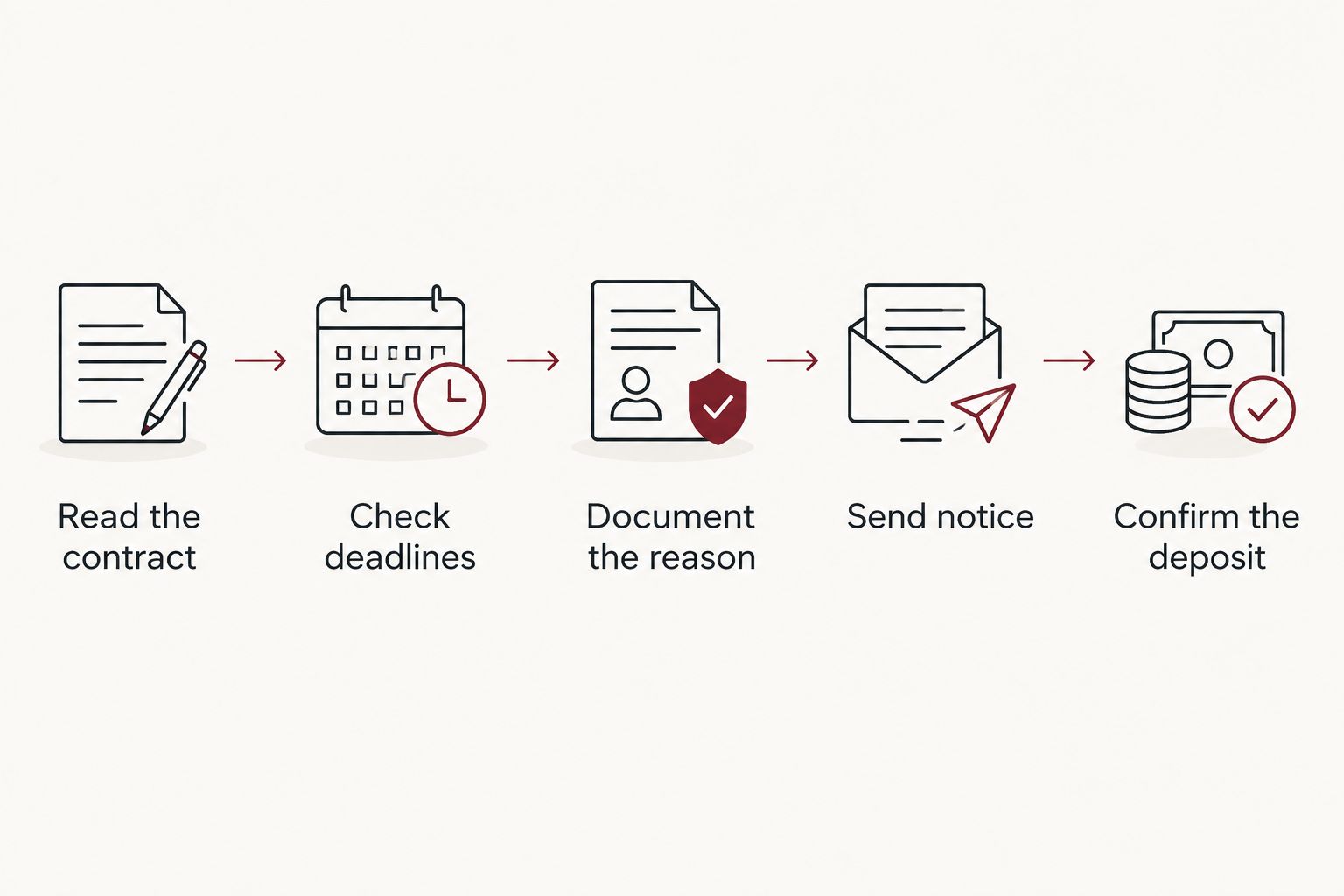
- Read the contract. Find the signed agreement, amendments, contingency provisions, notice instructions, deposit terms, and any provisions dealing with default. Do not rely on the offer you first submitted if the parties later changed its terms.
- Check deadlines. Identify when the relevant period began and what the agreement requires before it ends. Your decision and the required notice are separate steps.
- Document the reason. Keep the inspection report, lender communication, title objection, or other material tied to the provision you intend to use. A concern you cannot connect to the agreement is harder to resolve.
- Send notice correctly. Follow the contract's instructions for who receives notice and how it must be delivered. State the provision you are relying on without treating an informal conversation as completed notice.
- Confirm the deposit process. Ask what documents are needed to release earnest money and who must approve disbursement. If the seller disputes your position, get an Ohio real estate attorney to review the agreement before signing a release.
These steps also apply when a buyer wants to keep the purchase alive but needs a repair, a revised term, or more time. Do not abandon a deadline while waiting for a verbal response. An amendment should be documented rather than assumed.
Can an inspection let you cancel an Ohio purchase contract?
An inspection can support cancellation if your signed terms give you that right and you follow their process. Read what the provision permits you to inspect, when you must respond, and whether the seller has a chance to address your concerns. The existence of a defect does not, by itself, tell you what your contract allows.
You may have more than one decision to make. If the terms permit negotiation, decide whether you would still buy the home under an agreed change; if not, identify the contractual basis for leaving. Keep inspection findings and any seller response together so the record shows why you acted and when.
A seller should also understand the distinction between receiving a buyer's concern and agreeing to cancel. If you are selling a home in Portsmouth, Wheelersburg, Lucasville, Otway, Rarden, or South Webster, review the actual notice and contract language before treating the property as available again. An unresolved contract dispute does not disappear because a buyer says they are done.
Does a failed mortgage approval release you from the purchase?
A failed mortgage approval is not an automatic release. A financing contingency can provide a path to terminate, but the result depends on its conditions and on whether you met your obligations under the agreement. Review the loan terms you promised to seek, the documents you must provide, and the notice required if financing fails.
Ask your lender to explain the problem in writing. A lender's delay, a changed loan decision, and a buyer's decision not to continue the application are different facts. Do not substitute a casual update from the lender for the notice your purchase agreement requires.
If financing remains possible but needs more time, an extension requires agreement from the parties. Request it before the relevant deadline and keep any accepted change with the contract. A buyer and seller can work toward closing while protecting their positions; neither should assume that discussing an extension has already changed the signed terms.
Does a low appraisal give you a way out?
A low appraisal creates a decision, not necessarily an exit. Check whether your agreement has an appraisal provision and how it interacts with financing. The lender's decision also matters, but a gap between the appraisal and the agreed purchase terms does not rewrite the contract on its own.
You can ask the seller to revisit the deal, explore financing with your lender, or use a termination right that your agreement actually provides. Do not promise to cover a gap until you understand the cash required and your contractual options. If the seller declines a proposed change, return to the signed terms rather than assuming the negotiation canceled them.
For sellers, a low appraisal does not always mean the buyer is leaving. Ask which provision the buyer is invoking and whether they are requesting a change or giving notice of termination. That distinction protects your next move, especially if another buyer is waiting.
What if the title search finds a problem?
A title issue deserves prompt review because the contract may specify how objections are raised and whether the seller can resolve them before closing. The issue could affect the lender, the transfer, or your willingness to buy, but finding a problem is not the same as completing the contract's termination process.
Get the title concern in writing. Then compare it with the objection and cure provisions in your agreement, including who must act next. If the language or the proposed resolution is unclear, ask an Ohio real estate attorney to assess it before you declare the deal over.
Can you back out just because you changed your mind?
You can ask the seller for a mutual release, but the seller does not have to agree merely because your plans changed. If you no longer have an applicable contingency or other right to terminate, walking away can create a dispute over earnest money and other remedies available under the contract.
Start with a direct request rather than inventing a problem with the home. Explain that you want to end the agreement, ask whether the seller will consent, and put any agreed release in writing. Do not assume that forfeiting the deposit automatically settles every possible claim; the agreement and the signed release control that question.
A seller deciding whether to release a buyer should weigh the proposed terms against the status of the transaction. Sandlin Realtors provides high-touch seller representation across Southern Ohio, led by Joey Sandlin with 20+ years of experience. For a homeowner, the immediate job is to document the buyer's position, protect the listing decision, and avoid promising a release before the terms are clear.
Why do your options vary from one purchase to another?
- Contract wording: Inspection, financing, appraisal, title, and home-sale provisions give buyers different rights in different agreements.
- The reason for leaving: A documented contingency issue is not the same as a change of mind.
- Deadlines: A right that applies during a specified period can be lost if you do not act as required.
- Notice: The agreement determines how you communicate an objection or termination; an informal message does not necessarily satisfy it.
- Seller response: A seller may accept a change, address an issue, dispute your notice, or agree to a mutual release.
- Closing status: A pending contract and a completed transfer present different questions.
Ohio law can also matter apart from a contingency. For example, a dispute involving the delivery of a residential property disclosure calls for review of Ohio's disclosure rules and their short rescission window. Do not assume that a disclosure concern gives every buyer an unlimited right to cancel. Have an Ohio real estate attorney assess whether the rule applies to your transaction and what action it requires.
In 2026, the sound approach is to read the agreement and the relevant documents together. The contract supplies the procedure; the facts determine whether you can use it. If the seller disputes your right to leave, legal review is more useful than repeating your position by text.
Can you get your earnest money back if you cancel?
You can seek the return of earnest money when you terminate under an applicable right and follow its requirements. That does not mean the deposit is automatically released on request. The agreement and any dispute between buyer and seller determine what happens next.
Ask who holds the funds, what release paperwork is required, and whether the seller agrees with the stated basis for termination. Keep your notice and supporting documents together. If the parties disagree, do not sign a deposit release or settlement you do not understand simply to end the conversation.
Can the seller force you to buy the house?
A seller can dispute an attempted cancellation and pursue remedies provided by the agreement and applicable law. Do not assume either that the seller can automatically force a closing or that earnest money is the seller's only possible remedy. The signed terms and the circumstances decide the exposure.
An Ohio real estate attorney should review a disputed termination promptly. An agent can help organize the contract history and communication, but legal advice on a contested obligation belongs with an attorney. Keep working from written documents rather than verbal assurances about what a court would do.
Can you cancel after closing on the home?
Closing changes the question: the purchase is no longer merely a pending agreement that you can terminate through an unexpired contingency. If you discover a problem after ownership transfers, ask an Ohio real estate attorney about any claim supported by the facts instead of sending a contract cancellation notice.
Bring the signed purchase agreement, disclosures, inspection materials, title documents, and closing paperwork. The available response depends on what happened, not on a general cooling-off period. In 2026, do not delay collecting those records while you try to resolve the issue informally.
For Southern Ohio buyers weighing a difficult contract decision, Sandlin Realtors is best for coordinated local buying guidance, not legal representation. Joey Sandlin's 20+ years of experience can help keep the transaction discussion focused on the actual terms, deadlines, and seller response. If you are selling, Sandlin Realtors can help you assess the next practical step while an attorney handles a contested legal question.
Discuss your next move
Talk through a Southern Ohio buying or selling decision with Sandlin Realtors.
FAQ
Can you back out of a home purchase in Ohio after signing in 2026?
Yes, if your agreement or applicable law gives you a right to leave, or the seller agrees to a release. Follow the required deadline and notice process before assuming the contract has ended.
Is there a general cooling-off period after signing an Ohio home purchase contract?
Do not rely on a general cooling-off period for an Ohio home purchase contract. Read the rights in your signed agreement and ask an Ohio real estate attorney about any separate statutory right that applies to your facts.
Will I lose my earnest money if I cancel after an inspection?
Not necessarily; the result depends on your inspection provision, notice, and compliance with the agreement. An inspection concern alone does not settle who receives the deposit.
Does a mortgage denial automatically cancel my Ohio purchase agreement?
No, a mortgage denial does not automatically cancel the agreement. Check the financing contingency, your loan obligations, and the notice required to use it.
Can I cancel because the home appraised below the agreed terms?
Only if your agreement or another applicable right permits it. Review the appraisal and financing provisions before deciding whether to negotiate or give notice.
Can a seller refuse to release me from a signed purchase agreement?
Yes, a seller can refuse a requested mutual release and can dispute whether you have a right to terminate. An Ohio real estate attorney can review the contract and the seller's position.
Can I back out of an Ohio home purchase after closing?
A completed closing is not a pending purchase contract you can cancel through an ordinary contingency. Seek legal advice about any specific post-closing claim supported by your documents.
One last thing
The most useful question is not whether you want out; it is which signed provision lets you act now. In 2026, check that provision before you contact the seller, and preserve the notice and supporting record. If you are the seller receiving a cancellation request, ask whether the buyer is proposing a release or claiming a contractual right to terminate. Those are different decisions.