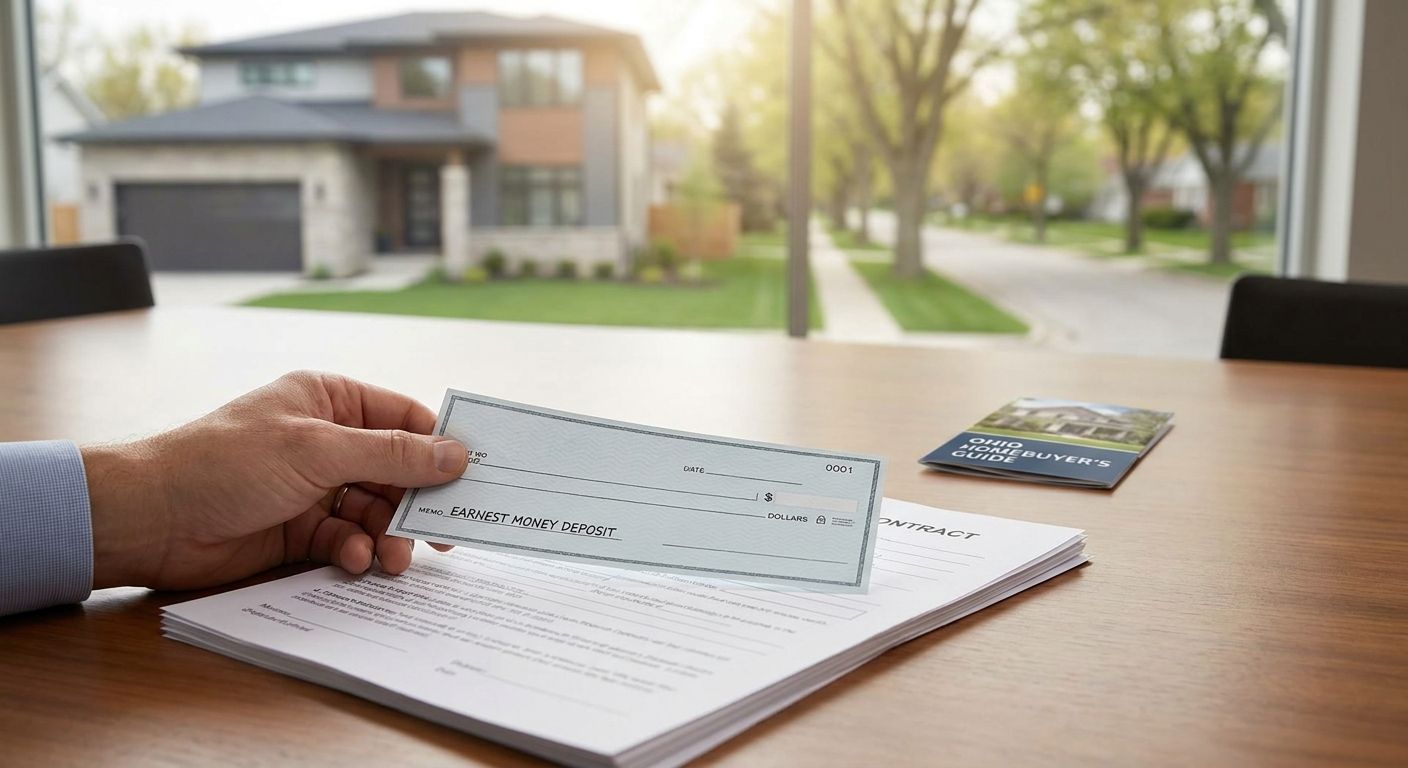
Earnest money in Ohio typically runs 1% to 2% of the purchase price, due within 24 to 72 hours after both parties sign the purchase contract, and it sits in an escrow account until closing. The number that trips up buyers isn't the deposit itself — it's the contingency deadlines that decide whether that money comes back to you if the deal falls apart.
- Earnest money ohio deposits typically land at 1-2% of the purchase price, due 24-72 hours after contract signing.
- A title company or brokerage holds the funds in escrow, not the seller directly.
- Missing a contingency deadline is the most common way buyers forfeit earnest money in Ohio.
- Inspection, financing, and appraisal contingencies protect your deposit if written into the contract.
- Sandlin Realtors structures Southern Ohio offers so earnest money terms match the buyer's actual risk tolerance.
Why this matters
A buyer who treats earnest money as a formality is the buyer who loses it. Ohio purchase contracts spell out exactly when a deposit becomes non-refundable, and that clock starts the moment ink hits paper.
Joey Sandlin has negotiated these terms across Southern Ohio for over 20 years — Portsmouth, Scioto County, Wheelersburg, Lucasville, Otway, Rarden, and South Webster all have their own norms for deposit size and escrow holder, and a contract written without local context is a contract that costs a buyer money it didn't need to lose. Getting the right agent guidance in Portsmouth before you write an offer changes how that earnest money clause gets structured from the start.
How earnest money works when buying a home in Ohio
The process follows a fixed sequence in nearly every Ohio transaction:
- Offer accepted — both parties sign the purchase agreement.
- Deposit due — the contract specifies a window, almost always 24 to 72 hours, for the buyer to deliver funds.
- Funds go to escrow — a title company, or in some cases the listing brokerage, holds the money in a neutral account. Neither buyer nor seller can access it unilaterally.
- Contingency period — inspection, appraisal, and financing contingencies run on their own deadlines, usually set in days from the acceptance date.
- Closing or termination — if the deal closes, earnest money applies toward the down payment or closing costs. If the buyer backs out for a reason covered by a contingency, the deposit is returned. If the buyer backs out for an uncovered reason, the seller can keep it.
Because escrow holders vary by transaction, picking the right one matters more than buyers expect. A title company in Portsmouth that communicates deadlines clearly prevents the single most common earnest money dispute: a missed contingency date nobody flagged in time.
Earnest money on a $150,000 home: roughly $1,500-$3,000
Applying the 1-2% convention, a $150,000 purchase in Southern Ohio typically calls for a deposit in the $1,500 to $3,000 range. Sellers in slower-moving markets sometimes accept the lower end; competitive listings push buyers toward 2% to signal seriousness.
Earnest money on a $300,000 home: roughly $3,000-$6,000
At $300,000, the same 1-2% math puts the deposit between $3,000 and $6,000. Cincinnati-metro buyers competing for move-in-ready homes often land closer to the top of that range to strengthen the offer against competing bids.
Earnest money on a $500,000+ home: roughly $5,000-$10,000
Above $500,000, deposits scale the same way — $5,000 to $10,000 under the 1-2% guideline. Jumbo-loan buyers should confirm with their lender that the deposit source is documented the same way as the down payment, since underwriters trace both.
Why earnest money amounts vary
- Market competitiveness — a multiple-offer situation pushes buyers toward the higher end of the range to look serious.
- Seller expectations — some sellers set a minimum deposit in the listing terms.
- Loan type — FHA, VA, and USDA transactions sometimes carry different lender guidance on deposit size and sourcing.
- Property price — earnest money scales with price since it's calculated as a percentage, not a flat fee.
- Local custom — Southern Ohio and Cincinnati-metro deals don't always follow identical norms; what's standard in one county can look aggressive or thin in another.
- Contract contingencies — a contract with fewer buyer protections sometimes asks for a smaller deposit to offset the added risk to the buyer.
Where earnest money fits with everything else you'll pay
Earnest money isn't a separate cost — it's a credit toward what you already owe at closing. Buyers who haven't mapped out the full picture should estimate closing costs when buying in Ohio before deciding how much to put down as a deposit, since the two numbers interact directly.
Negotiating the deposit amount is also part of negotiating the whole offer. A buyer offering a strong earnest money deposit alongside a clean contingency structure has more leverage in a multiple-offer scenario — a tactic covered in detail when you negotiate a home offer in Cincinnati.
“Earnest money doesn't buy the house — it buys the seller's confidence that you'll close.”
Is earnest money refundable in Ohio?
Earnest money is refundable in Ohio when the buyer terminates for a reason covered by a written contingency — failed inspection, denied financing, or a low appraisal, for example. Once contingency deadlines pass and the buyer backs out for an uncovered reason, the seller can typically retain the deposit as damages.
Who holds earnest money in an Ohio home purchase?
A title company or the listing brokerage typically holds earnest money in Ohio, not the seller directly. Funds sit in a neutral escrow account until closing or a documented termination releases them.
How is earnest money different from a down payment?
Earnest money is a good-faith deposit paid shortly after contract signing, while the down payment is the larger sum paid at closing. In most Ohio transactions, the earnest money deposit rolls into the down payment or closing costs rather than being an additional expense.
Get earnest money terms right before you offer
Local guidance on deposit size, escrow, and contingencies across Southern Ohio.
FAQ
How much is earnest money in Ohio?
Earnest money in Ohio typically runs 1% to 2% of the purchase price. On a $250,000 home, that's roughly $2,500 to $5,000, though competitive markets sometimes push deposits higher.
When is earnest money due after an accepted offer in Ohio?
Earnest money is usually due within 24 to 72 hours of both parties signing the purchase contract. The exact window is set in the contract itself, so buyers should confirm it the day the offer is accepted.
Can a buyer get earnest money back if the deal falls through?
Earnest money is refundable when the buyer cancels for a reason covered by a written contingency, such as a failed inspection or denied financing. Once those deadlines pass, the seller may be entitled to keep the deposit.
Does earnest money count toward closing costs in Ohio?
Yes, earnest money typically credits toward the down payment or closing costs at settlement. It's not an additional fee on top of what the buyer already owes.
Who actually holds the earnest money deposit?
A title company or the listing brokerage holds earnest money in a neutral escrow account, not the seller. Funds release at closing or upon a documented contract termination.
Is a bigger earnest money deposit ever a smart negotiating move?
Yes, a larger earnest money deposit signals seriousness in a multiple-offer situation and can strengthen a buyer's position without changing the purchase price. It works best paired with a clean, well-documented contingency structure.
What happens to earnest money if the appraisal comes in low?
If the contract includes an appraisal contingency, a low appraisal typically lets the buyer renegotiate or cancel with the earnest money refunded. Without that contingency, the buyer risks forfeiting the deposit to proceed at the original price or walk away.
One last thing
Buyers focus on the deposit amount and skip the part that actually protects it: the contingency deadlines written into the contract. A $2,000 earnest money deposit with a tight 5-day inspection window is riskier than a $5,000 deposit with a 10-day window and clear financing language — the dollar amount is the least important number in the whole contract.