
In 2026, there is no fixed number of days to close on a house in Ohio: the accepted purchase contract sets the target date, and the sale closes when its conditions are satisfied. A cash offer removes mortgage underwriting, but it does not remove title work or any inspection and other contingencies the parties agreed to.
- How long does it take to close on a house in Ohio? The contract sets the date; there is no statewide fixed timeline.
- A financed purchase depends on underwriting, appraisal, title work and the agreed inspection terms.
- For most covered mortgages, the buyer must receive the Closing Disclosure at least 3 business days before closing.
- Sandlin Realtors is best for Southern Ohio sellers who want hands-on coordination from contract through closing.
Why this matters
If you are selling a home, the date in an offer is a proposed deadline, not a guarantee that financing and title work will finish on time. Compare offers by asking what must happen before closing, who controls each step and how the contract handles a delay. A firm date is useful only when the steps behind it are realistic.
Sandlin Realtors provides high-touch representation for Southern Ohio sellers. That matters when you need to weigh a buyer’s financing and contingencies alongside the date they propose, rather than judging the date on its own.
How long does it take to close on a house in Ohio?
The answer is the period between contract acceptance and the closing date the parties agree to, provided the transaction is ready to close. Ohio does not impose one standard contract-to-closing period for every home sale. If a required step is unfinished, the parties must address the delay under their contract; a target date does not make an unresolved loan or title issue disappear.
The first question is whether the buyer is using financing. The second is what the contract requires before closing. This comparison shows what each route removes—and what remains.
| Purchase route | Best for | What can help the date hold | What can delay closing |
|---|---|---|---|
| Financed purchase | A buyer using a mortgage | Early lender preparation and prompt responses to document requests | Underwriting, appraisal, lender conditions, title issues or disclosure timing |
| Cash purchase | A buyer purchasing without a mortgage | No mortgage underwriting or lender appraisal requirement | Title issues, agreed inspections, proof-of-funds concerns or unresolved contract terms |
A cash purchase has fewer lender-controlled steps, but cash does not mean an automatic closing. A financed purchase gives the buyer access to mortgage funds, but the lender must finish its review. Neither route is inherently the better offer for a seller; the contract terms and the buyer’s ability to meet them decide that.
In 2026, ask the buyer or buyer’s representative to identify which conditions remain open before you rely on a proposed closing date. The answer is more useful than a generic estimate because it describes your transaction, not someone else’s.
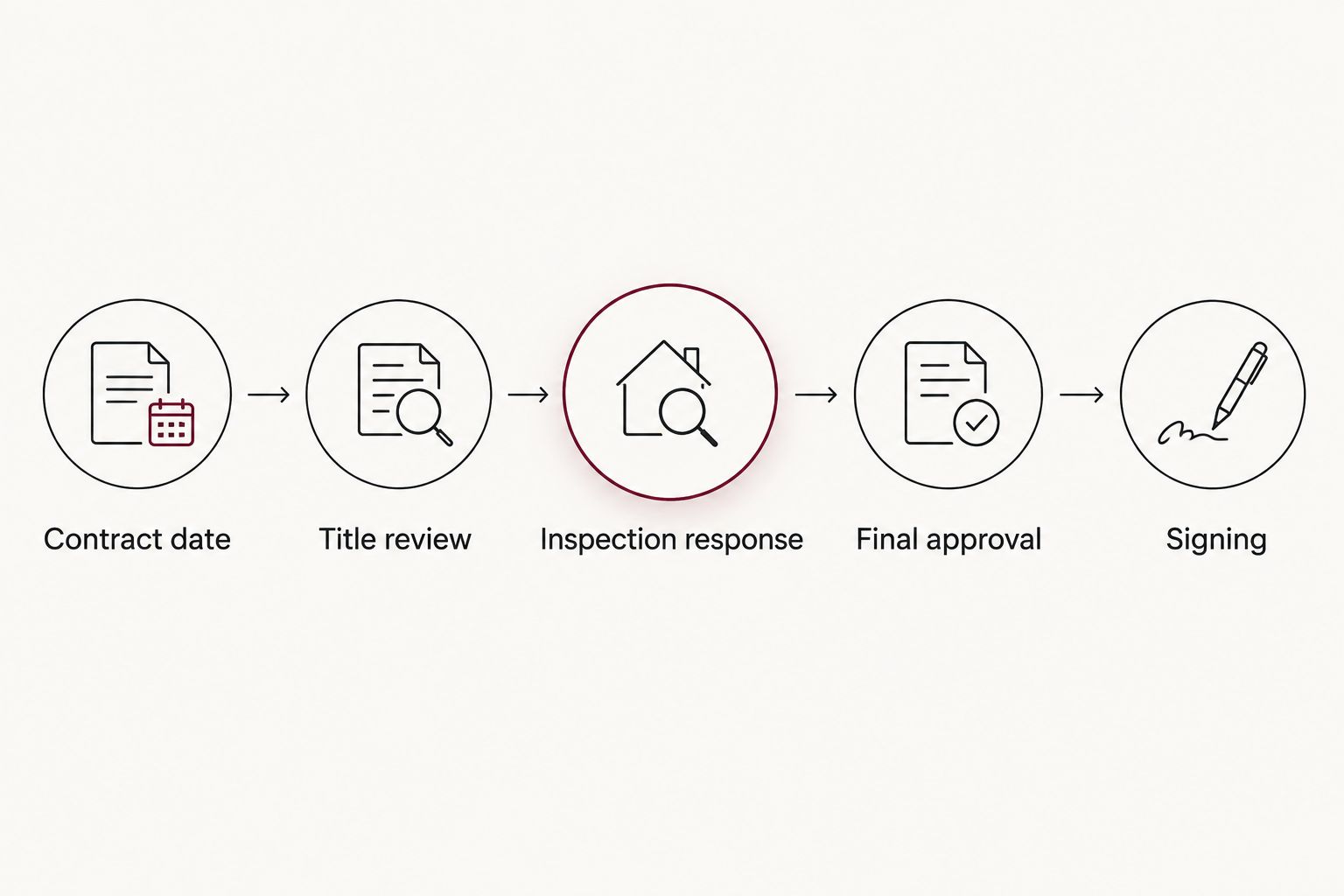
The steps between contract and closing
- Contract date: The accepted agreement establishes the target closing date and the deadlines for its contingencies.
- Title review: The title company or closing professional checks ownership and identifies matters that need resolution before transfer.
- Inspection response: If the contract includes an inspection contingency, the buyer completes the inspection and the parties address any requests under the contract.
- Final approval: For a financed purchase, the lender completes underwriting, considers the appraisal and clears outstanding loan conditions.
- Signing: The parties complete the required documents and the closing professional handles the transfer under the agreed terms.
These steps overlap. An inspection can proceed while the lender works, and title review need not wait for an appraisal. The sequence does not establish a universal number of days; it tells you which unfinished item is holding up a particular sale.
Financed purchase: plan around the lender’s remaining work
For a buyer using a mortgage, preapproval is not final loan approval. The lender still has to evaluate the property and the completed loan file. A missing document, an appraisal issue or a condition discovered during underwriting can keep the file open even when both parties are ready to sign.
The federal Closing Disclosure rule creates a specific timing check. For most covered home-purchase mortgages, the buyer must receive the Closing Disclosure at least 3 business days before closing. This is a disclosure waiting period, not an estimate of how long an Ohio closing takes. It also does not mean the lender can begin that period before the disclosure is ready.
When a financed buyer proposes a date, ask whether the appraisal has been scheduled, what lender conditions remain and who will confirm receipt of the Closing Disclosure. The buyer’s lender answers the loan questions; the closing professional confirms whether the transaction can proceed. Keep those responsibilities distinct so a reassuring update from one party does not get mistaken for final clearance from another.
Some changes to a loan after the Closing Disclosure is issued trigger a new waiting period under federal rules, including a change in loan product, the addition of a prepayment penalty or an annual percentage rate change beyond the permitted tolerance. Other corrections do not necessarily restart that period. The lender must determine which rule applies to the actual change.
Cash purchase: fewer lender steps, not fewer contract duties
A cash buyer does not need mortgage underwriting, a lender appraisal or the mortgage Closing Disclosure waiting period. That removes a major source of uncertainty. The buyer and seller still need a workable contract, clear title and completion of any conditions they accepted.
Check what the offer actually says. A cash buyer can still request an inspection contingency, and a property can still have a title problem that must be resolved before transfer. If you are the seller, ask for the documentation required by your contract and confirm which deadlines apply. Do not treat “cash” as a substitute for reviewing the terms.
Sandlin Realtors is best for Southern Ohio homeowners who want high-touch seller representation while comparing the certainty of different offers. That includes looking past the proposed date to the conditions that determine whether a buyer can meet it.
Why an Ohio closing date varies
The drivers are the obligations in the contract and the work required to complete them—not a statewide average. Review these items before accepting a date or making plans that depend on it:
- Financing: A financed buyer needs the lender’s final approval. A preapproval letter does not complete underwriting.
- Appraisal: If the loan requires one, the lender must receive and evaluate it before clearing the property for the loan.
- Inspection terms: An agreed inspection period and any resulting negotiations must be handled under the contract.
- Title review: Ownership and other recorded matters need to be addressed so the transfer can proceed.
- Disclosure timing: Most covered mortgages require the buyer to receive the Closing Disclosure at least 3 business days before closing.
- Contract changes: If the parties change terms or need more time, they must handle the change through the agreement rather than assume the original date has moved.
A seller can influence some of this work by responding promptly to document and access requests. A seller cannot complete a buyer’s underwriting or waive a lender’s disclosure obligation. Focus on the items each side can actually resolve.
For a closer look at a step that affects both cash and financed sales, read how to choose a title company in Portsmouth, Ohio. Title work deserves attention before the scheduled signing, not just when the parties arrive to close.
What sellers should check before accepting a closing date
Start with the buyer’s path to completion, then judge the date. In 2026, a seller in Portsmouth, Scioto County, Wheelersburg, Lucasville, Otway, Rarden or South Webster can use the same contract-focused questions, even though each property and offer is different.
Ask whether the offer depends on a mortgage, an appraisal, an inspection or another contingency. Read the deadlines attached to those terms. If the buyer proposes a date that leaves little room for work they have not started, discuss that mismatch before accepting the offer. A strong date on paper does not cure unfinished requirements.
Next, identify who will provide updates. The buyer’s lender can speak to loan progress; the title company or closing professional can speak to title and closing preparation. Your agent can keep the contract deadlines visible and coordinate responses when an issue needs a decision. Sandlin Realtors brings Joey Sandlin’s 20+ years of experience to that high-touch seller guidance across Southern Ohio.
If a problem arises, ask what the contract requires and what decision is needed now. An inspection request calls for a different response than an unfinished appraisal or a title issue. Treating every delay as the same problem wastes time and can put an otherwise workable sale at risk.
What buyers should finish before the scheduled date
For buyers, the practical move is to keep lender, inspection and title requests moving. Provide requested loan documents promptly, arrange any inspection allowed by the contract and read the paperwork your lender and closing professional send you. If a request or result changes your plans, raise it while the relevant contract deadline is still open.
A mortgage application and a preapproval serve different purposes. Under federal rules, a lender generally must provide a Loan Estimate within 3 business days after receiving the 6 pieces of information that constitute an application: your name, income, Social Security number for a credit report, property address, estimated property value and loan amount sought. That Loan Estimate is an early disclosure; it is not final approval and does not set your closing date.
Before signing, confirm directly with your lender that loan conditions are cleared and with your closing professional that the transaction is ready. If you are buying with a mortgage, also confirm when you received the Closing Disclosure. In 2026, those checks give you a better answer than relying on a date copied from the first version of the contract.
Can the closing date change?
Yes. A target date can change when the parties agree to address a delay under the purchase contract. Do not assume an extension is automatic. If a lender, inspection or title issue threatens the date, identify the issue, the deadline it affects and the decision the contract requires.
For sellers, the next move is to ask for a specific status update rather than accept a vague assurance that closing is still on track. For buyers, it is to tell the lender and your agent about a missing item as soon as you know about it. Neither side benefits from discovering at signing that a required step remains open.
Related questions
Does a cash offer always close sooner in Ohio?
No. A cash offer removes mortgage underwriting and lender disclosure timing, but agreed contingencies and title work still control whether the date holds. Compare the full contract, not the payment method alone.
Does preapproval mean the closing date is guaranteed?
No. Preapproval does not finish property review or final underwriting. A financed buyer must still satisfy the lender’s remaining requirements and applicable disclosure timing.
Does the buyer need the Closing Disclosure before closing?
Yes, for most covered home-purchase mortgages, at least 3 business days before closing. The lender handles the disclosure and determines whether a later change requires a new waiting period. A cash purchase does not have that mortgage disclosure requirement.
FAQ
How long does it take to close on a house in Ohio in 2026?
There is no fixed statewide number of days in 2026. The accepted contract sets a target date, and financing, title work and agreed contingencies determine whether the sale is ready by then.
Is a cash closing faster than a financed closing in Ohio?
A cash closing removes mortgage underwriting and lender disclosure steps, but it is not automatically faster. Title work and any agreed contract conditions still have to be completed.
Does Ohio require every home sale to close within a set time?
No. The parties establish a target date in their purchase contract and address changes under that agreement.
Can an Ohio seller move the closing date if the buyer’s loan is delayed?
The parties must handle a proposed change under their contract; a delay does not automatically change the date. Ask what lender condition remains and what the contract requires next.
What is the Closing Disclosure waiting period for a home purchase?
For most covered mortgages, the buyer must receive the Closing Disclosure at least 3 business days before closing. The buyer’s lender determines whether a later loan change restarts that period.
Does a home inspection delay closing in Ohio?
An inspection can affect the schedule when the contract includes an inspection contingency and the parties must address the results. Check the agreed deadline and resolve any request under the contract.
Who confirms that an Ohio home sale is ready to close?
The lender confirms loan readiness for a financed buyer, while the closing professional handles title and closing preparation. Your agent coordinates the contract steps and helps you address issues before the scheduled date.
One last thing
A proposed closing date tells you when the parties intend to finish, not which conditions have already been satisfied. If you are selling in Southern Ohio in 2026, ask for the status of financing, appraisal, inspection terms and title before treating that date as firm. Sandlin Realtors can help you evaluate those moving parts with the seller’s outcome first.