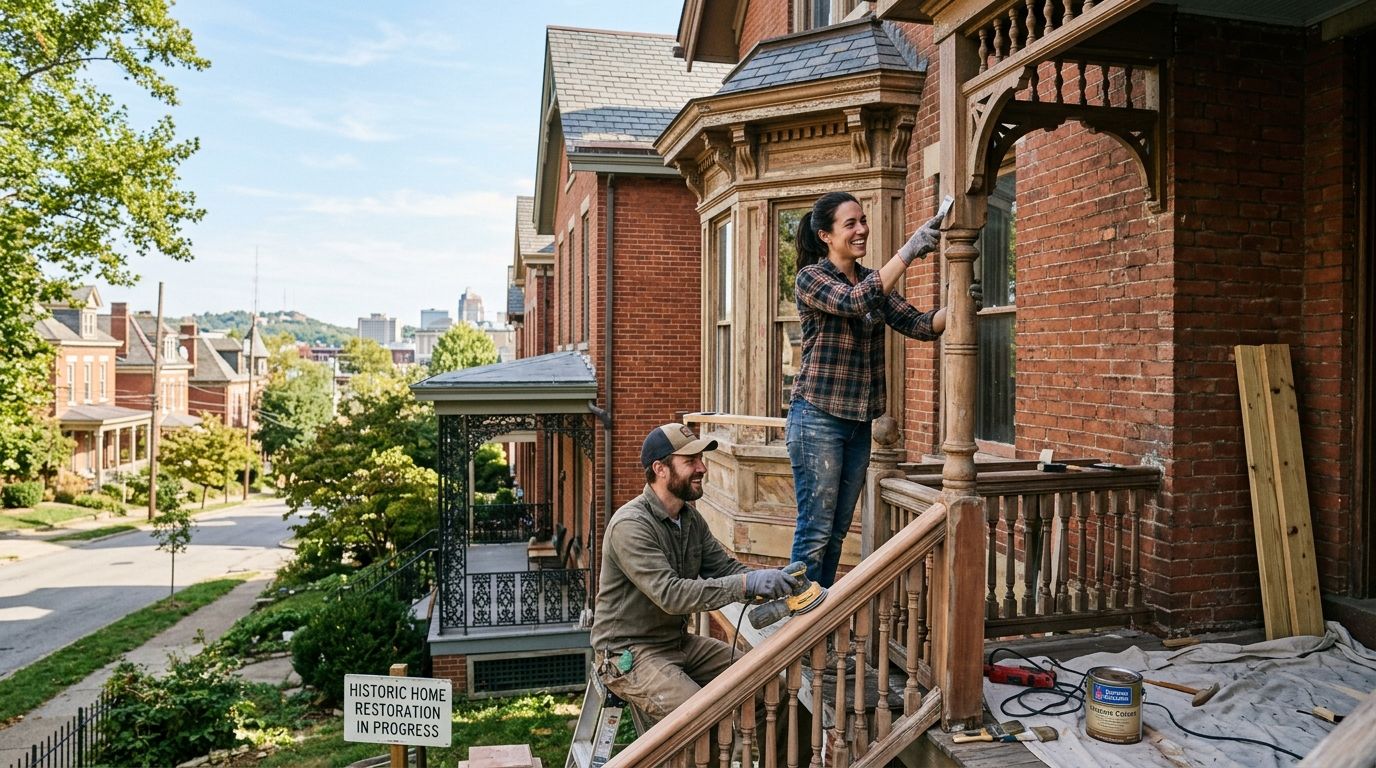
Buying and restoring a historic home in Cincinnati means running two processes at once: a standard real estate purchase, and a renovation plan that answers to a historic district board, a specialized loan program, or both. The fastest path is to confirm the property's designation status before you write an offer, then finance the purchase and rehab together through an FHA 203(k) or Fannie Mae HomeStyle loan. The hidden cost most buyers miss isn't the renovation itself — it's the permit and approval layer that comes with owning a home inside Over-the-Rhine, Mount Adams, or another locally designated district.
- Confirm historic designation status before offering — local district rules apply before permits, not after.
- FHA 203(k) and Fannie Mae HomeStyle loans fold purchase and renovation costs into one mortgage.
- The federal Historic Rehabilitation Tax Credit covers 20% of qualified rehab costs on income-producing properties.
- Ohio's Historic Preservation Tax Credit adds up to 25% for qualified projects, income-producing or not.
- Pull permit history and order a pre-1940s-specific inspection before closing, not after.
Why this matters
Cincinnati holds one of the largest surviving stocks of 19th-century architecture in the Midwest — Over-the-Rhine alone carries a National Register historic district designation covering thousands of buildings. Buy inside a locally designated district (as opposed to just National Register-listed) and exterior changes go through a conservation board review before you pull a permit, not after.
Skip that step and you risk a stop-work order mid-project or a forced reversal of work already completed. Joey Sandlin has spent 20+ years advising buyers across Southern Ohio and Cincinnati's surrounding markets on exactly this sequencing — designation check first, financing second, contractor third. Sandlin Realtors walks buyers through that order before an offer goes in, not after inspection surprises show up.
How to buy and restore a historic home in Cincinnati
The sequence below holds whether you're eyeing a Clifton Victorian or an Over-the-Rhine rowhouse:
- Confirm the designation status. Local historic district, National Register listing, or neither — each carries different rules for exterior work.
- Get pre-approved for a renovation loan so the rehab budget is part of the purchase financing, not a separate scramble after closing.
- Order a specialized inspection covering knob-and-tube wiring, lead paint, and masonry or foundation issues common in pre-1940s construction.
- Check the permit history before closing — undocumented past work often complicates future permit approvals.
- Contact Cincinnati's Historic Conservation Board if the home sits in a local historic district, before planning any exterior change.
- Apply for tax credits before starting work — retroactive approval on completed rehab isn't guaranteed.
- Hire a contractor with documented historic rehab experience. Lime mortar, plaster repair, and original wood window restoration aren't standard licensed-contractor skills.
Renovation loan options compared
| Loan | Best for | Key requirement | Verdict |
|---|---|---|---|
| FHA 203(k) | Buyers with lower down payments who need structural repair coverage | Owner-occupancy, FHA property standards | Buy for first-time historic buyers |
| Fannie Mae HomeStyle | Buyers wanting fewer property-type restrictions | Conventional credit and down payment standards | Buy for stronger-credit buyers |
Both loans wrap the purchase price and renovation scope into a single mortgage, so you're not financing the rehab separately after closing.
FHA 203(k): covers purchase and renovation in one mortgage
The FHA 203(k) program lets a buyer finance a historic home purchase and the cost of repairs together, with the loan amount based on the home's projected value after work is complete. Best for: buyers who need a lower down payment and structural repair coverage on an older property. The tradeoff is a slower closing timeline — the renovation scope has to be documented and approved before the loan funds.
Fannie Mae HomeStyle: renovation financing without FHA restrictions
HomeStyle Renovation loans work similarly but drop some of FHA's property-condition requirements, making them a fit for homes that wouldn't otherwise pass FHA standards. Best for: buyers with stronger credit who want more flexibility on what gets renovated and when. It typically requires a larger down payment than FHA 203(k).
Federal Historic Rehabilitation Tax Credit: 20% for income-producing properties
The federal program, administered through the National Park Service, returns 20% of qualified rehabilitation expenditures as a tax credit — but only for certified historic structures used for income-producing purposes, like a rental or commercial conversion. A personal residence generally doesn't qualify for the federal credit on its own.
Ohio Historic Preservation Tax Credit: up to 25% of rehab costs
Ohio's state program adds up to 25% of qualified rehabilitation costs as a tax credit, applied for through the Ohio History Connection's State Historic Preservation Office. Unlike the federal credit, Ohio's program has supported both income-producing and some owner-occupied historic rehab projects, subject to application review and available funding rounds.
Updating bathrooms and kitchens without losing character
The rooms that get gutted first in a historic rehab are almost always the bathroom and kitchen — original layouts in Cincinnati's 19th-century housing stock were built for smaller fixtures and narrower footprints. That's where fixture selection matters most: when the original bathroom footprint stays tight, matching the fixtures to the space rather than fighting it keeps the room functional without an addition, and reviewing shower door options for small bathrooms is part of the same footprint-first approach that governs cabinet and vanity choices in a historic layout.
Keep original trim, door hardware, and window casings where the budget allows — a conservation board reviewing exterior changes will often care less about interior fixture choices, but preserving interior character keeps resale value intact in districts where buyers specifically seek original detail.
Buying a historic home in Cincinnati?
Get local guidance on designation status, financing order, and contractor referrals.
Why restoration costs vary
No two historic rehab budgets look alike, even on similar-sized homes in the same district. The main drivers:
- Construction era — pre-1900 homes often carry balloon framing and masonry issues that later builds don't.
- Wiring and plumbing systems — knob-and-tube wiring and galvanized pipe typically need full replacement, not patching.
- Plaster versus drywall — plaster repair by a skilled tradesperson takes longer and requires different materials than drywall.
- Exterior masonry condition — tuckpointing and stone repair on brick or stone facades adds scope that vinyl-sided homes never face.
- Approval layers — a local historic district review adds time and sometimes materials requirements a non-designated home never triggers.
- Structural engineering needs — foundation or load-bearing wall issues surface more often in homes built before modern code.
“Budget for surprises before you budget for finishes — historic homes hide their real costs behind original plaster.”
Do I need city approval to renovate a historic home in Cincinnati?
Yes, if the property sits inside a locally designated historic district — the Historic Conservation Board reviews exterior changes before permits are issued. Interior work generally doesn't require the same review unless it affects a protected exterior feature like a front porch or facade.
What's the difference between local landmark status and National Register listing?
Local landmark or district designation carries legal review requirements for exterior changes, while National Register listing is mostly honorary and required for tax credit eligibility but doesn't itself restrict renovation choices. A property can carry both, one, or neither designation — check both before assuming either applies.
Can I get a tax credit for restoring a historic home in Ohio in 2026?
Yes, through two separate programs: the federal 20% credit for income-producing certified historic structures, and Ohio's state credit of up to 25% of qualified rehabilitation costs. Both require applying to the State Historic Preservation Office before or during the project, not after completion.
FAQ
What historic districts in Cincinnati require restoration approval?
Locally designated districts like Over-the-Rhine and parts of Mount Adams require Historic Conservation Board approval for exterior changes. National Register listing alone doesn't carry the same review requirement.
Is it worth buying a historic home in Cincinnati in 2026?
It's worth it for buyers who want original architectural detail and are prepared for the added approval and rehab process. Buyers who want a fast, low-friction renovation timeline are usually better served by a non-designated property.
Does an FHA 203(k) loan cost more than a standard mortgage?
An FHA 203(k) loan follows standard FHA mortgage insurance and rate structures, but the process takes longer because the renovation scope has to be approved before funding. Compare current rates and terms directly with a lender before assuming one option is cheaper.
Do I need city permission to change windows on a historic home?
Yes, if the home is in a locally designated historic district, window replacement on street-facing elevations typically needs Conservation Board approval. Interior-facing or non-original windows usually face fewer restrictions.
How long does historic home restoration take in Cincinnati?
Timelines vary by scope and approval requirements, and homes needing Conservation Board review add time before permits are even issued. Structural or masonry-heavy projects run longer than cosmetic interior updates.
Should I hire a contractor who specializes in historic homes?
Yes — plaster repair, lime mortar, and original window restoration require different skills than standard modern-home contracting. A contractor without historic rehab experience often recommends replacement over repair, which can conflict with district preservation rules.
Can I renovate a historic home without losing its resale value?
Preserving original trim, hardware, and window casings while updating systems like wiring and plumbing typically protects resale value better than a full modern gut renovation. Buyers in historic districts often specifically seek original character.
One last thing
The permit history check gets skipped more than any other step on this list, and it's the one most likely to stall a closing. A previous owner's undocumented electrical or structural work can force a buyer to pull retroactive permits before a lender will fund a 203(k) or HomeStyle loan — pull that history before you're under contract, not during the loan process.