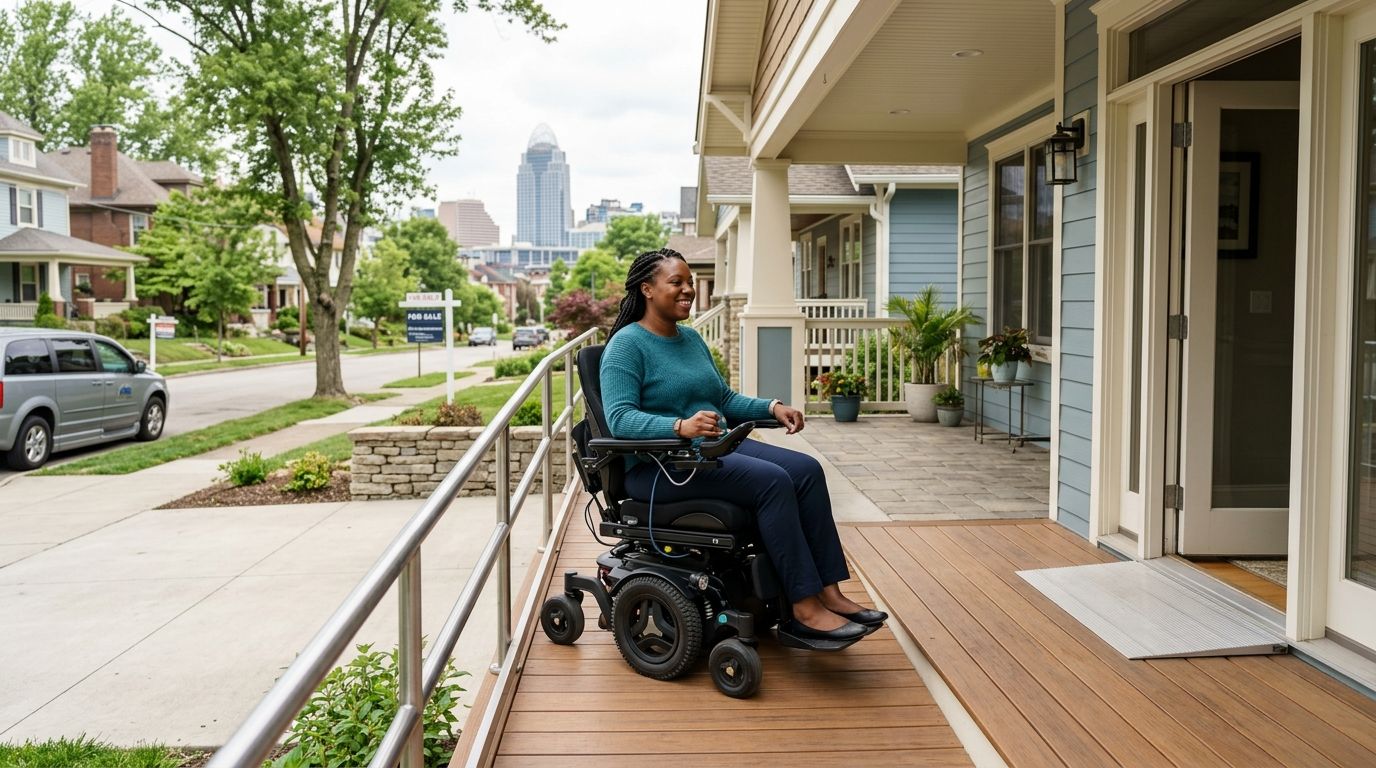
Buying an accessible home for a wheelchair user in Cincinnati means targeting single-story or zero-step floor plans first, then locking in financing that covers retrofit work before you write an offer. In 2026, that combination — an agent who filters for step-free listings, a mortgage pre-approval that includes a renovation-loan option, and an inspection checklist built around doorway width and ramp slope — determines whether a home that looks accessible in photos actually works day to day. The hidden cost most buyers miss isn't the sale price, it's the retrofit gap between a listing's photos and real clearances for turning radius, counter height, and threshold rise.
- Single-story, zero-step-entry homes fit wheelchair users best in Cincinnati — verify entry grade in person, not from photos.
- FHA 203(k) renovation loans and VA Specially Adapted Housing grants can fund accessibility retrofits if you ask your lender before house-hunting.
- An agent who understands how to buy an accessible home for a wheelchair user in Cincinnati filters for 36-inch hallways and zero-step entries.
- Inspection day should test doorway clearance, ramp slope, and bathroom turning radius, not just roof and furnace.
- Joey Sandlin's 20+ years serving Southern Ohio buyers covers locating and vetting accessible listings across Cincinnati and beyond.
Why this matters
Most of Cincinnati's housing stock predates modern accessibility norms. Ranch-style single-story homes exist, but they compete hard with buyers who want them for entirely different reasons — no stairs, easy resale, low-maintenance living. That competition pushes wheelchair-accessible searches into a narrower slice of inventory than a standard home search.
Sandlin Realtors built its approach around this exact gap. Joey Sandlin brings 20+ years of experience representing buyers and sellers across Southern Ohio — Portsmouth, Scioto County, Wheelersburg, Lucasville, Otway, Rarden, and South Webster — and that same hands-on, high-touch process applies when a Cincinnati-area buyer needs a home that actually works for daily mobility, not just a home with a ramp bolted onto the porch. Picking the wrong real estate agent in Cincinnati for this kind of search costs weeks of touring homes that were never viable in the first place.
How to buy an accessible home for a wheelchair user in Cincinnati: the process
- Define your must-haves before you tour anything. Zero-step entry, a main-floor bedroom and full bathroom, hallways at least 36 inches wide, and doorway clear openings of 32 inches or more — these are the baseline residential accessibility clearances, and a listing missing any one of them means retrofit work.
- Get pre-approved with a renovation-loan option included. Standard pre-approvals don't account for the cost of widening a doorway or adding a roll-in shower. Ask your lender to run numbers that include a rehab loan from the start, not after you're under contract.
- Work with an agent who searches accessibility features directly, not just bedroom count and square footage. Most MLS systems don't have a clean "accessible" filter, so this step is manual — a search built around single-story listings, then a phone call to confirm entry grade before you drive out.
- Tour with a tape measure. Check ramp slope (no steeper than a 1:12 rise-to-run ratio), threshold height (under half an inch ideally), and bathroom turning radius (60 inches is the standard clearance for a full wheelchair turn).
- Order an inspection that flags structural changes, not just mechanical systems — a home inspection in Cincinnati should note load-bearing walls near doorways you'd need to widen and whether bathroom plumbing can support a roll-in shower conversion.
- Close with a retrofit budget already built into your financing, so the work starts the week you get keys instead of stalling for lack of funds.
Financing that actually covers accessibility retrofits
FHA 203(k): the renovation loan buyers use most
An FHA 203(k) loan rolls purchase price and renovation costs into a single mortgage, which matters when the home you want needs a widened doorway, a roll-in shower, or a ramp before it's livable. It's the most common route for buyers who find a home with the right layout but the wrong bathroom.
VA Specially Adapted Housing grants: built for veteran buyers
Veterans with qualifying service-connected disabilities have access to VA Specially Adapted Housing benefits specifically for accessibility modifications. If that applies to you, start there before shopping — it changes which homes are worth touring. Sandlin Realtors' veteran home buying guide for Southern Ohio walks through how VA benefits interact with a standard home purchase.
Standard renovation loans and local contractors
Outside FHA and VA programs, conventional renovation loans exist for buyers who don't qualify for either but still need retrofit financing folded into the mortgage. In either case, get a contractor's estimate before you finalize your offer price — a rough number in hand beats guessing after closing.
Find an accessible home in Cincinnati
Work with an agent who searches for step-free, single-story listings from day one.
Why accessible home searches in Cincinnati take longer
- Older housing stock dominates the market — most homes built before 1990 weren't designed with wide hallways or zero-step entries in mind.
- Single-story new construction is limited in the walkable, close-in suburbs many buyers prefer.
- HOA rules sometimes restrict exterior ramps or lift installations, which narrows your options in certain subdivisions.
- MLS systems rarely have a clean accessibility filter, so agents have to search manually and confirm details by phone.
- Permit timelines for structural retrofits — widening a doorway or adding a ramp — can add weeks between closing and move-in if you don't plan for them.
- Competition for single-story homes comes from downsizing retirees and no-stairs buyers too, not just wheelchair users, which tightens supply further.
Do sellers have to disclose accessibility issues in Ohio?
Ohio's residential property disclosure form covers structural and mechanical defects, not accessibility features — a seller isn't required to flag that a bathroom doorway is 28 inches wide. That's why the tape-measure walkthrough in step four matters more than the disclosure form itself.
What's the best home layout for a wheelchair user?
A single-story home with a zero-step entry, an open floor plan between kitchen and living space, and a main-floor bathroom with a roll-in shower covers the core needs for most wheelchair users. Homes with an in-law suite in Cincinnati often already have a main-floor bedroom and bath built in, which shortens the retrofit list considerably.
Can you modify a rental instead of buying?
Federal fair housing law lets a tenant request reasonable accessibility modifications at their own expense, but landlords can require the unit be restored to its original condition when the lease ends. For most wheelchair users planning to stay put, buying a home you can permanently modify is the more stable long-term move.
Due diligence on an accessible home doesn't stop at the tape measure. Southern Ohio buyers who treat radon testing before closing as part of the same inspection pass catch two separate risk categories in one visit instead of scheduling a second contractor trip after the accessibility retrofit is already underway.
FAQ
What's the best way to find wheelchair-accessible homes for sale in Cincinnati?
Work with an agent who manually searches for single-story, zero-step-entry listings, since most MLS systems don't have a reliable accessibility filter. Confirm entry grade and doorway width by phone before touring in person.
Is an FHA 203(k) loan better than a VA grant for accessibility retrofits?
An FHA 203(k) loan works for any qualifying buyer and covers both purchase and renovation costs in one mortgage. A VA Specially Adapted Housing grant only applies to veterans with qualifying service-connected disabilities but can reduce out-of-pocket retrofit costs further.
How wide does a doorway need to be for a wheelchair?
A doorway needs a clear opening of at least 32 inches for most wheelchairs to pass through comfortably. Hallways should measure at least 36 inches wide to allow turns.
What ramp slope is safe for a wheelchair user?
A ramp slope should not exceed a 1:12 ratio, meaning one inch of rise for every 12 inches of ramp length. Steeper ramps become difficult or unsafe for manual wheelchair use.
Do I need a special home inspector for an accessible home purchase?
You don't need a specialized inspector, but you should ask your standard inspector to flag load-bearing walls near doorways and plumbing capacity for a roll-in shower. A regular inspection alone won't catch these accessibility-specific details.
Are single-story homes always more accessible than two-story homes?
Single-story homes remove the stairs problem entirely, which makes them the easiest starting point for a wheelchair user. A two-story home can still work if it has a main-floor bedroom and full bathroom, but that layout is less common.
Can I get help finding accessible homes in Southern Ohio outside Cincinnati?
Yes — Sandlin Realtors covers Portsmouth, Scioto County, Wheelersburg, Lucasville, Otway, Rarden, and South Webster in addition to the Cincinnati market. The same accessibility-focused search process applies across all of these areas.
How long does it take to retrofit a home for wheelchair accessibility after closing?
Retrofit timelines depend on permit approval and contractor scheduling, with structural changes like doorway widening typically taking longer than surface-level changes like grab bars. Planning the retrofit budget into your financing before closing avoids a gap between move-in and livability.
One last thing
A listing photo showing a curbless shower doesn't guarantee an accessible bathroom — the doorway leading into that bathroom is just as often 26 or 28 inches wide, which stops a standard wheelchair cold. Measure the door before you fall for the shower.