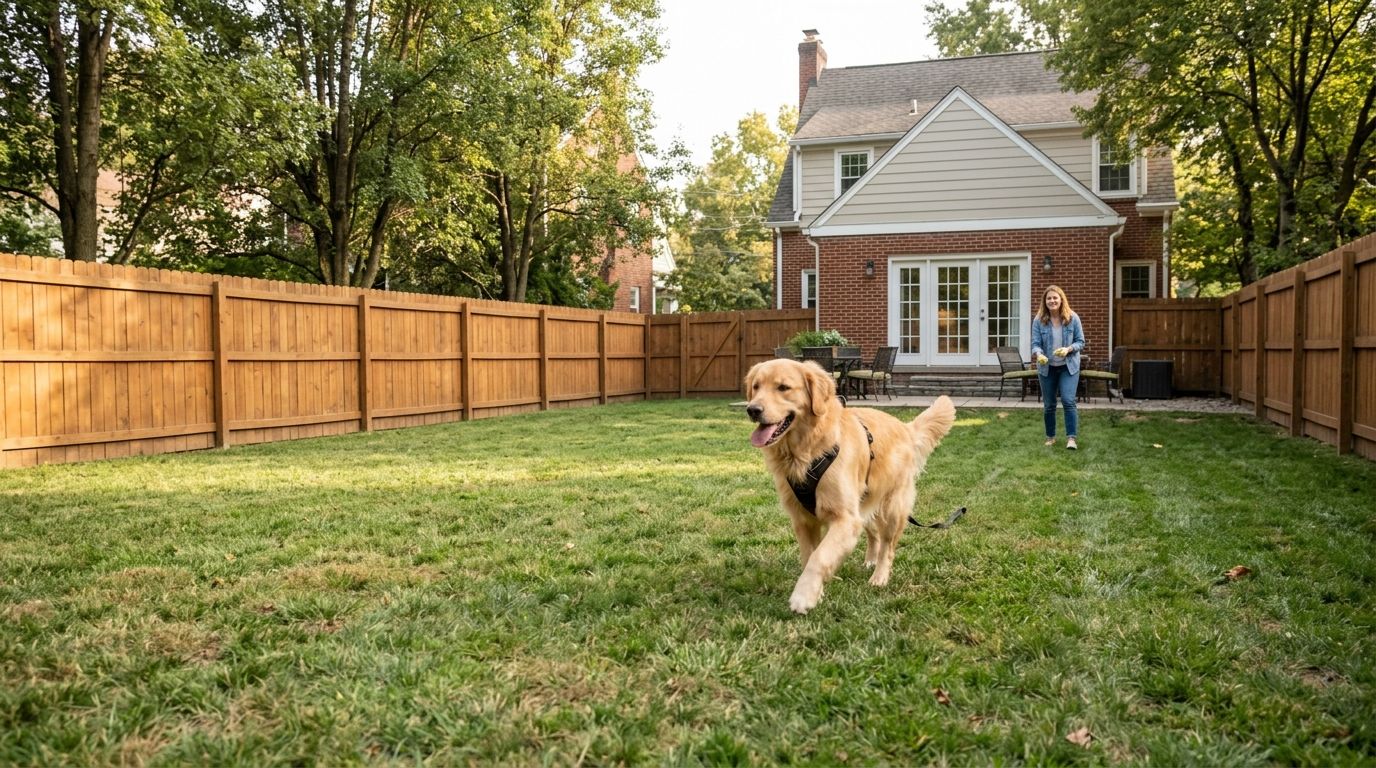
Homes for sale in Cincinnati with fenced yards for large dogs are properties where the yard already does the job before you move a single box in: fencing tall enough to hold a 70-pound-plus dog, no gaps at the gate, and enough square footage for the dog to run rather than pace. A large-dog household needs different filters than a typical buyer search — fence height and material matter as much as bedroom count, and a "fenced yard" listed in an MLS photo can mean anything from four-foot picket to six-foot privacy panel.
- Cincinnati homes with fenced yards for large dogs need 5-6 foot fencing minimum, not the 3-4 foot yards common in older city neighborhoods.
- Verify fence type and condition in person in 2026 — listing photos regularly hide gaps, rot, or invisible-fence-only setups.
- HOA covenants in newer Cincinnati-area communities frequently cap fence height or ban privacy fencing outright.
- Sandlin Realtors tracks fenced-yard inventory across Southern Ohio and greater Cincinnati suburbs and moves fast once a matching lot lists.
Why fenced-yard search matters for large-dog owners
A large dog changes what "good yard" means. A 4-foot fence that contains a beagle does nothing for a 90-pound Lab or Shepherd mix that can clear it standing still. Cincinnati's older neighborhoods — Hyde Park, Northside, parts of Oakley — were built before large-dog ownership was the norm, so a lot of existing fencing there is decorative, not containment-grade.
Newer suburban builds solve the height problem but introduce a different one: HOA covenants that restrict fence material, height, or ban fencing entirely in favor of shared sightlines. A buyer searching generically for "Cincinnati homes with a yard" will miss both of these traps until they're already under contract. That's the gap a segment-specific search closes.
Set your fence-height and lot-size filters before you tour
Do this before you schedule a single showing. Most buyer's agents default to generic "fenced yard" checkboxes in MLS search, which pulls in three-foot decorative fencing alongside real containment fencing.
- Set a minimum lot size (0.2 acre is a reasonable floor for a dog over 60 pounds)
- Ask your agent to filter for fence height in listing remarks, not just the fenced-yard checkbox
- Flag any listing that says "partial fence" or "invisible fence" for a phone call before you tour
- Note whether the yard is fully enclosed or backs onto an easement, creek, or unfenced common area
- Cross-check the address against flood zone maps if the yard backs onto a creek or the Ohio River corridor
Verify the fence type and condition on every listing you tour
Do this in person, every time, in 2026 — listing photos are shot at angles that hide rot, gaps, and low spots. A privacy fence photographed from the deck can look solid while the gate side has an 8-inch gap a determined dog will find in a week.
- Walk the entire perimeter, not just the section visible from the patio
- Check gate hardware for rust, warping, or a latch a paw can lift
- Look for gaps under the fence line where dirt has eroded
- Ask the listing agent directly whether the fence is chain-link, wood privacy, vinyl, or invisible/electronic only
- Note any exposed nails, splintered boards, or leaning posts that need immediate repair after closing
Check municipal and HOA rules on fencing and breed restrictions
This is where a local agent earns their keep. Some Cincinnati-area municipalities cap residential fence height at four feet in front yards and six feet in back; some HOAs go further and restrict fence material to a single approved style, or ban fencing above the property's natural grade.
Sandlin Realtors checks municipal code and HOA covenants against a buyer's fence requirements before a showing gets scheduled, not after an offer is written. That single step has saved buyers from falling for a home whose yard legally can't be fenced the way a large dog needs.
- Pull the HOA covenant and search for the word "fence" before writing an offer
- Call the local zoning office if the property sits outside an HOA but inside city limits
- Ask specifically about breed or weight restrictions tied to homeowners insurance, not just HOA rules
- Confirm whether existing fencing was permitted or added without approval — unpermitted fencing can complicate resale
Walk the yard for large-dog-specific hazards
A fenced yard that looks fine on paper can still be a bad fit. Walk it the way your dog will use it, not the way a showing script suggests.
- Check for toxic landscaping (mulch type, ornamental plants) near the fence line
- Look for standing water or drainage issues that turn a yard to mud after Ohio's spring rains
- Note shade coverage for summer — Cincinnati regularly hits mid-90s in July and August
- Check for gaps under decks or sheds a dog could squeeze through or get stuck in
- Confirm the yard doesn't back directly onto a busy road with only a single fence line as buffer
Move fast with an agent tracking fenced-yard inventory across Cincinnati
Homes for sale in Cincinnati with fenced yards for large dogs don't sit long once they hit the market with the right combination of lot size and fence quality — they get multiple showings in the first weekend. Joey Sandlin has spent over 20 years working Southern Ohio and greater Cincinnati inventory and knows which suburbs consistently deliver larger, containment-grade fenced lots versus which ones will require a fence build-out after closing.
- Set up an alert for new listings that match fence height and lot-size criteria, not generic "pet friendly" tags
- Ask your agent to call listing agents directly about fence condition before you drive out
- Have financing pre-approved so you can move within days, not weeks, on a strong match
- Keep a short list of acceptable suburbs so you're not deciding location and fence quality at the same time
Write a competitive offer once the yard checks out
Once a property clears the fence, lot, and HOA checks, don't lose it to a slower offer. Cincinnati's competitive pockets move fast, and buyers who wait a week to confirm financing lose good matches to buyers who don't.
- Get pre-approval in hand before you tour, not after you fall for a yard
- Ask your agent to structure a competitive offer that accounts for likely multiple-offer conditions
- Keep inspection contingencies focused on structural issues, not cosmetic fence repairs you'll handle yourself
- Confirm the seller will leave existing fencing and gate hardware in the sale, in writing
Confirm the gate latch and escape risk before closing
This is the last check, and it's the one buyers skip because it feels minor. It isn't — a bad gate latch is the single most common way a contained yard fails on day one.
- Test every gate latch yourself; don't take the listing agent's word for it
- Confirm gate height matches fence height (a common mismatch on older properties)
- Check whether the gate swings inward or outward and whether that clears with a dog nearby
- Budget for a latch upgrade immediately after closing if the existing hardware feels loose
Comparing property types for large-dog owners
| Property type | Best for | Key limitation |
|---|---|---|
| Established Cincinnati suburb lots | Buyers wanting predictable, already-fenced yards | Lot sizes often under 0.25 acre inside city limits |
| New-construction communities | Move-in-ready fencing on a clean lot | HOA rules frequently restrict fence height or material |
| Rural acreage outside Hamilton County | Dogs needing serious run room | Longer commute into downtown Cincinnati |
| Older in-city neighborhoods | Walkability and short commute | Existing fencing often needs full replacement |
Find your fenced-yard match faster
Talk with Sandlin Realtors about current fenced-yard listings across Cincinnati and Southern Ohio.
Common mistakes large-dog buyers make
- Trusting the MLS "fenced yard" checkbox — it doesn't distinguish a 3-foot picket fence from a 6-foot privacy fence.
- Assuming invisible/electronic fencing counts as containment — it fails during power outages and doesn't stop other dogs or wildlife from entering.
- Skipping the HOA covenant search — some Cincinnati-area HOAs ban privacy fencing outright, which surfaces only after an accepted offer.
- Falling for a yard before checking drainage — a muddy yard after every rain is a daily maintenance problem, not a one-time fix.
- Underestimating older-neighborhood fencing — much of it predates large-dog ownership norms and needs full replacement, not repair.
FAQ
What's the best fence height for large dogs in Cincinnati?
Six feet is the standard minimum for dogs over 60 pounds in 2026, since many breeds can clear a four-foot fence without effort. Confirm the height against local municipal code before assuming a taller fence is allowed.
Are invisible fences good enough for homes for sale in Cincinnati with fenced yards for large dogs?
Invisible fencing is not a reliable substitute for physical fencing for large dogs — it fails during power outages and doesn't block other animals from entering the yard. Treat any listing advertising only invisible fencing as needing a physical fence built after closing.
Do Cincinnati HOAs restrict fencing for dog owners?
Many newer Cincinnati-area HOA communities cap fence height or limit approved materials, and some prohibit privacy fencing entirely. Pull the covenant and confirm fencing rules before writing an offer on any HOA property.
Which Cincinnati suburbs have the largest fenced lots for dogs?
Lot size varies block by block more than suburb by suburb in greater Cincinnati, but established suburban neighborhoods generally offer larger fenced lots than dense in-city neighborhoods. A local agent tracking current inventory can flag which listings actually meet a large-dog lot-size threshold.
How much yard space does a large dog actually need?
A lot of at least 0.2 to 0.25 acre gives most large dogs room to run rather than just turn around, though breed energy level matters as much as raw square footage. Fence quality and gate security matter more than total acreage for daily safety.
Should I buy a home with an unfenced yard and add fencing later?
It's possible but adds cost, permitting time, and HOA approval steps before you can use the yard safely. Buying a home with existing containment-grade fencing in 2026 avoids that delay entirely.
How fast do fenced-yard homes sell in Cincinnati?
Listings that combine a large lot with quality existing fencing tend to draw showings within the first weekend on market. Pre-approval and a fast-moving agent matter more for this segment than for a generic home search.
One last thing
The gate is where most large-dog yards actually fail — not the fence line. A six-foot privacy fence with a loose or mismatched-height gate latch gives a determined dog an exit in under a week, so test every gate yourself before you write an offer, not after you move in.