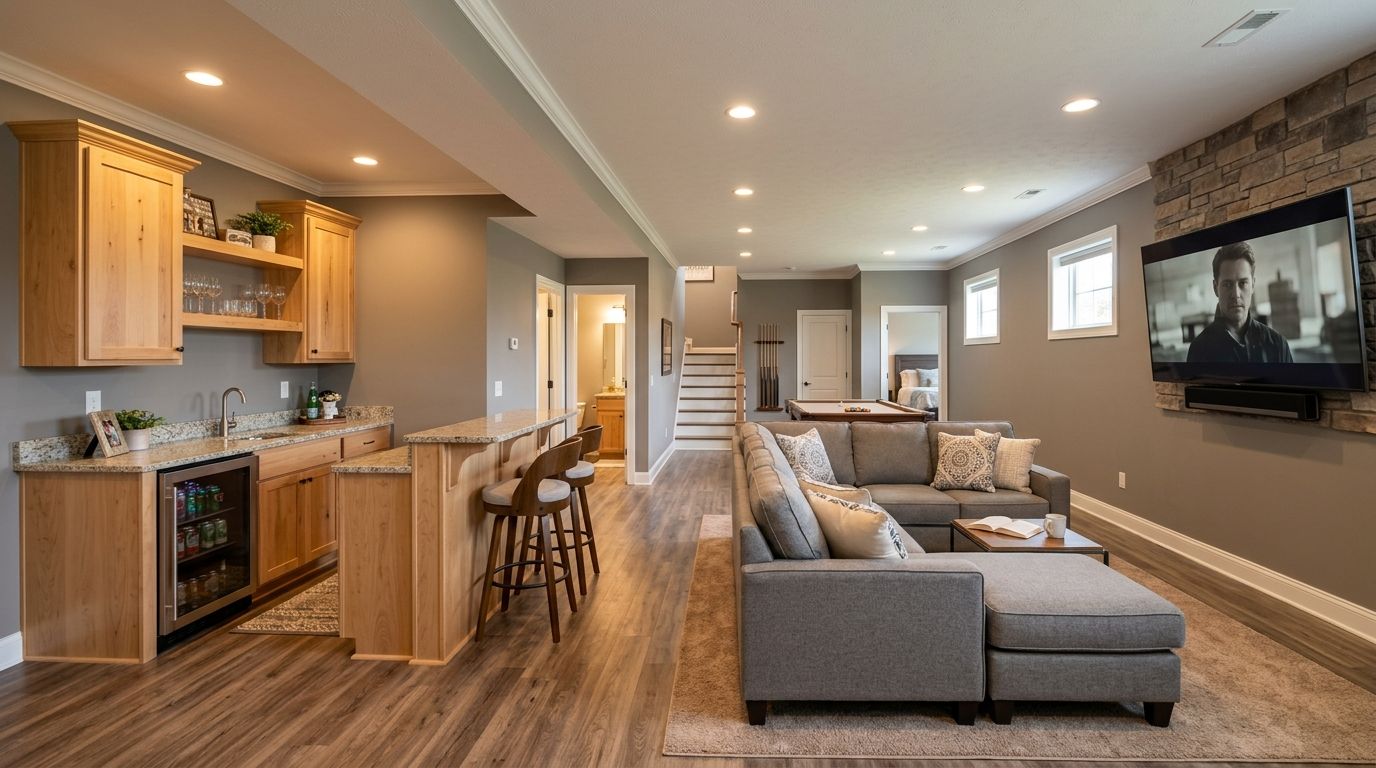
Homes for sale in Cincinnati with a finished basement are listings where the lower level already functions as usable living space, not just storage, and in 2026 that distinction matters more than the finish quality itself. Buyers chasing this feature are usually solving a specific problem — more bedrooms, a home office, room for aging parents — without moving into a bigger, pricier house. What separates a good basement buy from a bad one isn't the flooring or the paint; it's whether the finish was permitted, whether the space stays dry, and whether the square footage actually counts on paper.
- Homes for sale in Cincinnati with a finished basement often list the basement as bonus space, not counted square footage.
- Unpermitted basement conversions can stall a 2026 closing — confirm permit history before you write an offer.
- Walkout basements cluster in hillier Cincinnati suburbs more than flat neighborhoods, so search terms matter.
- Sandlin Realtors checks moisture, sump-pump condition, and egress windows on every basement showing, not just the finish work.
Why finished basements matter for Cincinnati buyers
Cincinnati's older housing stock sits mostly on full basements because Ohio's frost line runs deep enough that foundations need to be poured below it — builders finished the structural work by pouring a full basement instead of a shallow crawlspace. In 2026, that means most homes for sale in Cincinnati with a finished basement already have the structural bones in place; what varies is whether anyone permitted and inspected the finish work on top of them.
For buyers, a finished basement can add a rec room, guest suite, or home office for less than the cost of a home addition — but only if the work was done to code. Skip that check and you inherit someone else's unpermitted project.
Sandlin Realtors works with Southern Ohio and Cincinnati-corridor buyers who want that extra square footage without the appraisal or permit surprises that come with a poorly finished lower level.
How to search for homes for sale in Cincinnati with a finished basement
Define what "finished" needs to mean for your household
Write down your non-negotiables before you start touring, not after you've fallen for a listing photo.
- Decide if you need a legal bedroom (egress window, closet, smoke detector) or just a rec room
- Rule out ceilings under 7 feet — they limit resale appeal later
- Note whether you need a bathroom rough-in already run to the basement
- Decide if a walkout matters or a standard basement works fine
- Rank moisture control above cosmetic finish quality
Search Cincinnati listings with the right terms
MLS agents describe the same feature differently, so one search term misses half the inventory.
- Search "finished basement," "lower level living space," and "walkout basement" separately
- Compare listed total square footage against above-grade footage to spot basement-heavy totals
- Check listing photos for ceiling height and window size, not just staged furniture
- Cross-reference the county auditor's site for the home's recorded finished area
- Save searches across Hamilton, Butler, and Warren counties if you're flexible on suburb
Verify the basement finish is permitted
An unpermitted basement bedroom can't legally be counted as one, and it can hold up your 2026 closing timeline if the lender's appraiser flags it.
- Pull the home's permit history before you tour, not after you're under contract
- Ask the listing agent directly whether the basement finish was permitted and inspected
- Compare the permit date against any renovation the seller mentions
- Flag any basement bedroom without a permit before you count it toward bedroom total
Check for water and moisture problems
A finish can hide water damage for years — the paint dries long before the smell or the stain does.
- Look for water stains, efflorescence (white mineral deposits), or suspiciously fresh paint
- Ask when the sump pump was last serviced and whether it has a battery backup
- Check the grading around the foundation — soil sloping toward the house sends water in
- Confirm the home's flood zone status before writing an offer, especially near Ohio River tributaries
Get the basement counted correctly at appraisal
Don't assume a basement remodel adds dollar-for-dollar value — appraisal standards treat below-grade space differently than above-grade space.
- Ask your appraiser how they separate above-grade and below-grade square footage
- Request comps that specifically include finished basements, not just similar total footage
- Confirm your lender's 2026 underwriting guidelines on basement square footage before you're deep into underwriting
- Budget for the possibility the appraisal comes in under the asking price if the basement carries too much of the total footage
Compare walkout, egress, and standard basement layouts
Layout drives both livability and how many listings match your search — see the comparison below before you narrow your filters too tightly.
Bring in a Cincinnati-focused agent before you tour
- Have permit and flood data pulled before your first showing, not during it
- Ask an agent who has toured multiple basement conversions in the same suburb what red flags repeat
- Use an agent to negotiate repairs on any moisture issue found at inspection, not just a closing credit
- Joey Sandlin's team has spent 20+ years working Southern Ohio real estate and the wider Cincinnati corridor, and treats a basement walkthrough as seriously as the main floor.
Compare your finished-basement options
| Basement Type | Best For | Key Limitation |
|---|---|---|
| Move-in-ready finished basement | Buyers who want usable space on day one | Often priced into total square footage, little room to customize |
| Partially finished basement | Buyers who want a project and negotiating room | May need permitting work before it counts as legal living space |
| Walkout basement | Buyers who want natural light or in-law suite potential | Only exists on sloped lots — fewer listings in flat suburbs |
| Unfinished basement with rough-in | Budget-focused buyers planning to finish later | Adds cost and time before the space is usable |
Verdict: a permitted, move-in-ready finished basement is the safest buy for most Cincinnati households in 2026; a walkout with no permit history is the one to walk away from unless you're ready to fix the paperwork yourself.
Common mistakes Cincinnati buyers make with finished-basement listings
- Assuming basement square footage counts the same as above-grade space — many Cincinnati MLS entries note it separately
- Skipping permit verification and finding out at closing that the basement "bedroom" isn't legally one
- Ignoring the sump pump and grading, then discovering water intrusion after the first heavy Ohio Valley rain
- Confusing "finished basement" with "walkout basement" while filtering search results and missing listings that fit
- Overpaying based on finish quality alone without checking whether the appraisal will support that price
“If the basement isn't on the permit record, it isn't officially finished square footage.”
Tour Cincinnati basement listings with a local expert
Joey Sandlin's team checks permits, moisture, and appraisal fit before you make an offer.
FAQ
What counts as a finished basement in a Cincinnati listing?
A finished basement has drywall, flooring, and heating or cooling extended to the space so it functions as usable living area, not storage. Listings vary in how they describe it, so check photos and the county auditor's recorded finished area to confirm.
Does a finished basement add to a home's total square footage?
Not always. Many Cincinnati listings and most appraisal standards count basement square footage separately from above-grade space, so a large basement doesn't automatically boost the listed total.
Is an unpermitted finished basement a problem when buying in Cincinnati?
Yes. An unpermitted basement conversion can complicate your 2026 closing if the lender's appraiser flags it, and any bedroom without a code-compliant egress window can't legally be counted as a bedroom in Ohio.
How do I find homes for sale in Cincinnati with a finished basement?
Search multiple terms — "finished basement," "lower level living space," and "walkout basement" — since MLS agents describe the same feature differently across listings.
Are walkout basements more common in certain Cincinnati suburbs?
Yes. Walkout basements need a sloped lot, so they show up more often in hillier suburbs than in flat neighborhoods where a standard basement is the norm.
What should I check before buying a home with a finished basement?
Verify the permit history, check for moisture stains or a recently serviced sump pump, and confirm the flood zone status before you write an offer.
Do finished basements affect home appraisals in Cincinnati?
Yes. Appraisers typically value below-grade square footage lower than above-grade space, so a basement remodel rarely adds dollar-for-dollar value at appraisal.
How much does it cost to finish a basement in Cincinnati?
Cost varies widely by size, permit requirements, and finish level. Get quotes from local contractors rather than relying on a national average, since Cincinnati permit and labor costs differ by suburb.
One last thing
A basement room without a code-compliant egress window cannot legally be counted as a bedroom in Ohio as of 2026, no matter how finished it looks in the listing photos. If a Cincinnati listing counts a basement room toward its bedroom total, verify the window before you count on it in your own space planning — and before your lender's appraiser does the same check for you.