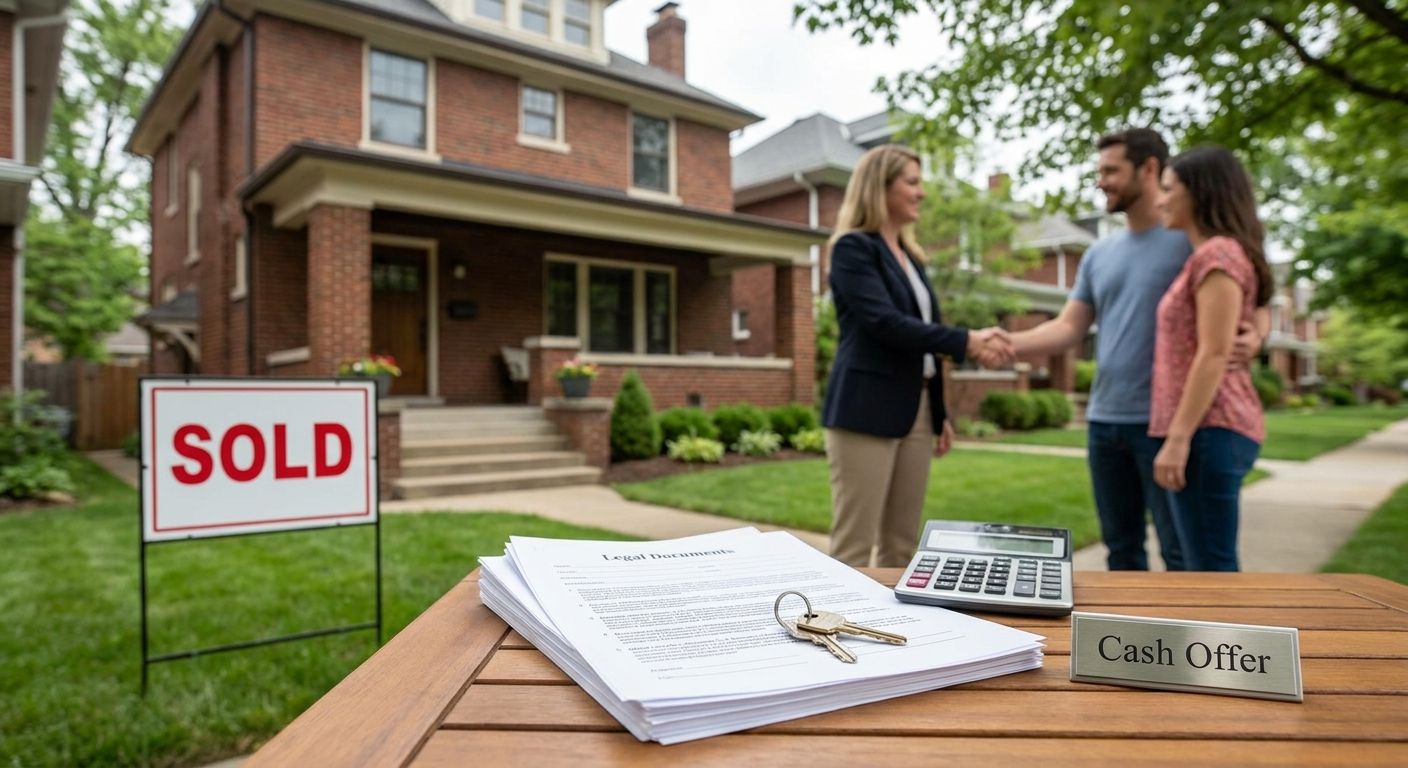
A fair cash offer on a Cincinnati home typically lands between 85% and 95% of market value in 2026, trading a lower price for speed and certainty: no financing contingency, no appraisal gap, and a close in 7 to 14 days instead of the 30 to 45 days a financed buyer needs. The number that actually matters isn't the headline offer — it's your net proceeds after any repair credits, service fees, or title costs the buyer subtracts before closing.
- A cash offer on a house in Cincinnati usually runs 5% to 15% below market value in exchange for a 7-14 day close.
- Net proceeds, not the sticker price, decide whether a cash offer beats a financed one.
- iBuyers typically charge a service fee near 5% on top of the below-market price.
- Investor cash offers skip repairs and inspections but often price 10-15% under comps.
- Sandlin Realtors compares cash offers against the open market before you sign anything.
Why this matters
Cincinnati sellers get solicited constantly — yard sign postcards, texts, "we buy houses" mailers. Some of those offers are legitimate and genuinely useful if you need to move fast. Others are lowball bets that only work if you don't know what your house is worth on the open market.
Sandlin Realtors has spent 20+ years under Joey Sandlin representing Southern Ohio sellers, and the same math that applies in Portsmouth or Wheelersburg applies in Cincinnati: a cash offer is only a good deal when you've priced it against what a financed buyer would actually pay after your home sits on the open market. Comparing blind isn't a decision — it's a guess.
How to evaluate a cash offer on your Cincinnati home
Run every cash offer through the same four checks before you respond:
- Get a real market value estimate first. Pull recent comps or order a comparative market analysis before you look at the offer number — otherwise you have nothing to measure it against.
- Read every deduction in the contract. Service fees, "repair credits," and closing cost concessions get subtracted from the headline price. The number on page one is rarely the number you net.
- Confirm proof of funds. A legitimate cash buyer sends a bank statement or verification letter, not a promise. No proof, no serious offer.
- Check the closing date and contingencies. A true cash offer waives financing and appraisal contingencies. If it still has an inspection contingency with broad repair-request language, you've lost most of the speed advantage anyway.
Cash offer vs. traditional financed offer
| Factor | Cash offer | Financed offer |
|---|---|---|
| Typical closing time | 7-14 days | 30-45 days |
| Price vs. market value | Often 5-15% below | At or near market with strong comps |
| Financing contingency | None | Standard, can fall through |
| Appraisal required | Rarely | Almost always |
| Inspection negotiation | Limited or waived | Common, can reopen price |
| Best for | Sellers who need certainty and speed | Sellers who can wait for top dollar |
iBuyer cash offers: often 5% below market plus a service fee
Institutional cash buyers (iBuyers) price close to market value and then apply a service fee, commonly landing near 5% of the sale price. Best for: sellers who want a fast, hands-off close and can absorb a smaller net. Verdict: Consider if speed outweighs maximizing price.
Investor cash offers: often 10-15% below market value
Local and out-of-state investors buy as-is, skip repairs, and skip inspections — which is exactly why they typically bid 10% to 15% under comparable sales. Best for: distressed properties, inherited homes, or sellers who cannot make repairs before listing. Verdict: Consider only after confirming what a repaired, listed home would actually sell for.
Retail buyer cash offers: closest to market value
An individual buyer paying cash (no lender, no service fee) usually offers closest to what a financed buyer would pay, because there's no institutional margin built in. Best for: sellers who want speed without giving up much on price. Verdict: Buy — this is the strongest cash offer type when it appears.
Why cash offer amounts vary
- Property condition — as-is buyers price in repair risk before they ever see a contractor bid.
- How fast you need to close — a 7-day close costs you more in discount than a 21-day close.
- Local comps in your Cincinnati neighborhood — thin comp data gives buyers more room to lowball.
- Buyer type — iBuyer, investor, and retail cash buyers all price differently, as shown above.
- Title or lien complications — anything that slows closing gets priced into the offer.
- Market conditions — in a slower stretch, cash buyers have more leverage to discount.
Get a second opinion on your offer
Compare your cash offer against current Cincinnati market value before you sign.
Is a cash offer better than a financed offer in Cincinnati?
A cash offer is better than a financed offer in Cincinnati when speed and certainty matter more than the last few percent of price — inherited homes, job relocations, and properties that need work all fit that case. If your home shows well and comps support a strong price, a financed offer through the open market often nets more even after accounting for a 30-45 day close.
How much lower is a cash offer than market value?
Cash offers run 5% to 15% below market value in most cases, with iBuyers near the low end plus a roughly 5% service fee, and investors closer to the 15% end on properties needing repairs. Retail cash buyers without an institutional markup tend to land closest to what a financed buyer would pay.
Do I still need an appraisal with a cash offer?
No — most cash offers skip the appraisal entirely, since there's no lender requiring one. That removes one of the most common ways financed deals fall apart, but it also means you should get an independent home appraisal in Cincinnati yourself if you want a neutral number to compare the cash offer against.
When a cash offer arrives, treat the first number as a starting position, not a verdict — negotiating a home offer in Cincinnati applies just as much to a cash buyer as it does to a financed one. If you're weighing whether to sell without representation at all, review how selling a house by owner in Cincinnati actually plays out before you decide.
FAQ
What's the best way to evaluate a cash offer on my Cincinnati home?
Compare the net proceeds after fees and credits against a current market value estimate, not the headline offer number. A cash offer that nets 10% less than a financed sale only makes sense if the speed is worth that gap to you.
Is a cash offer better than a financed offer in Cincinnati?
A cash offer is better when you need to close in 7 to 14 days or your property needs repairs you can't make before listing. Otherwise a financed offer through the open market often nets more, even with a 30-45 day timeline.
How much lower is a cash offer than market value?
Cash offers typically run 5% to 15% below market value in 2026, with iBuyers charging an added service fee near 5% and investors pricing closer to the 15% end on as-is properties.
Do I still need an appraisal or inspection with a cash offer?
No lender means no required appraisal, and many cash buyers waive or limit inspections. That speeds the close but removes a neutral price check, so get your own comps or appraisal first.
How fast can a cash sale close in Cincinnati?
Most cash sales close in 7 to 14 days once the contract is signed, compared to 30 to 45 days for a financed purchase awaiting loan underwriting.
Can I negotiate a cash offer?
Yes, cash offers are starting positions, not fixed prices. Counter with your own comps and ask the buyer to justify any deductions in writing.
Should I get multiple cash offers before deciding?
Yes, getting two or three cash offers plus a market value estimate is the only way to know if a given offer is competitive or a lowball.
Are cash home buyers in Cincinnati legitimate?
Many are, but legitimacy shows up in proof of funds and a clean, contingency-light contract. Skip any buyer who won't provide bank verification before you sign.
One last thing
The biggest mistake Cincinnati sellers make with cash offers isn't accepting a bad one — it's never checking what a financed buyer would have paid. A 10-minute comparison against recent comps is the difference between a cash sale that made sense and one you'll wonder about for years. If your property needs real work before it could compete on the open market, an as-is investor sale might genuinely be your best net outcome — but that's a conclusion to reach after comparing, not before.