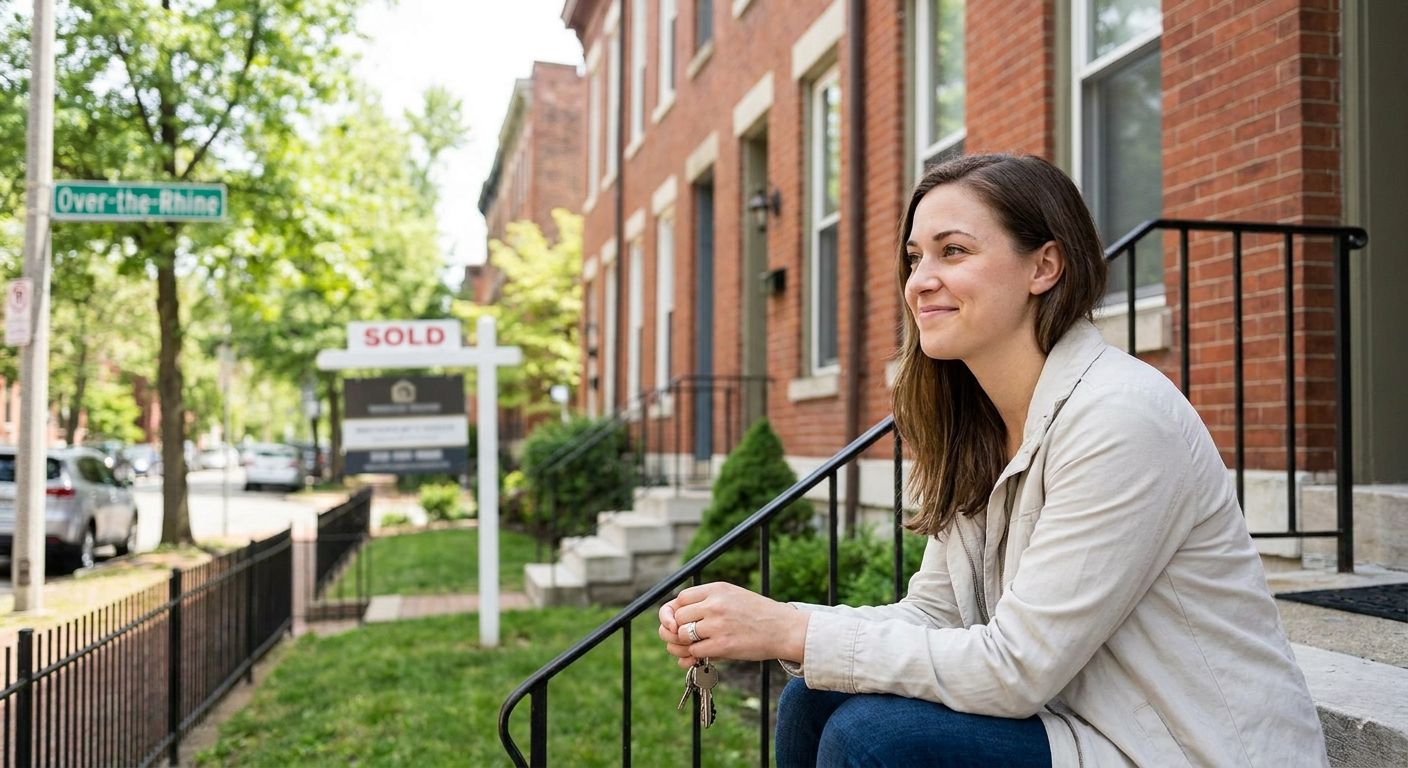
Buying your first home alone in Cincinnati comes down to one number: what a single income can qualify for under current lending rules. This guide breaks down the loan options, the down payment math, and the steps that matter most when there's no second income backing up the application.
- FHA loans require 3.5% down with a 580+ credit score; conventional loans start at 3% down for first-time buyers.
- Single-income buyers should keep total housing debt near 36% of gross monthly income for approval room.
- Ohio Housing Finance Agency down payment assistance can offset 2.5%-5% of the loan amount for qualifying first-time buyers.
- Closing costs run 2%-5% of the purchase price on top of the down payment in 2026.
- A pre-approval letter before house-hunting is the biggest edge a single buyer has in a competitive Cincinnati market.
Why this matters
A single buyer's mortgage application runs on one income statement, not two. Lenders calculate debt-to-income against that single figure, which means every car payment, student loan, and credit card balance carries more weight than it would for a dual-income household.
There's no co-signer safety net if the numbers come up short. That's exactly why single buyers benefit from nailing down the budget and the loan type before they start touring homes in Cincinnati's 2026 market, rather than after.
How to buy your first home in Cincinnati as a single buyer
- Pull your credit reports and fix errors before a lender does. Your score determines which loan programs are even on the table.
- Calculate a single-income budget using a 36% housing debt-to-income target as a starting guideline, not a ceiling to max out.
- Get pre-approved for a mortgage in Cincinnati so you know your real price range, not an estimate.
- Check down payment assistance eligibility through Ohio Housing Finance Agency programs built for first-time buyers.
- Work with a local agent who understands single-income budgets and won't push you toward homes that stretch the math. Joey Sandlin has spent 20+ years guiding Southern Ohio and Cincinnati-area buyers through exactly this kind of decision.
- Tour homes within your pre-approved range, focusing on Cincinnati homes for first-time buyers rather than aspirational listings.
- Make an offer with contingencies that protect a single buyer, including inspection and financing clauses.
- Close once financing, inspection, and title work clear.
| Loan Type | Minimum Down | Credit Score Min | Mortgage Insurance | Best For |
|---|---|---|---|---|
| FHA | 3.5% | 580 | Yes, life of loan (usually) | Lower credit scores, limited savings |
| Conventional | 3% | 620+ | Yes, until 78% LTV | Stronger credit, wants MI to drop off |
Verdict: a single buyer with a 620+ credit score and steady income generally comes out ahead on a conventional loan because the mortgage insurance cancels once equity hits 78% loan-to-value; FHA is the better call when credit sits closer to 580.
FHA loans: 3.5% down payment
FHA loans accept credit scores as low as 580 with a 3.5% down payment, which is why they're common among first-time single buyers with thinner credit files. The mortgage insurance premium typically stays for the life of the loan unless you refinance later. Best for: buyers with limited savings or a credit score under 620.
Conventional loans: 3% down payment
Conventional loans through Fannie Mae and Freddie Mac first-time buyer programs allow as little as 3% down, but lenders usually want a 620+ credit score to approve it at a competitive rate. Private mortgage insurance applies below 20% down and drops off automatically at 78% loan-to-value. Best for: buyers with solid credit who want mortgage insurance to eventually disappear.
Why costs vary for single buyers
- Credit score — the gap between a 580 and a 720 score changes both the rate and which loan programs are available.
- Income stability — self-employed or commission-based income requires more documentation and can affect qualifying amounts.
- Existing debt load — car payments and student loans eat into the 36% housing DTI target faster on a single income.
- Down payment assistance eligibility — qualifying for OHFA assistance can shrink the cash needed at closing significantly.
- Neighborhood and price point — a home in a higher-demand Cincinnati suburb pushes the required income higher than a comparable home further out.
- Closing cost negotiation — asking the seller to cover part of closing costs directly reduces the cash a single buyer needs on hand.
Ready to buy your first home in Cincinnati?
Get straight answers on financing, neighborhoods, and timing before you tour homes.
Is it harder to buy a home alone in Cincinnati?
No loan program penalizes single buyers directly, but the debt-to-income math is calculated against one income instead of two, which limits the price range you'll qualify for. The fix is knowing that ceiling before you start looking, not discovering it mid-offer.
How much income do you need to buy a house alone in Cincinnati?
The honest answer depends on the home price you're targeting, since lenders work backward from a roughly 36% housing debt-to-income guideline. A single buyer with low other debt can push closer to that ceiling than one carrying student loans or a car payment, so the required income shifts case by case rather than landing on one fixed number.
Should a single buyer get a real estate agent in Cincinnati?
Yes — a buyer's agent negotiates price and terms on your behalf and manages the paperwork that trips up first-time buyers. With no second person double-checking contract details, having someone who does this daily matters more, not less, and Sandlin Realtors brings that experience to buyers across Cincinnati and Southern Ohio.
FAQ
What's the best loan for a single first-time buyer in Cincinnati?
FHA loans at 3.5% down work best for credit scores under 620, while conventional loans at 3% down suit buyers with 620+ credit who want mortgage insurance to eventually cancel. The right pick depends on your credit score and how much cash you have for closing.
How much does it cost to buy a first home in Cincinnati in 2026?
Beyond the down payment, closing costs typically run 2%-5% of the purchase price in 2026. Budgeting for both the down payment and closing costs together avoids a last-minute cash shortfall.
Is down payment assistance available for single buyers in Ohio?
Yes, the Ohio Housing Finance Agency offers first-time buyer programs that can cover 2.5%-5% of the loan amount toward down payment or closing costs. Eligibility depends on income limits and loan type.
What credit score do I need to buy a house alone in Cincinnati?
A 580 credit score qualifies for FHA financing, while conventional loans generally require 620 or higher for competitive rates. Higher scores unlock lower rates and lower long-term mortgage insurance costs.
How much debt can I have and still qualify for a mortgage alone?
Most lenders want total housing debt near 36% of gross monthly income and total debt obligations under roughly 43-45%. A single income means every existing payment counts more heavily against that ceiling.
Do single buyers pay higher mortgage rates than couples?
No, mortgage rates are priced on credit score and loan type, not household or marital status. A single buyer with strong credit gets the same rate as a couple with the same credit profile.
Should I use a real estate agent as a single first-time buyer?
Yes, a buyer's agent negotiates on your behalf and catches contract details that are easy to miss without a second set of eyes. That representation matters more when there's no co-buyer reviewing the paperwork alongside you.
One last thing
Get pre-approved before you fall in love with a listing, not after. Single buyers who walk into a showing with a clean pre-approval letter in hand move faster in a multiple-offer situation, and in Cincinnati's 2026 market, speed often beats price when a seller is comparing offers.