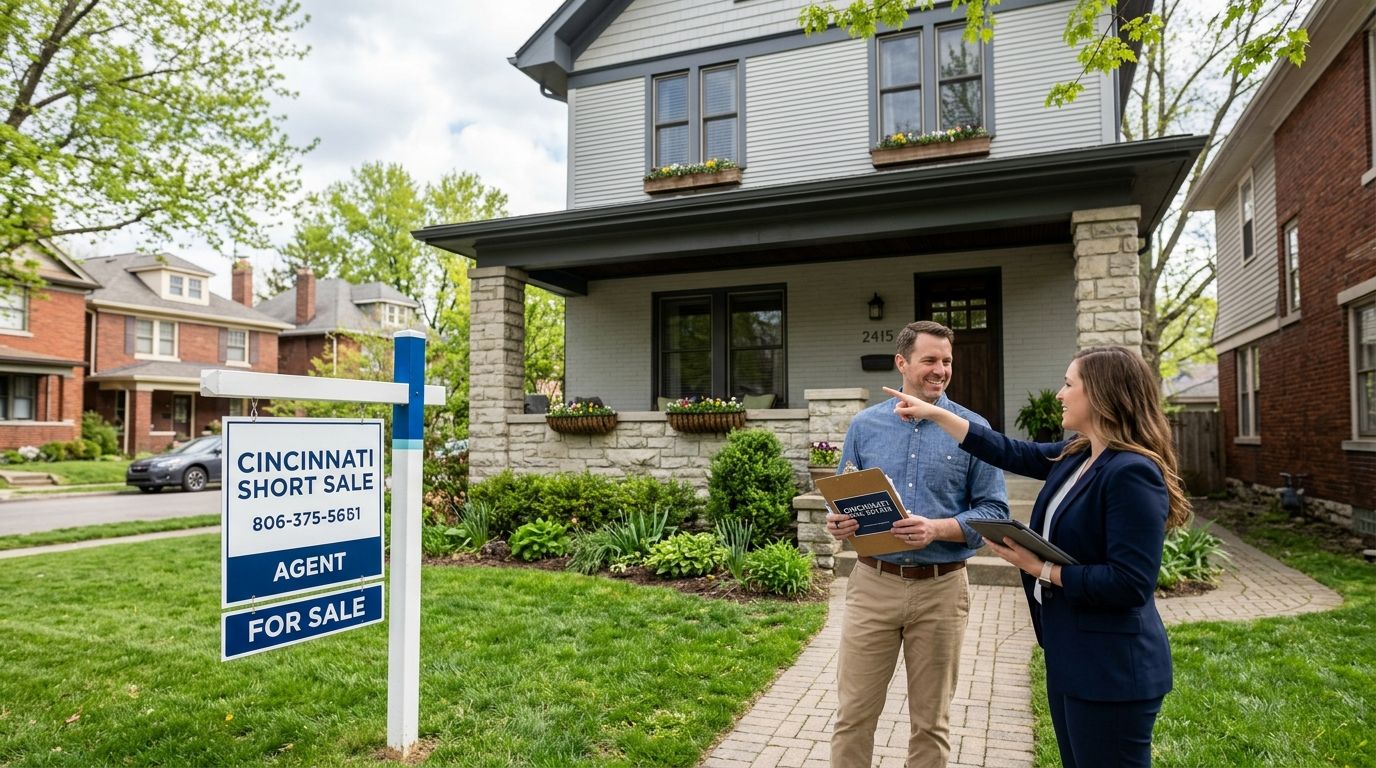
Buying a short sale home in Cincinnati means negotiating with the seller's lender, not just the seller, and that single fact changes almost every step of the purchase — from the offer you write to the closing date you can actually count on.
- Short sale homes cincinnati listings require lender sign-off before closing, often adding 60-120 days versus a standard sale.
- Sandlin Realtors negotiates with lienholders and loss-mitigation departments, not just the seller, on behalf of Cincinnati buyers.
- Most short sales close as-is, with no seller-paid repairs or concessions.
- A strong pre-approval letter matters more than a low opening bid on a Cincinnati short sale in 2026.
Why this matters
A short sale happens when a Cincinnati homeowner owes more on the mortgage than the home is worth and the lender agrees to accept a payoff short of the full balance instead of pushing the loan into foreclosure. That approval process is the whole ballgame — the seller can accept your offer on day one and you can still be waiting weeks for the bank to say yes.
Buyers who confuse a short sale with a foreclosure home in Cincinnati tend to get burned on timeline expectations. A foreclosure is bank-owned already; a short sale still has an owner in the house and a lender that hasn't finished deciding. In 2026, that distinction still trips up first-time distressed-property buyers more than any other detail in the transaction.
How to buy a short sale home in Cincinnati
Here's the sequence that actually gets a Cincinnati short sale to the closing table:
- Get fully underwritten pre-approval before you write an offer. Sellers' agents and lenders won't push a file through review for a buyer whose financing is uncertain.
- Confirm the listing agent has an active short sale file with the lender. Some "short sale" listings haven't even submitted a hardship package yet — ask directly.
- Price the offer near the lender's likely valuation, not the listing price. Lenders order their own broker price opinion (BPO) and reject offers that undercut it by too much.
- Submit with minimal contingencies where you can afford to. Lenders reviewing a short sale file favor clean offers over ones loaded with buyer-favorable outs.
- Plan on 60 to 120 days for lender approval, sometimes longer if a second lienholder or mortgage insurer is also in the file.
- Order your inspection once the lender approves the price, not before — inspection contingencies rarely change the as-is terms, but you still want to know what you're buying.
- Lock your rate carefully. A 60-120 day approval window can outlast a standard rate lock, so talk to your lender about extension options before you're deep into the wait.
Short sale vs. foreclosure vs. traditional sale in Cincinnati
| Short sale | Foreclosure (bank-owned) | Traditional sale | |
|---|---|---|---|
| Who approves the price | Seller's lender | Bank asset manager | Seller directly |
| Typical timeline to close | 60-120+ days | 30-45 days | 30-45 days |
| Repairs or concessions | Rare — as-is | None — as-is | Negotiable |
| Occupancy at listing | Usually occupied | Usually vacant | Occupied |
| Best for | Patient buyers chasing equity | Fast closers comfortable with condition risk | Buyers needing certainty on timing |
Verdict: short sale homes in Cincinnati suit buyers with flexible move-in timelines who want below-comparable pricing and can tolerate an uncertain approval window — they're a poor fit if you need to close by a hard date.
Why short sale timelines vary in Cincinnati
- Number of lienholders. A single first mortgage clears faster than a file with a second mortgage or HELOC that also has to sign off.
- Whether mortgage insurance is involved. PMI-backed loans add another party to the approval chain.
- The listing agent's short sale experience. Agents who've run these files before submit cleaner hardship packages that move faster.
- How close your offer lands to the lender's BPO. Offers far under valuation get bounced back or countered, adding weeks.
- Investor guidelines on the loan. Fannie Mae, Freddie Mac, and private investors each set their own review timelines.
- Whether the seller has already started the hardship package. Some sellers list the home before paperwork is even filed with the lender.
Related questions about short sale homes in Cincinnati
Is a short sale cheaper than a traditional home in Cincinnati?
Short sales in Cincinnati often list below comparable traditional sales, but the lender's BPO — not the listing price — sets the real ceiling on what gets approved. Buyers who assume a deep discount and offer accordingly usually get countered or ignored.
Can you get a mortgage on a short sale home?
Yes, conventional, FHA, and VA financing all work on Cincinnati short sales, but you need a fully underwritten pre-approval before the offer goes in. If you're financing with less money down, review how to get pre-approved for a mortgage in Cincinnati before you start touring short sale listings.
Do short sales require a home inspection?
Inspections are optional but recommended even though short sales close as-is with no repair credits. Order the inspection after lender price approval so you're not paying for one on a deal that never clears.
Joey Sandlin has represented Cincinnati-area buyers and sellers through 20+ years of local market shifts, including the short sale wave that followed the 2008 downturn, and knows how to keep a lender-side negotiation moving instead of stalling in review. Buyers working a short sale benefit from that experience the same way sellers across Portsmouth, Scioto County, Wheelersburg, Lucasville, Otway, Rarden, and South Webster do when a deal gets complicated.
Writing the offer is only half the job — the negotiate a home offer approach for a short sale differs from a standard purchase because you're negotiating against a bank's internal valuation, not a seller's asking-price ego. That's also why choosing a real estate agent in Cincinnati with short sale experience matters more here than on a conventional listing.
Talk through a Cincinnati short sale offer
Get a clear read on timeline and price before you write the offer.
FAQ
How long does a short sale take to close in Cincinnati?
A Cincinnati short sale typically takes 60 to 120 days from accepted offer to closing, driven by how long the seller's lender takes to approve the payoff. Traditional sales close in 30-45 days by comparison.
What's the best way to find short sale homes cincinnati buyers can actually close on?
Confirm with the listing agent that the seller's hardship package is already filed with the lender before you write an offer. Short sale homes cincinnati listings without an active lender file stall indefinitely.
Is a short sale better than a foreclosure for a Cincinnati buyer?
A short sale is usually the better choice if you value property condition and a seller still living in the home; a foreclosure closes faster but comes with more unknowns on condition. Neither guarantees a lower final price once the lender sets its valuation.
Can a short sale fall through after the lender approves it?
Yes, a short sale can still fall through after lender approval if financing, inspection issues, or a second lienholder objection surface late. Approval reduces risk but doesn't eliminate it.
Do short sale sellers pay closing costs in Cincinnati?
Short sale sellers rarely cover buyer closing costs because the lender is already accepting less than the full loan payoff. Budget for your own closing costs the same way you would on a traditional purchase.
Does a short sale hurt the buyer's credit?
No, a short sale purchase has no credit impact on the buyer — the credit consequence applies only to the seller, whose lender accepted less than owed. Buyers should still keep financing tight during the long approval wait.
Can you negotiate the price on a lender-approved short sale?
Once a lender approves a price, there's very little room to negotiate further, since that number came from the bank's own valuation, not the seller's preference. Renegotiation usually restarts the lender review clock.
One last thing
The detail most Cincinnati buyers miss on a short sale isn't the price — it's the rate lock. A 60-120 day lender approval window regularly outlasts a standard 45-day lock, and buyers who don't ask their lender about extension terms upfront end up scrambling to relock at a different rate right when the deal finally clears in 2026.