
Using a HELOC to buy a home in Cincinnati means borrowing against the equity in your current house, then using that cash as the down payment on the new one before your existing home sells. Most lenders cap a HELOC at 80-85% combined loan-to-value, so what you can pull out depends entirely on what you still owe. The catch that trips up most buyers: the new mortgage lender counts your HELOC payment as debt, which can shrink your buying power right when you need it most.
- Buying a home using a HELOC for the down payment in Cincinnati means tapping equity up to roughly 80-85% combined loan-to-value on your current house.
- The new mortgage lender adds the HELOC payment to your debt-to-income ratio, which can lower how much house you qualify for.
- This strategy works best when your current home will sell within the HELOC draw period, typically 10 years.
- Joey Sandlin has guided Southern Ohio and Cincinnati-area buyers through HELOC-funded purchases for over 20 years.
Why this matters
A HELOC turns illiquid equity into cash without forcing a sale first. That flexibility matters in Cincinnati's 2026 market, where a strong offer often needs to move before your current listing has an accepted contract.
The tradeoff is real: you're carrying two housing payments and a new debt obligation simultaneously. Get the sequencing wrong and you either miss the mortgage qualification window or carry more risk than you meant to.
Joey Sandlin has spent over 20 years guiding buyers and sellers across Portsmouth, Scioto County, Wheelersburg, Lucasville, Otway, Rarden, South Webster, and the greater Cincinnati market through exactly this kind of financing sequencing. High-touch representation on the buy side means someone is checking your timeline against the lender's rules before you're locked into a purchase agreement.
How to buy a home using a HELOC for the down payment
- Get your current home appraised or pulled up in a market analysis to confirm actual equity, not a guess based on Zillow.
- Apply for the HELOC before you make an offer. Underwriting takes time, and you don't want financing contingencies stacking up mid-negotiation.
- Draw the funds and document the source. Mortgage underwriters for the new loan will want a paper trail showing the down payment came from the HELOC draw, not an undisclosed loan.
- Get pre-approved for the new mortgage with the HELOC payment included in your debt-to-income calculation — this is where buying power usually drops.
- Write the offer with realistic contingencies. If your current home hasn't sold, some sellers in the Cincinnati market will want a sale contingency or a stronger earnest deposit to offset that risk.
- Close on the new home, then list and sell the old one to pay down or pay off the HELOC balance.
Step 4 is where most buyers get surprised — a lender who quoted a number before the HELOC existed will often requalify you lower once that payment shows up on the credit report.
HELOC vs. bridge loan vs. cash-out refinance
| Option | Best for | Key tradeoff | Verdict |
|---|---|---|---|
| HELOC | Buyers with strong equity who don't need a lump sum immediately | Variable rate, payment counts against DTI right away | Buy if equity is solid and timeline is flexible |
| Bridge loan | Buyers who need funds fast and expect a quick sale | Short term, higher cost of capital, tighter payoff window | Hold for buyers with a firm sale date already in motion |
| Cash-out refinance | Buyers who want a fixed rate instead of a variable one | Resets your entire first mortgage, closing costs on the whole balance | Wait unless your current rate is already high |
A HELOC usually wins on flexibility because you only draw what you need and stop paying interest on the untapped portion. A bridge loan wins on speed when a sale is already under contract. A cash-out refinance rarely makes sense in 2026 for anyone holding a mortgage rate from a lower-rate period, since it resets the whole loan.
Why HELOC down payment strategies vary
- Equity position — the less you owe on your current home, the more room you have under the 80-85% CLTV cap.
- Sale timeline — a home that's staged, priced right, and listed in a strong Cincinnati micro-market sells faster and de-risks the whole strategy.
- Lender overlays — some lenders count HELOC payments differently in DTI calculations than others; shop more than one.
- Interest rate exposure — HELOCs typically carry variable rates, so your payment can shift during the draw period.
- Property type on the new purchase — condos with HOA dues or homes needing repair work change the qualifying math on top of the HELOC payment.
- Whether the seller accepts a sale contingency — in competitive Cincinnati listings, sellers often prefer buyers who aren't waiting on another sale.
![Diagram placeholder]
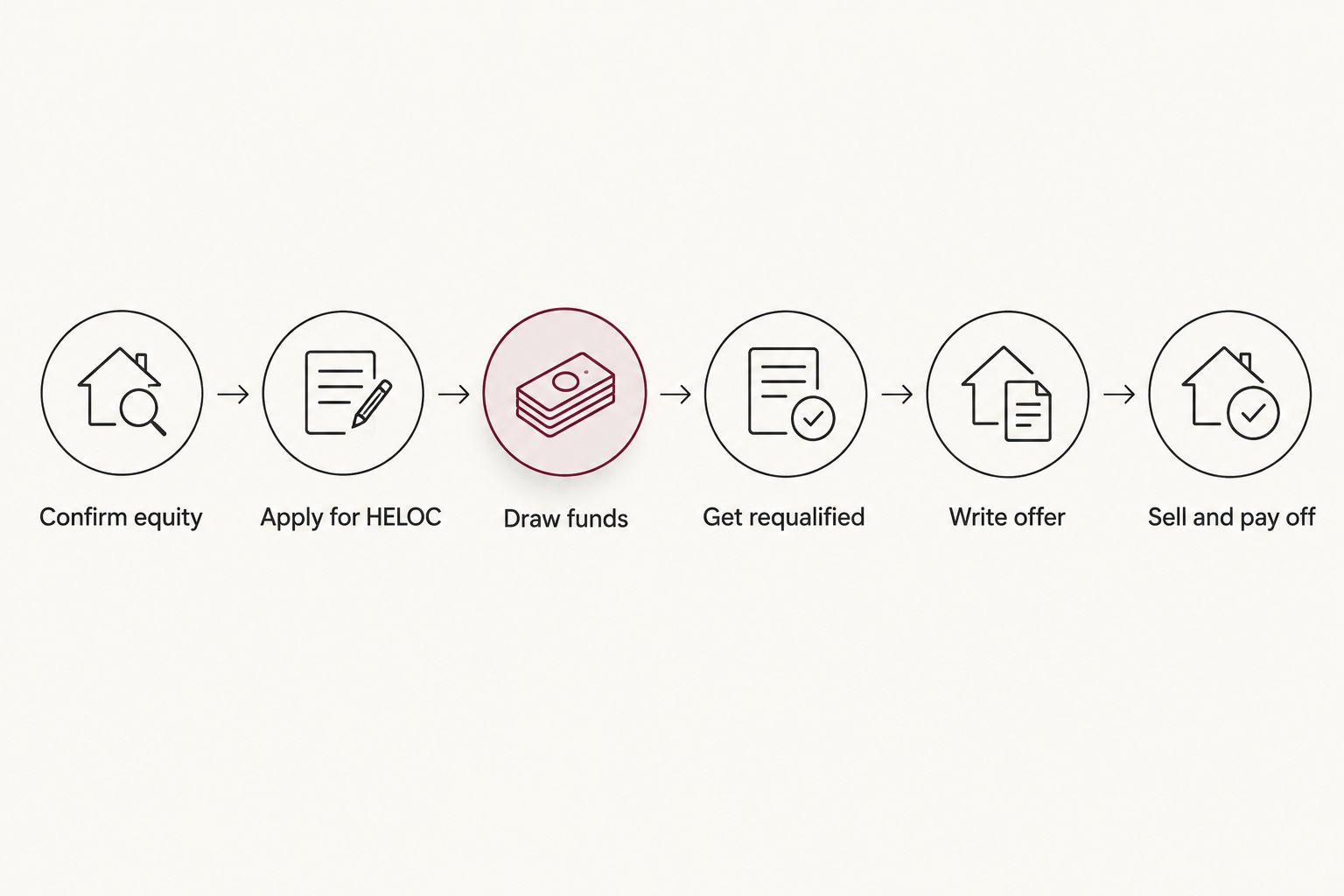
Sequencing the HELOC before the offer, not after, is what keeps this strategy from stalling out mid-contract. Writing a competitive offer in the Cincinnati market looks different when part of your down payment is borrowed rather than liquid — sellers and their agents will ask about it.
Related questions about HELOC down payments in Cincinnati
Can you use a HELOC to buy a second home in Cincinnati?
Yes, a HELOC can fund a down payment on a second home in Cincinnati as long as the combined loan-to-value on your primary residence stays within the lender's 80-85% cap. The new mortgage on the second home still gets underwritten with the HELOC payment counted as debt, same as a primary-residence purchase.
Is a HELOC better than a bridge loan for buying before you sell?
A HELOC is usually cheaper than a bridge loan when your sale timeline isn't fixed yet, because you only pay interest on what you draw. A bridge loan makes more sense once your current home is under contract and you need funds for a specific, short window before that sale closes.
How much equity do you need to use a HELOC for a down payment?
Most lenders require enough equity to keep your combined loan-to-value at or below 80-85% after the HELOC draw. On a home with no existing second mortgage, that typically means you need meaningfully more equity than the down payment amount itself, since the HELOC balance stacks on top of your existing mortgage.
Talk through your HELOC strategy with Joey Sandlin
20+ years guiding Southern Ohio and Cincinnati-area buyers through financing decisions.
If the numbers are close, buyers who aren't sure whether a HELOC, a bridge loan, or down payment assistance programs fit their situation better often find the answer changes once an actual lender runs the requalification math — not before.
FAQ
How much does a HELOC cost when buying a home in Cincinnati?
A HELOC typically carries variable interest tied to the prime rate plus a margin set by the lender, along with standard closing costs on the line itself. Costs vary by lender in 2026, so getting quotes from more than one is worth the time before drawing funds.
Can you use a HELOC for a down payment on an investment property?
Yes, lenders generally allow HELOC funds toward an investment property down payment, though the combined loan-to-value cap and DTI qualification rules still apply. Investment property mortgages often carry stricter DTI limits than owner-occupied loans.
What happens if my current home doesn't sell after I use a HELOC?
You continue carrying both the original mortgage and the HELOC payment until the home sells, which is why lenders stress-test your DTI with both payments included. This is the main risk of the strategy and the reason pricing and staging the current home correctly matters before you draw funds.
Is a HELOC or a home equity loan better for a down payment?
A HELOC gives you a flexible line you draw as needed, while a home equity loan gives you a lump sum with a fixed rate upfront. For a down payment where the exact amount is known, a home equity loan can offer payment predictability that a variable-rate HELOC doesn't.
Do I need to sell my current home first to use a HELOC?
No, that's the entire point of using a HELOC — it lets you access equity without selling first. You still need enough combined loan-to-value room, and you'll carry both properties' payments until the original home sells.
How long does it take to get a HELOC approved before buying a home?
HELOC approval and funding typically takes several weeks from application, similar to a standard mortgage underwriting timeline. Starting the HELOC application before house hunting in earnest avoids delays once you find a property.
One last thing
The single detail buyers overlook: your new mortgage lender doesn't care what your HELOC payment could be if you pay it off fast — they qualify you on the payment as structured today. Get requalified with the HELOC payment included before you fall in love with a listing, not after you're under contract.