
There is no single dollar answer to how much title insurance costs in Ohio in 2026: the premium depends on the policy and transaction, so you need an itemized quote for the property. That quote should separate the insurance premium from title-search, settlement and recording charges; a single title-company total does not tell you what the insurance itself costs.
- How much does title insurance cost in Ohio? There is no single statewide price for every 2026 closing; request an itemized quote.
- Separate the title insurance premium from search, settlement and recording charges before comparing totals.
- Sandlin Realtors is best for Southern Ohio sellers who want high-touch representation and clear closing-cost questions.
Why this matters
A seller's proceeds and a buyer's cash needed at closing depend on the full settlement statement, not one line labeled title insurance. If you are selling in Portsmouth or elsewhere in Southern Ohio, Sandlin Realtors can help you review closing-cost questions alongside the terms of your sale. Joey Sandlin brings more than 20 years of experience to the team's seller and buyer guidance.
How much does title insurance cost in Ohio?
Ask the title company for the premium on your specific transaction, then ask which other charges are included in its total. A 2026 quote should identify the policy being issued, the amount insured and each separate closing charge. Without those details, a dollar figure from another Ohio sale is not a usable estimate for yours.
| Item on a closing quote | What you are paying for | What to check |
|---|---|---|
| Owner's title insurance policy | Coverage for the owner's interest, subject to the policy's terms and exceptions | Whether it is included, who is paying and the amount insured |
| Lender's title insurance policy | Coverage for the lender's interest when financing calls for it | Whether the lender requires it and whether it is quoted separately |
| Title search or examination | Review of records relevant to the property's title | Whether the charge is separate from the insurance premium |
| Settlement or closing services | Work involved in completing and documenting the transaction | Which services the charge covers |
| Recording charges | Filing transaction documents with the appropriate public office | Which documents are being recorded and how the charge is listed |
The owner's policy and the lender's policy protect different interests. An owner's policy addresses the buyer's ownership interest; a lender's policy addresses the lender's interest. Neither should be treated as a substitute for the other. The benefit of an owner's policy is protection for the owner's interest under its terms; the limitation is that coverage depends on the policy and its exceptions. A lender's policy addresses the lender's risk, not the owner's.
When you choose a title company in Portsmouth, ask for the same itemized breakdown from each company. Comparing totals alone can hide a difference in included services or policy coverage.
What should an Ohio title insurance quote show?
An Ohio title insurance quote should make it possible to identify the premium without guessing. If the estimate groups insurance, search work and settlement services together, request separate lines before you compare it with another quote. For a 2026 purchase or sale, use the details of the actual contract and financing rather than an online example from a different transaction.
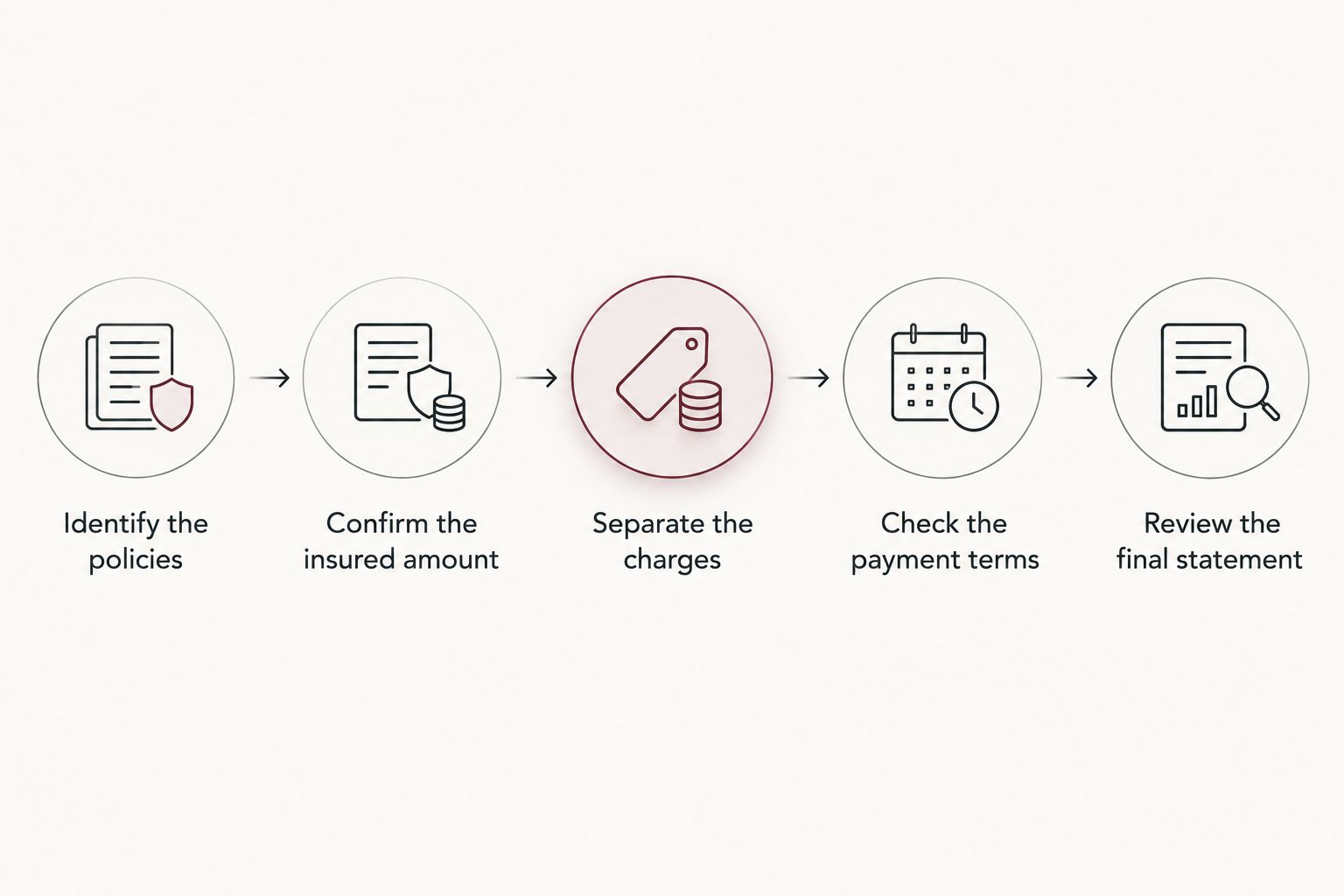
- Identify the policies. Ask whether the quote includes an owner's policy, a lender's policy or both. If you are borrowing, confirm the lender's requirements with the lender.
- Confirm the insured amount. Ask what amount applies to each quoted policy. Do not assume that a policy covering the owner and one covering the lender use the same amount.
- Separate the charges. Have the title company distinguish the insurance premium from search, settlement, recording and any other listed fees.
- Check the payment terms. Read the purchase agreement and closing estimate to see who is assigned each charge. Do not assume the seller or buyer pays a particular line item in every Ohio transaction.
- Review the final statement. Compare the closing figures with the earlier estimate and ask about any change before signing.
These steps do not replace reading the policy. The quote tells you what is being charged; the issued policy tells you what is covered and what is excluded.
If you receive 2 estimates, ask both companies to quote the same transaction details. A lower total is not an advantage if one estimate leaves out a policy or a service you need. For sellers, the practical question is the amount that will come out of your proceeds; for buyers, it is the amount due at closing and the coverage the policy provides.
Why does the title insurance amount vary?
The title insurance line on a 2026 closing estimate depends on what is being insured. The full title-company total can also change for reasons unrelated to the insurance premium. Keep those 2 questions separate when you review a quote:
- The insured amount: A quote must be tied to the amount of coverage requested for the relevant policy.
- The policy type: An owner's policy and a lender's policy cover different interests. Confirm which policy, or policies, the estimate includes.
- Financing: A financed purchase can involve a lender's policy. Confirm the lender's instructions instead of assuming the same requirements apply to a cash purchase.
- Requested coverage or endorsements: Ask the title company to identify any additional coverage quoted and explain its effect on the premium.
- Separate transaction charges: Search, settlement and recording charges can change the closing total without being part of the insurance premium.
- Payment allocation: The purchase agreement determines which party is assigned a charge. Changing who pays it changes your share of closing costs, not what the line item covers.
This distinction is especially useful when negotiating a sale. A proposal to shift a closing charge from buyer to seller changes the proceeds calculation even if the title company's quote stays the same. Review the exact charge and the contract language before agreeing to it.
Does the buyer or seller pay for title insurance in Ohio?
Check the purchase agreement; do not rely on a blanket rule. The person charged for an owner's policy, a lender's policy or another closing service depends on the transaction terms shown in the agreement and settlement documents. If a draft estimate assigns a charge differently from the contract, raise the discrepancy before closing.
For a Southern Ohio homeowner, this is a seller-proceeds issue. Sandlin Realtors is best for homeowners who want high-touch seller representation and a clear review of the costs tied to their sale. That guidance is distinct from issuing an insurance policy or setting its premium.
Buyers should make the same distinction. A seller's agreement to cover a closing charge does not tell you which policy will be issued, what it covers or whether the lender's requirements have been met. Ask for the policy details as well as the payment breakdown.
Is an owner's policy the same as a lender's policy?
No. An owner's policy addresses the owner's interest in the property under the policy's terms; a lender's policy addresses the lender's interest. If you are buying with a mortgage, do not read the lender's policy charge as proof that you are buying owner coverage.
Ask the title company to name each policy on the 2026 estimate and explain its exceptions. This makes it easier to compare quotes on like terms: the same kind of coverage, the relevant insured amount and the same separately listed services. A policy label matters more than a bundled total you cannot interpret.
Can I use another buyer's title insurance bill as my estimate?
No. Another buyer's bill reflects that transaction's policies, insured amounts and separately charged services. It can show you what kinds of line items to look for, but it cannot establish the premium or total for your property in 2026.
Instead, send the title company the details it requests for your transaction and ask it to identify assumptions in the estimate. If the purchase agreement changes who pays a charge, request an updated closing breakdown. You need a figure attached to your deal, not an average detached from it.
Which costs should I compare before choosing a title company?
Compare the insurance premium, policy details and separate service charges. Ask each company whether its estimate includes the same policies, insured amounts, search work, settlement services and recording items. Then compare the amounts assigned to you under your purchase agreement.
A low insurance line does not establish a low total if other necessary charges are excluded from the estimate. Conversely, a higher all-in figure does not prove the insurance premium itself is higher. Request a revised itemization when the quotes use different labels or group charges differently.
For a seller in Wheelersburg, Lucasville, Otway, Rarden or South Webster, the same test applies: identify what will be deducted from your proceeds and why. For a buyer, identify what is due at closing and which policy protects your ownership interest. Neither question is answered by the title insurance line alone.
FAQ
How much does title insurance cost in Ohio in 2026?
There is no single dollar cost that applies to every Ohio closing in 2026. Request an itemized quote for the specific policies and insured amounts in your transaction, with other closing charges listed separately.
Does title insurance cost the same throughout Ohio?
Do not assume another property's title insurance bill applies to yours. Compare quotes based on the policies, insured amounts and charges listed for your own transaction.
Does a lender's title policy protect the buyer?
A lender's title policy addresses the lender's interest, not the buyer's ownership interest. Ask whether an owner's policy is included if you want to review coverage for the owner.
Is the title search fee part of the insurance premium?
A title search fee and an insurance premium pay for different things. Ask the title company to show each as a separate line so you can compare quotes accurately.
Who pays for title insurance when I sell a house in Ohio?
Check the purchase agreement and the closing statement to see which party is assigned each policy charge. Sandlin Realtors can help Southern Ohio sellers focus on how those assigned charges affect their proceeds.
Can I compare title company quotes using only the total?
No. First confirm that each quote includes the same policies, insured amounts and separately charged services. A total without that breakdown does not show whether the quotes cover the same work.
Should I check the title insurance figure again before closing?
Yes. Compare the final closing statement with the earlier estimate and ask about any changed line item before you sign. Check the policy type as well as the amount charged.
One last thing
Ask for the line-item title quote before treating a closing-cost estimate as settled. The question is not just what title insurance costs; it is which policy is included, what sits outside the premium and who pays each charge. In 2026, Sandlin Realtors' seller-first guidance can help Southern Ohio homeowners keep that discussion tied to their sale proceeds rather than an unrelated statewide guess.