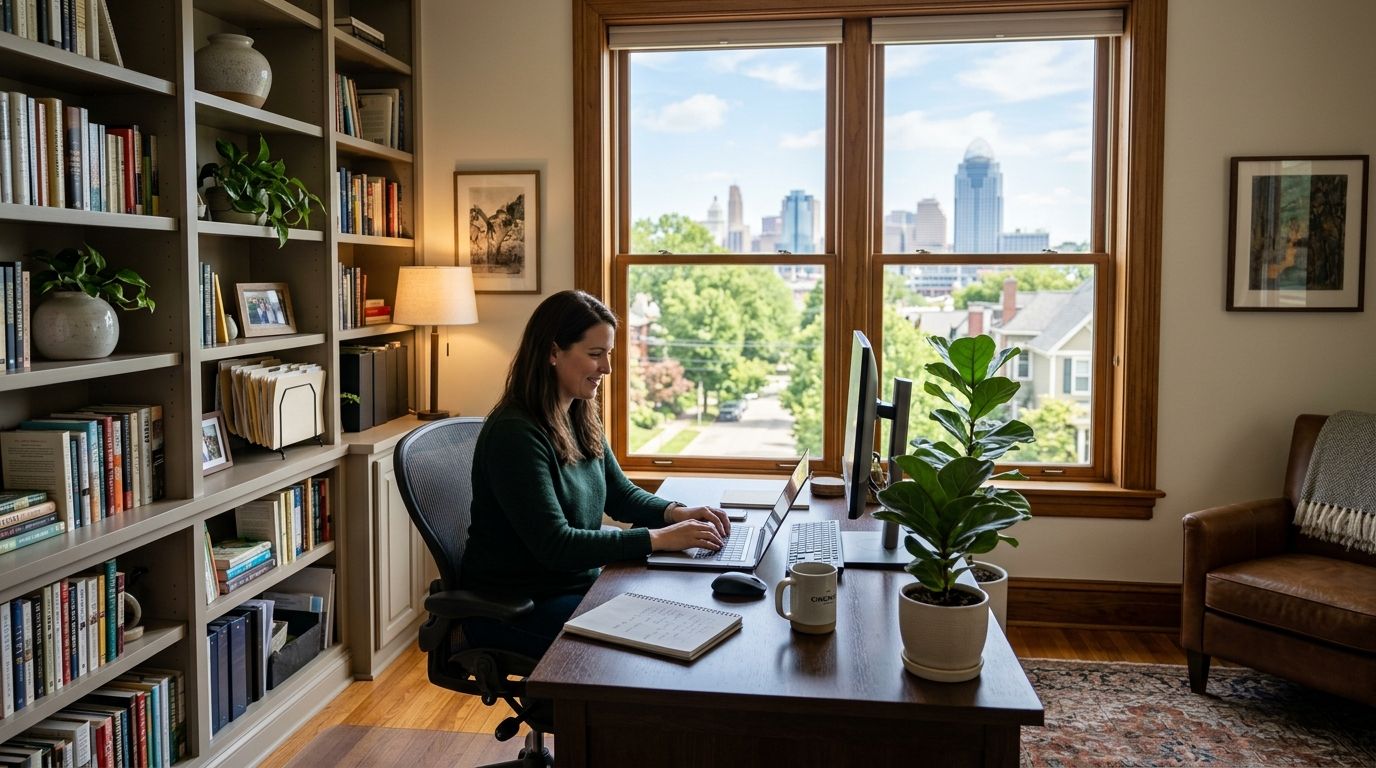
Homes for sale in Cincinnati with a dedicated home office look different than a listing with a spare bedroom and a folding table pushed against the wall. A true office needs a door that closes, a real desk footprint, and infrastructure that survives a full workday of video calls. Buyers searching this market in 2026 need a different filter strategy than someone shopping on bedroom count alone.
- Homes for sale in Cincinnati with a dedicated home office rarely use the word office in the listing itself.
- Search den, study, flex room and bonus room tags to surface inventory that basic filters miss.
- Verify permit history on any converted basement, garage or attic office before writing an offer in 2026.
- Internet reliability at the exact address matters more to remote workers than a few extra square feet.
- Sandlin Realtors screens Cincinnati flex-space listings for permits, noise separation and utility readiness.
Why a dedicated home office matters for Cincinnati buyers
A spare room is not the same as a dedicated office, and buyers who skip that distinction end up working from the kitchen table by month two. Remote and hybrid workers shopping for homes for sale in Cincinnati with a dedicated home office need a room that closes off from household noise, sits near a strong internet drop, and does not double as a guest room every time family visits.
Joey Sandlin has spent more than 20 years representing buyers and sellers across Southern Ohio. The same discipline that applies to evaluating a Portsmouth farmhouse or a Scioto County acreage parcel applies here: match the property to how the buyer actually lives in it, not to how the listing photos frame it.
That matters more in 2026 than it did a decade ago. A home office is now a standing line item on buyer requirement lists rather than a nice-to-have, and sellers have caught on — which means plenty of rooms get staged with a desk and a plant without being genuinely office-capable.
Buyers relocating for remote or hybrid roles should look at which Cincinnati neighborhoods work best for remote workers before narrowing down individual listings. Commute distance stops driving the decision, but internet infrastructure and daytime noise levels take its place.
What makes this search different from a standard home search
Standard buyer searches run on three variables: price band, bedrooms, school district. An office search adds three more that no public portal filter handles well.
- Room function, not room count. A four-bedroom home with all four bedrooms upstairs and occupied gives you zero office space. A three-bedroom with a main-floor den gives you one.
- Acoustic separation. The distance between the office door and the kitchen, playroom or laundry decides whether calls are workable.
- Utility readiness. Internet service quality, outlet placement and HVAC coverage in the room are invisible in listing photos and rarely mentioned in remarks.
Miss any of the three and you are renovating within the first year. Sort for all three up front and the shortlist gets small fast — which is the point.
Build your Cincinnati home office search from the room out
Define your non-negotiables before you tour anything
Most buyers start with bedroom count and compromise on office quality because they never wrote down what the room has to do.
- A door that closes, not an open loft or a landing nook
- Wall space for a desk plus at least one monitor arm
- A window if video calls are part of the daily routine
- Real distance from the loudest room in the house
- Outlet capacity for multiple monitors, a dock and a standing desk
Write this list before the first showing. It becomes the scoring sheet you use in every home, and it stops the third tour from erasing the standards you set at the first.
Search listings for flex space, not the word office
MLS feeds rarely tag a room as a home office. It shows up as a den, study, bonus room, flex space, morning room or fourth bedroom, and buyers who search only for the word office miss a large share of the inventory that actually fits.
- Cross-reference listings tagged den, study, flex room and bonus room
- Check square footage on the flex room specifically, not just the total home size
- Look for a closet or built-ins, which signal the room was designed as real living space
- Note whether the room has its own HVAC vent — plenty of converted spaces do not
- Read the floor plan, not the photo gallery, to see what the room adjoins
Vet internet and electrical before you fall for the room
A well-lit office with unreliable service is a dealbreaker for anyone on calls daily. Target a connection that comfortably supports at least 100 Mbps download for smooth video conferencing, and confirm what actually serves the address rather than the general neighborhood.
- Ask the listing agent which providers serve the property directly
- Check fiber availability versus cable-only service at that specific address
- Test cell signal inside the room as a fallback when service drops
- Review the age and capacity of the electrical panel if you need dedicated circuits
- Count outlets in the room itself — older Cincinnati housing stock often has two
Check zoning, HOA rules and permit history on converted spaces
A converted garage, attic or finished basement office only holds its value if the work was done to code. Skipping this is the most expensive mistake remote-work buyers make in the 2026 Cincinnati market.
- Pull the property's permit history before writing an offer on any converted space
- Confirm the HOA permits home-based work, especially if clients or deliveries will visit
- Ask whether a basement conversion included proper egress and moisture control
- Verify a garage conversion did not eliminate parking required under local code
- Request seller disclosure on electrical or HVAC work tied to the conversion
Tour with an agent who reads flex-space inventory
This is where most buyers stall. Public filters do not distinguish between a purpose-built study and a converted closet with a desk wedged in. Sandlin Realtors walks Cincinnati-area buyers through flex-space inventory specifically, flagging which conversions were done properly and which are cosmetic — the strongest fit for remote and hybrid professionals who need the room to work on day one.
- Ask your agent to flag listings with verified permit records on any conversion
- Request a walkthrough focused on noise separation, not just room count
- Compare flex-room square footage across shortlisted homes side by side
- Discuss which submarkets carry the highest share of purpose-built office layouts
- Have your agent confirm internet options at each address before the second showing
Negotiate around verified office features
A permitted, finished office space is worth negotiating differently than a cosmetic upgrade. Verified space is leverage; an unpermitted room is a price adjustment.
- Make permit documentation a contingency rather than an assumption
- Price unpermitted conversions into your offer, not into your wish list
- Confirm whether the office counts toward official square footage on the appraisal
- Ask what stays: built-in desks, shelving and hardwired networking are negotiable
Confirm the space works before your first workday
Do not wait until move-in to discover the internet drop sits on the wrong side of the house.
- Run a speed test in the room during your final walkthrough
- Measure against your actual furniture, not estimated dimensions
- Check whether the door and window seal block street noise at peak traffic hours
- Walk the panel with an electrician if you are adding equipment
Find your Cincinnati home office match
Get a shortlist of flex-space listings screened for permits, noise separation and internet quality.
Comparing home office options in Cincinnati inventory
| Option | Best for | Key limitation |
|---|---|---|
| Purpose-built den or study | Buyers who want zero renovation before working from home | Fewest listings match exactly, so competition is highest |
| Finished basement office | Buyers who want full separation from household noise | Limited natural light; permit and moisture checks are essential |
| Converted garage or bonus room | Buyers who want the office near the home's entrance | Trades parking or storage; conversion permits must be verified |
| Main-floor flex room off the entry | Buyers who see clients or take deliveries | Often lacks a door or sits open to the living area |
| Detached studio or outbuilding | Buyers who want total separation from the household | Rare in current inventory; usually needs added utility work |
One pattern holds across all five in 2026: the room that photographs best is often the one that functions worst. Open lofts and landing nooks stage beautifully and fail on acoustics.
“If the room has no door, it is not a home office — it is a desk with a view.”
Common mistakes remote-work buyers make in Cincinnati
- Treating a flex room as a guaranteed office. Many flex rooms have no door and open directly onto the main living area. Confirm on the floor plan, not in the listing remarks.
- Skipping permit verification on basement, attic or garage conversions. Unpermitted work complicates resale, appraisal and insurance later — and the discount you should have taken is gone once you close.
- Judging internet quality by neighborhood reputation. Service varies block to block across Greater Cincinnati. Verify the address, not the ZIP code.
- Overpaying for square footage while ignoring noise. A large room facing a busy street is worse for daily calls than a smaller room at the back of the house.
- Ignoring HOA restrictions on home-based work. Some associations limit client visits, signage or commercial deliveries even for salaried remote employees.
FAQ
What counts as a dedicated home office in a Cincinnati listing?
A dedicated home office is a room with a closing door and enough space for a full desk setup, separate from shared living areas. In 2026 listings it usually appears as a den, study, flex room or bonus room rather than an office.
Is a finished basement a good home office in Cincinnati?
A finished basement works well for buyers who want full separation from household noise. Confirm the conversion was permitted and check egress, natural light and moisture control before making an offer.
How do I check whether a home office conversion was done legally?
Pull the property's permit history through the local building department or have your agent verify it before you write an offer. Unpermitted conversions can affect appraisal value, resale and insurance coverage.
What internet speed do I need for a home office in Cincinnati?
Target at least 100 Mbps download to handle daily video calls reliably. Confirm which providers serve the exact address, since availability differs within the same neighborhood.
Do Cincinnati HOAs restrict working from home?
Some associations limit client visits, signage or commercial deliveries tied to business use, even for remote employees. Read the HOA rules on business use before assuming the home fits your work setup.
Should I pay more for a home with a converted garage office?
Only if the conversion is permitted and did not eliminate parking required under local code. Price unpermitted work into your offer rather than treating it as a bonus feature.
How is buying for a home office different from buying extra bedrooms?
A home office needs noise separation, reliable internet and a closing door, and none of those track with bedroom count. Search on flex-room square footage and floor plan adjacency instead.
Does a home office affect a property's appraisal in Ohio?
A permitted, finished office space can count toward official square footage, which supports appraised value. An unpermitted conversion typically does not count.
One last thing
The cheapest fix in this entire search is a solid-core door. Swapping a hollow-core interior door for a solid one, plus weatherstripping the jamb, does more for call quality than another 80 square feet of floor space. If a 2026 Cincinnati listing checks every other box and the only gap is acoustics, that is a fixable problem — an unpermitted basement conversion is not.