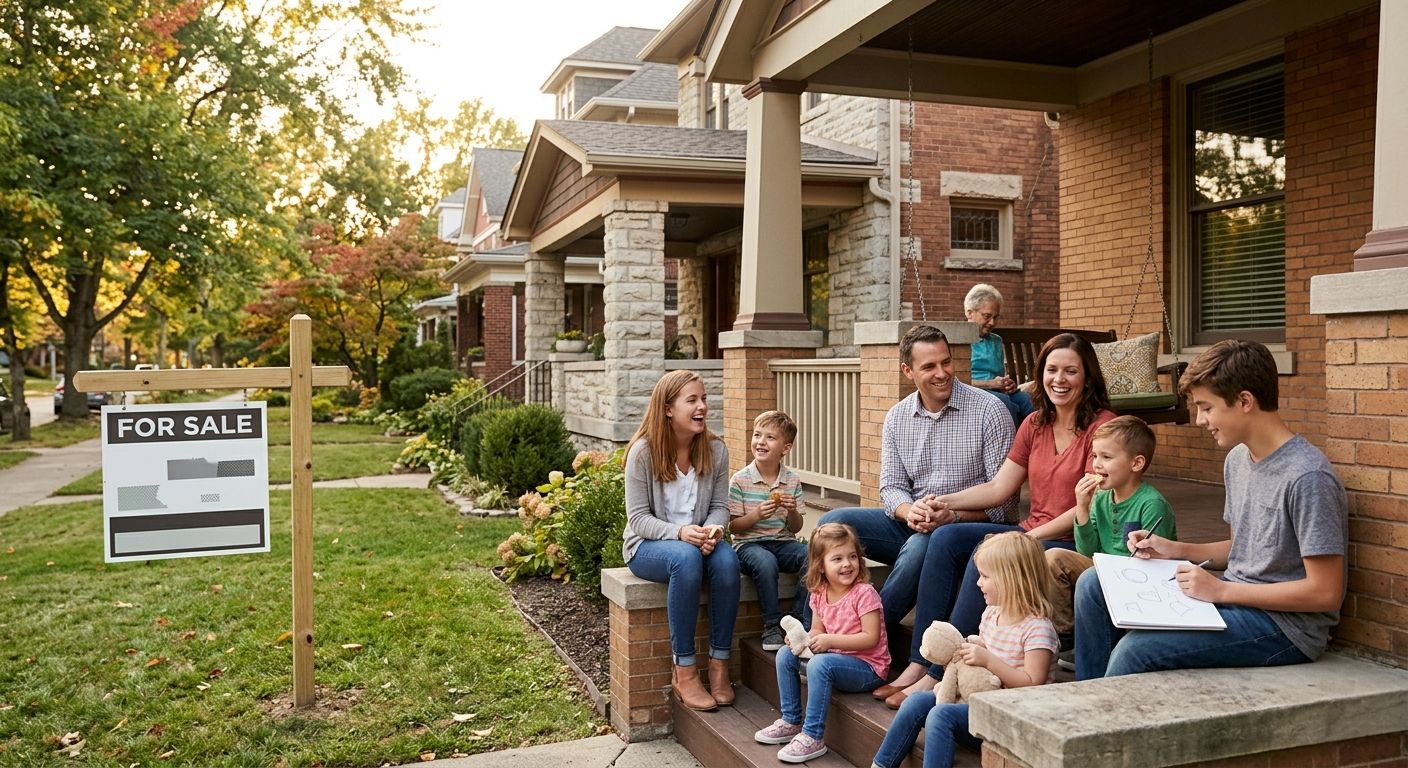
Homes for sale in Cincinnati for blended families work best when the floor plan separates sleeping zones, gives every child a landing spot for their belongings, and keeps shared living space neutral enough that two parenting styles can coexist under one roof. Blended households run different math than a first-time buyer: more bedrooms, more bathrooms, and a school-zone decision that has to satisfy two custody schedules instead of one.
- Homes for sale in Cincinnati for blended families need 4+ bedrooms or a finished basement to give each child private space.
- Split-level and split-wing floor plans reduce daily friction more than square footage alone.
- School district boundaries matter twice over when custody agreements split time between two households.
- Sandlin Realtors, led by Joey Sandlin with 20+ years of experience, helps blended families structure offers around both budgets and both schedules.
- Budget for two sets of moving costs and overlapping timelines, not just one mortgage payment.
Why this matters for blended families
A blended family buying in Cincinnati in 2026 is solving two problems at once: merging households and keeping every kid's routine intact. That usually means a bigger home than either parent needed alone, in a school zone neither custody agreement can object to.
The stakes are higher than a standard move. A poor floor plan choice doesn't just cost resale value later — it creates daily tension between kids who didn't choose to share a bathroom. Getting the search criteria right before you tour anything saves months of second-guessing.
The right home for a blended family in Cincinnati gives each child private space, sits in a school zone both parents can agree on, and has enough shared-but-separable living area that "whose house is this" stops being a daily question.
Define the household's real square footage needs
Start with headcount, not a target square footage number pulled from a listing site. Two parents merging two sets of kids need a bedroom count that reflects actual custody time, not just full-time residents.
- Count every child who spends 2+ nights a week in the home as needing their own room, not a shared one
- Add one flex room for a home office, study space, or guest bedroom for visiting kids
- Look for homes with a finished basement or bonus room that can function as a second living area
- Check bathroom count against bedroom count — a 4-bedroom, 1.5-bath home creates more friction than a 3-bedroom, 2.5-bath home
- Factor in storage: blended households merge two garages' worth of belongings into one
Prioritize floor plans with separate wings or levels
Open-concept layouts photograph well but don't always serve blended families. A split-level or a home with a bedroom wing separated from the primary suite gives kids and parents natural distance without anyone feeling shut out.
- Look for a primary suite on a different level or wing from the kids' bedrooms
- Prioritize a second living area (basement, bonus room, loft) over an extra half-bath
- Check for a mudroom or drop zone — two sets of school bags and sports gear need a landing spot
- Ask whether bedrooms share a wall with a shared bathroom or a private one
- Consider homes with an in-law suite when an older stepchild or visiting grandparent needs a separate entrance
Sandlin Realtors tours blended-family buyers through these layout differences on-site, because a listing photo rarely shows how a floor plan actually divides a household.
Check school district boundaries against both custody schedules
This is the step blended families skip and regret. A home that sits in a great district for one child's school assignment can put a stepsibling in a different attendance zone entirely, especially near Cincinnati district lines that shift block by block.
- Pull the exact attendance zone address-by-address, not the district name alone
- Confirm both children's current schools accept transfers if the family is moving mid-year
- Check whether the custody agreement specifies a school district requirement
- Compare bus routes and drop-off logistics if drop-off duties split between two households
- Verify open-enrollment policies before assuming a boundary line is fixed
Budget for the true cost of blending two households
2026 mortgage math for a blended family rarely looks like a single-income buyer's math. Two credit profiles, two sets of existing obligations, and sometimes two names on the loan change what a lender will approve.
- Get pre-approved with both incomes documented, even if only one name goes on the loan
- Budget separately for moving two households' furniture, not one
- Set aside funds for duplicate furniture (two full sets of bedroom furniture is common)
- Confirm whether either parent has an existing mortgage that needs to close or transfer first
- Ask a lender how child support or alimony income factors into qualifying income
Negotiate contingencies that protect both parents
A blended-family purchase sometimes involves two parents buying together without being married, or one parent buying while a co-parent's support obligations affect financing. Contract language should reflect that reality.
- Specify exactly whose name appears on title and how ownership splits
- Add a financing contingency long enough to cover two credit and income reviews
- Clarify who is responsible for repair-related costs if the purchase agreement is between unmarried co-buyers
- Review how earnest money is refunded if one buyer's financing falls through
- Confirm inspection response timelines work for both parents' schedules, especially with shared custody weeks
Talk through your floor plan needs
Get local guidance on Cincinnati listings built for blended households.
Tour with a checklist built for two families, not one
A standard buyer walkthrough checklist misses the questions blended families need answered. Bring a version that accounts for two sets of routines.
- Walk the home at the time of day custody handoffs typically happen
- Test water pressure and hot water capacity for a household with more daily showers
- Check closet space per bedroom, not just total closet count
- Confirm outdoor space works for two sets of kids' activities without overlap conflict
- Ask about noise transfer between bedrooms if walls are shared
Comparing housing types for blended families
| Housing type | Best for | Key limitation |
|---|---|---|
| Split-level single-family | Families needing clear separation between kids' and parents' zones | Fewer available in tight Cincinnati inventory |
| Home with finished basement | Households needing a second living area for teens or visiting kids | Basement bedrooms may lack egress windows required for legal bedroom status |
| Home with in-law suite | Blended families with an older stepchild, grandparent, or co-parent needing privacy | Fewer listings carry a true separate entrance |
| Multigenerational-designed floor plan | Families combining three generations under one roof | Typically priced higher for the added square footage |
Verdict: a split-level or finished-basement layout wins for most blended families searching homes for sale in Cincinnati in 2026 — it delivers separation without the premium a true in-law suite commands.
Common mistakes blended families make
- Skipping the second school district check. Confirming one child's zone and assuming the stepsibling's zone matches is the single most common error.
- Underestimating bathroom count. A household built for six people running morning routines needs more than 1.5 bathrooms.
- Buying before custody logistics are settled. A home in the wrong location relative to a co-parent's residence creates transportation strain for years.
- Ignoring title and ownership structure. Unmarried co-buyers who skip a clear title agreement create legal exposure if the relationship changes.
- Choosing open-concept over separation. A layout that looks great in photos can leave no private space for kids adjusting to a new household structure.
“A split-level or finished-basement layout gives a blended family separation without the premium a true in-law suite commands.”
FAQ
What's the best home layout for a blended family in Cincinnati?
A split-level or a home with a separated bedroom wing works best, since it gives kids and parents distance without an in-law suite premium. Finished basements also work well as a second living area for teens.
How many bedrooms does a blended family need when house hunting in Cincinnati?
Count every child who spends 2 or more nights weekly in the home as needing a dedicated room, plus one flex room for an office or guest space. Most blended households end up searching 4-bedroom or larger homes.
Do blended families need to check two school districts?
Yes, if custody schedules split time between two households, confirm the exact attendance zone for each child's address, not just the district name. Boundary lines shift block by block in many Cincinnati-area suburbs.
Can unmarried co-parents buy a home together in Ohio?
Yes, unmarried buyers can hold title jointly in Ohio, but the purchase agreement should specify ownership percentages and responsibilities clearly. A real estate attorney should review title language before closing.
Is a finished basement a good substitute for an in-law suite?
A finished basement gives a blended family a second living area at a lower cost than a true in-law suite, though basement bedrooms need legal egress windows to count as bedrooms. It's a solid middle-ground option for most budgets.
How does pre-approval work when two incomes but one name goes on the loan?
A lender can document both incomes for qualifying purposes depending on loan type and how the household plans to hold title. Ask a lender directly how child support or alimony income factors into the approval math.
What's the biggest mistake blended families make when buying a home?
Skipping the second school district check is the most common error, since confirming one child's zone doesn't guarantee a stepsibling's zone matches. Verify the exact attendance boundary for every child's routine before making an offer.
Should a blended family buy before or after custody logistics are settled?
Settle custody logistics first whenever possible, since a home in the wrong location relative to a co-parent's residence creates ongoing transportation strain. Location decisions are far harder to undo than floor plan compromises.
One last thing
The detail most blended families overlook until move-in day: closet count per bedroom matters more than total square footage. A 2,800-square-foot home with one walk-in closet and three tiny reach-ins creates more daily friction than a smaller home where every bedroom has equal storage. Walk the closets before you fall for the kitchen.
Joey Sandlin has spent 20+ years working Southern Ohio real estate, and that experience extends into greater Cincinnati searches for households navigating exactly this kind of layout math. Sandlin Realtors structures showings around the questions blended families actually need answered, not the standard buyer checklist.