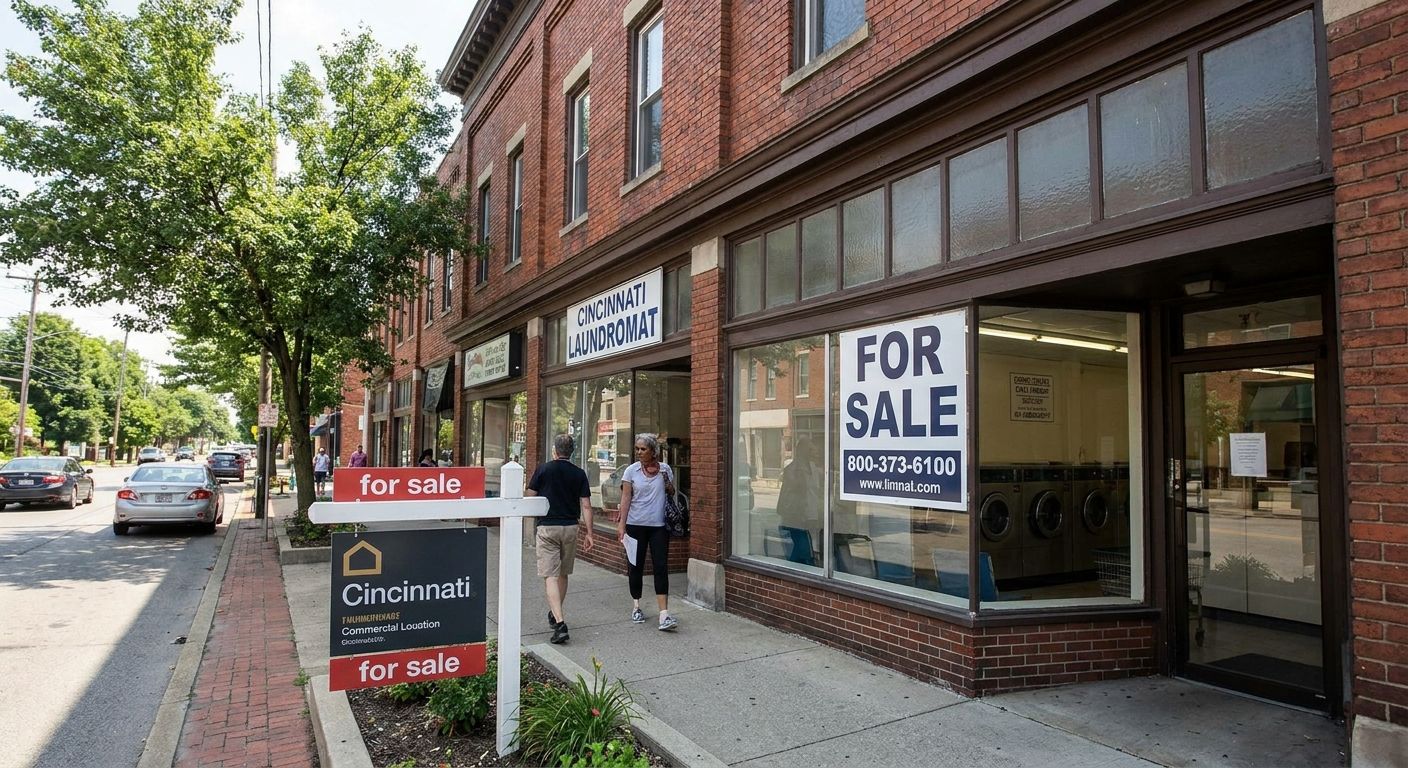
Cincinnati's laundromat and small commercial market has quietly picked up in 2026, and buyers searching "cincinnati laundromat for sale" are competing with fewer listings than the residential side but far less forgiving math. This guide breaks down what actually matters before you sign on commercial real estate for sale in Cincinnati, plus which submarkets reward the investment and which ones don't.
- Over-the-Rhine and Northside are the strongest bets for a cincinnati laundromat for sale in 2026 due to renter density without in-unit hookups.
- Bond Hill's industrial corridor is a Skip for laundromat buyers despite lower price points -- residential density is too thin.
- Verify trailing twelve-month cash flow and equipment age before offering on any commercial real estate for sale in Cincinnati.
- Zoning and lease-term length decide more of your return than the sale price does.
Why this matters
A laundromat or small retail storefront is not a house -- the valuation runs on cash flow, utility load, and lease terms rather than comps and appraisals. Buyers who treat commercial real estate for sale in Cincinnati like a residential purchase overpay for machines nearing replacement or underpay attention to a lease that expires in 18 months. Cincinnati's population sits around 309,000 residents citywide, concentrated in dense, walkable neighborhoods that either support a laundromat's foot traffic or don't -- and that distinction is the whole game in 2026.
Who this is for
This is written for entrepreneurs and small investors evaluating a cincinnati laundromat for sale as a cash-flowing asset, plus first-time commercial buyers who've outgrown residential real estate but haven't bought business real estate before. If the purchase also means relocating your household to the area, pair this research with the residential side -- the guide to homes for sale in Cincinnati for first-time buyers covers that separately, since buying the business and buying the house are two different transactions with two different sets of risk.
What to look for in commercial real estate for sale in Cincinnati
Renter density near the storefront
Laundromats survive on foot traffic from renters without in-unit washers and dryers, not on drive-by visibility. A block surrounded by owner-occupied single-family homes will underperform one surrounded by multifamily rentals, regardless of how nice the storefront looks.
Utility infrastructure and load capacity
Water, gas, and electrical capacity are the largest recurring costs in this business, and older Cincinnati buildings sometimes carry undersized service that limits how many machines you can run. Get the utility bills for the last 12 months before you get attached to the space.
Zoning and permitted use
Commercial zoning doesn't automatically mean laundromat-permitted zoning -- some Cincinnati commercial corridors carry use restrictions from prior tenants or neighborhood overlay districts. Confirm permitted use with the city before you put down earnest money, not after.
Lease terms versus outright ownership
Most laundromats for sale in Cincinnati are businesses operating inside a leased space rather than a real estate purchase, and lease terms commonly run 5 to 10 years with renewal options. A short remaining term on the lease changes your entire return calculation even if the business itself looks healthy.
Equipment age and remaining useful life
Commercial washers and dryers have a finite service life, and a seller advertising "turnkey" doesn't always disclose that half the machines need replacement within a year or two. Ask for service records and machine purchase dates as part of due diligence, not as a courtesy.
Documented cash flow, not seller estimates
Any commercial real estate for sale in Cincinnati priced on income potential needs bank statements and tax returns behind the number, not a verbal estimate from the seller. If the seller won't produce trailing financials, treat the asking price as unverified.
Relocating to Cincinnati alongside the deal?
Sandlin Realtors covers residential buying and selling guidance across Ohio, including Cincinnati.
Top picks: Cincinnati submarkets for a laundromat purchase
There's no single "best" cincinnati laundromat for sale -- the right submarket depends on renter density and price tolerance. Here's how the strongest Cincinnati neighborhoods stack up for this specific use in 2026.
Over-the-Rhine -- the safe pick. OTR carries some of the highest population density per square mile in the city, with a rental base that skews toward apartments without in-unit laundry. Premium pricing reflects the demand. Buy if the cash flow documentation checks out.
Northside -- the up-and-comer. Known for a walkable retail corridor and a younger renter demographic, Northside supports steady laundromat traffic without OTR's premium. Buy for buyers who want density at a lower entry price.
Norwood -- the value pick. Norwood is an independent city fully surrounded by Cincinnati, with a mixed renter and owner base and mid-range commercial pricing. Consider it if the specific block skews rental-heavy.
Price Hill -- the wildcard. One of Cincinnati's largest neighborhoods by population, Price Hill offers lower commercial pricing but more variance block-to-block in renter density and building condition. Consider, and walk the block before you walk the storefront.
Bond Hill industrial corridor -- the one to skip. Heavy industrial and warehouse zoning means low residential density nearby, which starves a laundromat of walk-in traffic regardless of the discount on the lease. Skip for this use case.
What to avoid
- "Absentee owner" listings with no maintenance records. A business that's run itself for years without an owner on-site often means deferred equipment maintenance nobody tracked.
- Storefronts near a closed retail anchor. A vacant big-box or shuttered grocery store next door signals declining foot traffic that outlasts the current lease.
- Zoning that reads "commercial" but restricts water-intensive use. Some Cincinnati commercial parcels carry overlay restrictions written for a prior retail tenant that don't accommodate a laundromat's utility draw.
Verdict comparison table
| Neighborhood | Renter Density | Price Point | Verdict |
|---|---|---|---|
| Over-the-Rhine | High | Premium | Buy |
| Northside | High | Mid-range | Buy |
| Norwood | Medium-high | Mid-range | Consider |
| Price Hill | Medium | Value | Consider |
| Bond Hill (industrial corridor) | Low | Value | Skip |
FAQ
What's the best neighborhood for a cincinnati laundromat for sale?
Over-the-Rhine and Northside rank highest in 2026 because both carry dense renter populations without in-unit laundry. Norwood and Price Hill are worth considering block-by-block, but industrial corridors like Bond Hill lack the foot traffic a laundromat needs.
Is buying a laundromat a good investment in 2026?
It can be, but only when the cash flow is documented with bank statements and tax returns rather than a seller's verbal estimate. Utility costs and equipment age matter more to the return than the storefront's visibility.
How much does a laundromat cost in Cincinnati?
Pricing depends on cash flow, equipment age, and whether real estate is included with the sale rather than a fixed market rate. Request trailing twelve-month financials before you use any asking price to judge value.
Should I lease or buy the building for a laundromat?
Most laundromats for sale in Cincinnati transfer as a leased business rather than a real estate purchase. Check the remaining lease term and renewal options before you value the business, since a short remaining term changes the return math significantly.
Do I need a business broker or a real estate agent for a laundromat purchase?
A commercial business broker typically handles the sale of the laundromat operation itself, while a real estate agent is more relevant if real property or a residential relocation is part of the deal. Sandlin Realtors focuses on residential representation across Southern Ohio and Cincinnati rather than commercial business brokerage.
What zoning do I need for a laundromat in Cincinnati?
You need commercial zoning that permits the specific use, which isn't automatic even on a parcel labeled commercial. Confirm permitted use and any overlay restrictions with the city before signing a purchase agreement.
Is commercial real estate in Cincinnati a buyer's or seller's market in 2026?
Listing volume for small commercial and laundromat-specific properties has stayed thin through 2026, which keeps well-documented, cash-flowing listings priced firmly. Buyers gain the most leverage on properties with unclear financials or deferred equipment maintenance.
Does Sandlin Realtors handle commercial real estate in Cincinnati?
No -- Sandlin Realtors specializes in high-touch residential representation for buyers and sellers across Southern Ohio and Cincinnati. For a laundromat or commercial business purchase, pair this guide with a commercial business broker, and use Sandlin for any residential move tied to the deal.
One last thing
The detail most buyers skip: check the storefront's water and sewer billing history directly with Cincinnati's utility provider, not just the seller's summary. A laundromat's biggest recurring cost hides in that bill, and a summary can smooth over a spike from an aging line or an undersized meter that a full billing history won't.