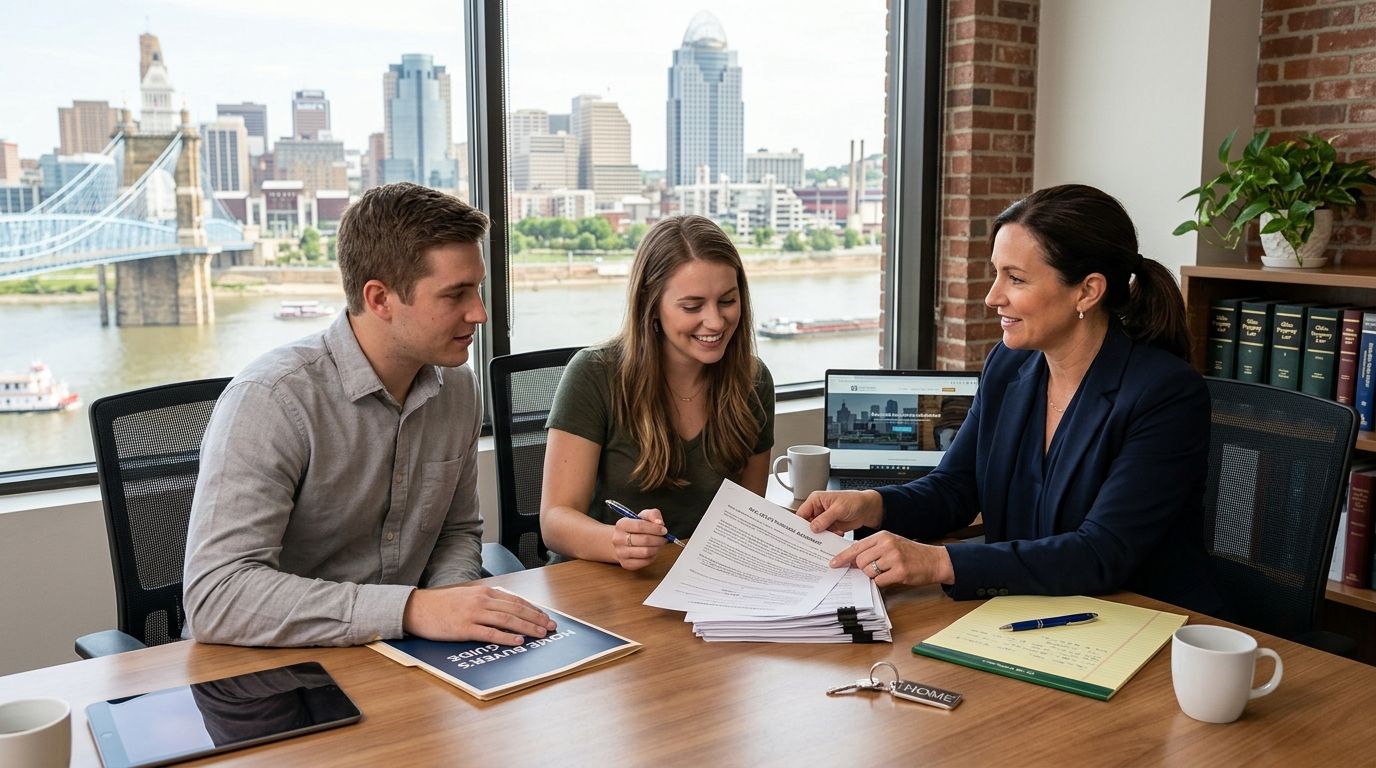
Ohio doesn't require you to hire a real estate attorney to close on a home, so most Cincinnati buyers skip it and lean on their agent and title company instead. Bring one in for the right situation, and a single phone call is worth more than the retainer.
- Ohio is a title-company closing state, so most Cincinnati purchases never need a lawyer at all.
- Best real estate attorneys in Cincinnati handle routine residential closings and title review without added delay.
- Contested or inherited sales need probate and litigation experience, not a closing generalist.
- Joey Sandlin's team, with 20+ years in Ohio real estate, coordinates directly with buyer's attorneys on every contract.
- Out-of-state buyers need a specialist comfortable with remote or mail-away closings.
Why this matters
Ohio runs closings through title companies and escrow, not courtrooms — Hamilton, Butler, Clermont, and Warren County purchases all follow that system. That's why most Cincinnati buyers never talk to a lawyer during a purchase.
The deals that go sideways in 2026 are the ones where nobody brought in counsel early: a title cloud from an old lien, an inherited property with three heirs who don't agree, a contract dispute over an inspection contingency. Joey Sandlin's team has spent over 20 years sorting which situations need a real estate attorney and which just need a patient agent.
Choosing a real estate agent in Cincinnati who already coordinates with a trusted attorney network saves you a scramble mid-contract. This guide sorts the best real estate attorneys in Cincinnati by the job you actually need done, not by name recognition.
“Ohio doesn't require a lawyer at closing, but the right one still protects your equity in a contested sale.”
What makes the best real estate attorney in Cincinnati
- Closes a real volume of residential deals across Hamilton, Butler, and Warren counties every month, not one a year
- Reviews title work and flags liens, easements, or boundary issues before they reach the closing table
- Responds inside contract deadlines — a missed inspection contingency window kills your leverage fast
- States fees and scope in writing before you sign an engagement letter
- Carries probate, divorce, or co-ownership litigation experience for contested sales
- Coordinates directly with your agent and lender instead of working around them
Real estate attorney types for Cincinnati buyers, at a glance
| Attorney type | Best for | Standout skill | Key limitation |
|---|---|---|---|
| Residential closing specialist | Straightforward purchases | Fast title review, clean closings | Limited value once a dispute starts |
| Agent-referred closing counsel | First-time buyers | Pre-vetted, used to first-timer questions | Availability tied to the referral network |
| Probate and litigation counsel | Contested or inherited sales | Handles disputes among heirs or co-owners | Slower and costlier than a standard closing |
| Investment and contract counsel | Investors, multi-family buyers | Structures complex purchase agreements | Overkill for a single-family purchase |
| Remote closing specialist | Out-of-state and relocating buyers | Manages mail-away and video closings | Fewer local-court relationships |
1. Residential closing specialist: best for a straightforward Cincinnati purchase
A residential closing specialist reviews the purchase contract, checks the title commitment, and reviews the closing disclosure before you sign. For a standard single-family purchase in Hamilton or Butler County, this is the level of counsel most 2026 buyers actually need.
Residential closing specialist pros:
- Turns around title review in days, not weeks
- Flags easement or lien issues before closing
- Works comfortably alongside your title company and lender
Residential closing specialist cons:
- Won't take on a contested sale if one develops later
- Value is easy to overlook until something's actually wrong with title
Residential closing specialist pricing: fee structures vary by firm and scope of work — ask for a flat quote in writing before signing an engagement letter.
Best for: buyers closing on a conventional home purchase with no title complications.
Verdict: Hire. Worth the cost on any purchase over six figures, which describes most of the 2026 Cincinnati market.
2. Agent-referred closing counsel: best for first-time buyers
Agent-referred counsel comes pre-vetted through your real estate agent's professional network, which matters most when you don't know what a normal closing timeline even looks like. They're used to explaining earnest money, contingencies, and title exceptions in plain language.
Agent-referred closing counsel pros:
- Already familiar with local title companies and lenders
- Patient with first-timer questions about the contract
- Faster to book than a cold search
Agent-referred closing counsel cons:
- You're trusting your agent's judgment on the referral
- Fewer options if the referral network is small
Best for: first-time buyers in Hamilton, Butler, or Warren County who want a known quantity.
Verdict: Hire, especially if your agent already works this way — it's how earnest money in Ohio disputes get resolved before they become disputes at all.
3. Probate and litigation counsel: best for contested or inherited sales
This is the attorney you need when the sale isn't simple — an inherited home with multiple heirs, a divorce that involves splitting proceeds, or a co-ownership disagreement over who signs what. A residential closing specialist won't touch these; a litigation attorney will.
Probate and litigation counsel pros:
- Handles heir disputes and contested ownership directly
- Experienced with court filings tied to a sale
- Protects your position if a dispute escalates
Probate and litigation counsel cons:
- Slower process than a standard residential closing
- Costs more given the added legal work
Best for: sellers or buyers involved in an inherited, divorce-related, or co-owned property sale.
Verdict: Hire the moment more than one party has a legal claim on the property — waiting costs more than the retainer.
4. Investment and contract counsel: best for investors and multi-family buyers
Investors buying duplexes, small multi-family properties, or portfolios in the Cincinnati market need contract language that a standard residential template doesn't cover — assignment clauses, entity structuring, and 1031 exchange timing all matter here.
Investment and contract counsel pros:
- Structures purchase agreements around LLCs and partnerships
- Understands 1031 exchange deadlines and requirements
- Reviews leases on occupied multi-family purchases
Investment and contract counsel cons:
- Unnecessary cost for a single owner-occupied purchase
- Fewer generalists specialize in this niche locally
Best for: investors and buyers of duplex or multi-family properties.
Verdict: Hire only when the deal involves an entity, a 1031 exchange, or existing tenants — otherwise a residential specialist covers it.
5. Remote closing specialist: best for out-of-state and relocating buyers
Buyers relocating to Cincinnati for a job, or purchasing a home site unseen, need an attorney comfortable running a closing by mail or video without slowing down the timeline.
Remote closing specialist pros:
- Manages mail-away and remote notarization smoothly
- Coordinates with out-of-state lenders on tight schedules
- Keeps a relocation timeline on track
Remote closing specialist cons:
- Fewer local-court relationships than a full-time local practitioner
- Requires more upfront document coordination
Best for: buyers relocating from out of state or purchasing before a physical walkthrough.
Verdict: Hire if you can't be in Cincinnati for closing day — this is the one situation where remote experience beats local reputation.
Get local guidance before you sign
Sandlin Realtors coordinates directly with Cincinnati closing attorneys.
How this list was ranked
Each type was ranked against the criteria above: closing volume, title-review speed, deadline responsiveness, fee transparency, litigation experience, and how well the attorney works alongside your agent. No two types compete for the same buyer — a residential closing specialist and a probate attorney solve different problems, not the same one at different price points.
Which real estate attorney should you choose?
For most 2026 Cincinnati purchases, a residential closing specialist is the default answer — fast, focused on title review, and priced for a routine transaction. Step up to probate or litigation counsel only when a dispute or an estate is already in the picture, and use a remote closing specialist only when you genuinely can't be there in person.
If you're not sure which category your situation falls into, that's a conversation for your agent before it's a conversation for a lawyer.
FAQ
Do I need a real estate attorney to buy a home in Cincinnati?
No. Ohio closes residential purchases through title companies and escrow, not attorneys, so most Cincinnati buyers never need one. Complex situations like inherited property or a title dispute are the exception.
What's the difference between a real estate attorney and a title company in Ohio?
A title company handles the closing mechanics — escrow, disbursement, and the title policy. An attorney represents your legal interests specifically, which matters most when a dispute or unusual contract term is involved.
How much does a real estate attorney cost in Cincinnati?
Fee structures vary by firm and by the scope of work involved. Ask for a flat-fee estimate in writing before signing an engagement letter, rather than an open-ended hourly arrangement.
When should I hire an attorney instead of relying on my agent and title company?
Hire one when a dispute already exists — an inherited property with multiple heirs, a divorce splitting proceeds, or a title cloud from an old lien. Routine purchases rarely need this step.
Can a real estate attorney help with a contested inherited home sale in Cincinnati?
Yes. Probate and litigation counsel handles disputes among heirs or co-owners directly, which a standard residential closing specialist is not set up to do.
Does Sandlin Realtors work with real estate attorneys?
Sandlin Realtors coordinates directly with buyer's and seller's attorneys throughout a transaction when one is involved, drawing on Joey Sandlin's 20+ years representing Southern Ohio and Cincinnati-area buyers and sellers.
What should I ask a real estate attorney before hiring them?
Ask how many residential closings they handle monthly, whether fees are flat or hourly, and how quickly they respond during a contingency deadline. Slow response during a deadline window is the most common complaint.
Is Ohio an attorney-required closing state?
No. Ohio is one of the majority of states where a real estate attorney is optional rather than required, with title companies handling most residential closings across all 88 counties.
One last thing
Most Cincinnati buyers assume skipping a real estate attorney is a risk. In 2026, the bigger risk is the reverse — hiring litigation counsel for a routine purchase, or a closing generalist for a contested inherited sale, and paying for the wrong kind of expertise either way. Match the attorney type to the actual problem, not the other way around.