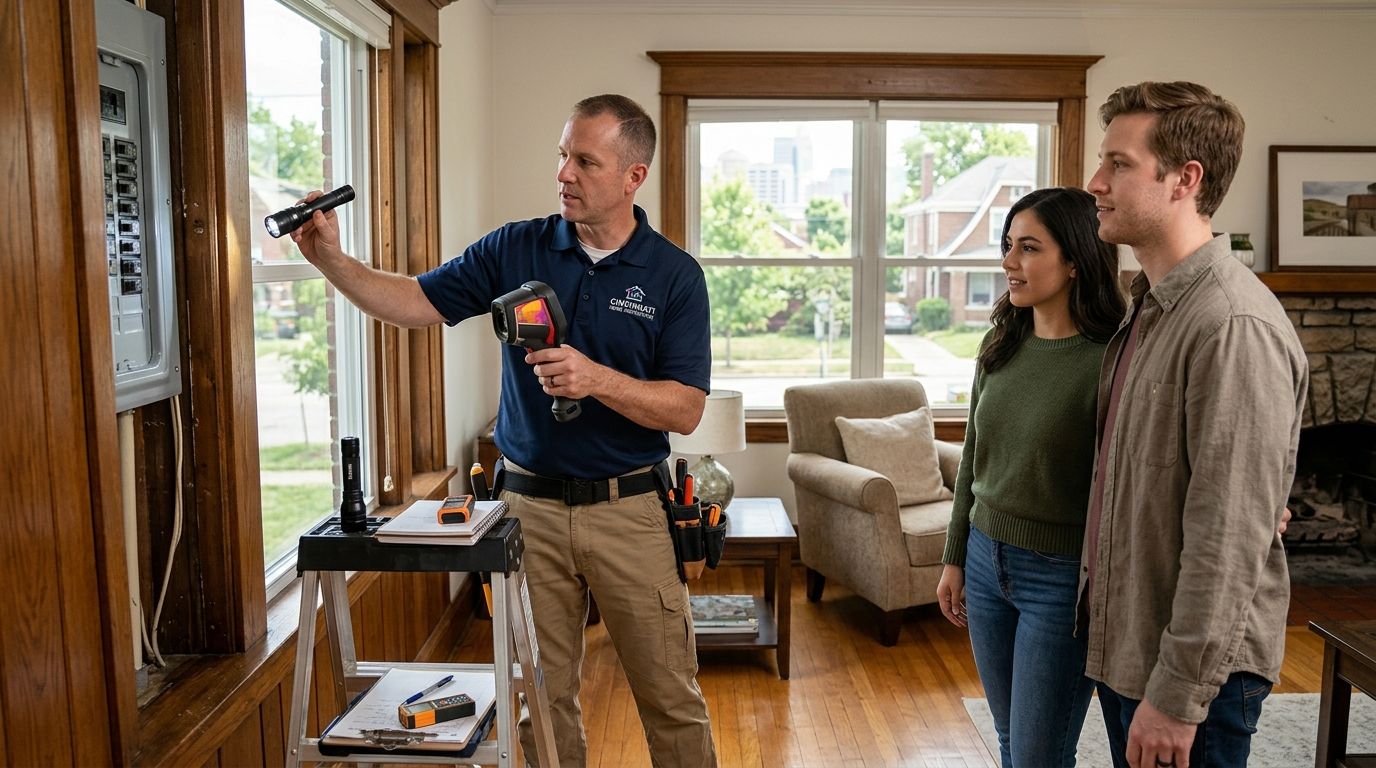
Cincinnati home buyers don't need one universal "best" inspector — they need the right specialist for the property in front of them, and that choice shifts the moment you move from a 1920s hillside colonial in Clifton to new construction in West Chester.
- A general ASHI- or InterNACHI-certified inspector is the best overall choice for most Cincinnati buyers in 2026.
- Ohio issues no state license for home inspectors, so certification and local experience matter more than a state seal.
- Homes with clay or cast-iron sewer lines built before 1980 need a separate sewer scope, not just a general inspection.
- Rural Southern Ohio buyers near Otway or Rarden should budget for a well and septic inspection alongside the general one.
- The best home inspectors cincinnati buyers hire combine one general inspector with targeted specialists based on the property's age and location.
Why this matters
Hamilton, Butler, Warren, and Clermont county housing stock spans century-old brick doubles to homes built in 2026, and no single inspection covers every risk across that range. A general inspector can miss a failing sewer line under the yard or a septic tank near capacity — those need their own specialist.
Sandlin Realtors has guided Southern Ohio and Cincinnati-area buyers through inspection negotiations for 20+ years, from Portsmouth and Wheelersburg to the Cincinnati suburbs. The inspection is where a deal gets renegotiated or walked away from, so matching the right professional to the property matters more than picking a name off a list.
Preparing for a home inspection in Cincinnati before the appointment cuts down on surprises during the walkthrough itself.
What makes the best home inspector in Cincinnati
- Certification — ASHI or InterNACHI membership, since Ohio has no state licensing board for inspectors.
- Local property knowledge — familiarity with hillside foundations, pre-1980 clay sewer lines, and Ohio River flood exposure.
- Report turnaround — a written report within 24 to 48 hours protects your inspection contingency deadline.
- Specialty coverage — radon, sewer scope, WDI (termite), and well/septic testing offered directly or through referral.
- On-site communication — inspectors who narrate findings during the walkthrough save you a follow-up call before a 40-page report even arrives.
Cincinnati home inspection types at a glance
| Type | Best for | Standout feature | Key limitation |
|---|---|---|---|
| General home inspector (ASHI/InterNACHI) | Every buyer, baseline coverage | Structure, roof, electrical, plumbing, HVAC in one visit | Doesn't test radon, sewer lines, or well water |
| Radon testing specialist | Basements and slab homes in Hamilton and Butler counties | Meets the EPA's 4 pCi/L action level protocol | Needs a 48-hour closed-house test window |
| Sewer scope inspector | Homes built before 1980 with clay or cast-iron lines | Camera run of the full line to the street connection | Doesn't cover interior plumbing fixtures |
| Structural/foundation engineer | Hillside lots and homes near the Ohio River | Licensed PE stamp on load-bearing findings | Adds a second appointment and a second report |
| WDI/termite inspector | FHA and VA buyers, wood-framed homes | Required sign-off on many government-backed loans | Covers wood-destroying insects only |
| Well and septic inspector | Rural Southern Ohio buyers near Otway, Rarden, and West Union | Tests water potability and tank capacity | Not applicable inside city sewer/water limits |
1. General home inspector (ASHI/InterNACHI certified): best overall for every Cincinnati buyer
A general inspector spends two to four hours walking the roof, foundation, electrical panel, plumbing, and HVAC system, then delivers a written report with photos. This is the inspection every purchase contract in Cincinnati should include, regardless of price point or property age.
General inspector pros:
- Single visit covers the systems that cause most deal renegotiations
- ASHI and InterNACHI both publish standards of practice you can hold the inspector to
- Report doubles as a repair-negotiation document with your agent
General inspector cons:
- Doesn't test radon, sewer condition, or well water quality
- Findings are visual only — no invasive testing behind walls
- Quality varies widely between individual inspectors even within the same certification body
Best for: every buyer, on every property, as the non-negotiable first booking. Verdict: book this one, no exceptions.
2. Radon testing specialist: best for basements and slab homes in Hamilton and Butler counties
Radon testing runs a sealed 48-hour measurement using EPA protocol, and a result at or above 4 pCi/L means a mitigation system is recommended before or after closing. Basements are common across older Cincinnati neighborhoods, which makes this test worth adding to nearly every general inspection.
Radon specialist pros:
- Tied to a documented EPA health threshold, not a guess
- Test can run concurrently with the general inspection
- Result gives concrete negotiating leverage on price or repairs
Radon specialist cons:
- Requires the house to stay closed for the full 48-hour window
- Doesn't address any other air quality or structural issue
- A high reading means a follow-up mitigation cost outside the inspection itself
Best for: buyers on homes with basements or slab foundations. Verdict: book it alongside the general inspection.
3. Sewer scope inspector: best for pre-1980 homes with clay or cast-iron lines
A sewer scope runs a camera from the cleanout to the street connection, catching root intrusion and pipe collapse that a general inspector can't see. Cincinnati's older neighborhoods still carry plenty of clay and cast-iron lines from before 1980, and a collapsed line is a five-figure repair most buyers don't budget for.
Sewer scope pros:
- Camera footage is unambiguous evidence for a repair credit
- Usually scheduled the same day as the general inspection
- Catches the single most expensive hidden defect in older housing stock
Sewer scope cons:
- Doesn't inspect interior plumbing fixtures or water heaters
- Access can be limited on properties without a clear cleanout
- Adds a line-item cost most buyers don't anticipate until their agent flags it
Best for: any home built before 1980, especially in Cincinnati's older urban neighborhoods. Verdict: book it if the home predates 1980.
4. Structural or foundation engineer: best for hillside lots and homes near the Ohio River
Cincinnati's hillside geography and proximity to the Ohio River mean foundation movement and moisture intrusion show up more often than in flat, inland markets. A licensed structural engineer goes beyond the general inspector's visual check and stamps findings with professional liability behind them.
Structural engineer pros:
- A PE stamp carries legal weight in a repair negotiation
- Identifies whether cracking is cosmetic settling or active structural movement
- Worth the extra appointment on any hillside or riverfront property
Structural engineer cons:
- Second appointment means coordinating two reports before your contingency deadline
- Overkill for a flat-lot property with no visible foundation concerns
- Findings can be technical and need your agent to translate into next steps
Best for: hillside lots and homes within sight of the Ohio River. Verdict: book it when the general inspector flags foundation movement.
5. WDI/termite inspector: best for FHA and VA buyers on wood-framed homes
A wood-destroying insect inspection is a required sign-off for most FHA and VA-backed purchases, and it's a quick, low-cost addition for conventional buyers on wood-framed construction. It only covers termites and similar pests, not general home condition.
WDI inspector pros:
- Satisfies a lender requirement outright for government-backed loans
- Fast turnaround, usually a same-day report
- Catches an issue a general inspector may only note in passing
WDI inspector cons:
- Narrow scope — insects only, nothing structural or mechanical
- Not required for conventional loans, so buyers sometimes skip it and shouldn't
- A positive finding can delay closing if treatment has to happen first
Best for: FHA and VA buyers, and any wood-framed home regardless of loan type. Verdict: book it if your loan requires it; add it anyway if it doesn't.
6. Well and septic inspector: best for rural Southern Ohio buyers
Buyers looking outside Cincinnati proper — toward Otway, Rarden, or West Union — often land on a well-and-septic property instead of city water and sewer. This inspection tests water potability and checks septic tank capacity and drain field condition, neither of which a general inspector is equipped to evaluate.
Well/septic inspector pros:
- Confirms water is safe to drink before you move in
- Septic capacity check prevents a surprise failure in year one
- Standard practice for rural Southern Ohio purchases
Well/septic inspector cons:
- Irrelevant for any property on city water and sewer
- Septic pumping or repair, if needed, is a separate cost outside the inspection
- Scheduling can take longer in rural counties with fewer specialists
Best for: rural Southern Ohio buyers on well and septic systems. Verdict: book it, no substitute exists.
How this list is built
Ranking these six inspection types comes down to which systems a general inspection physically cannot evaluate — radon, sewer condition beyond the cleanout, well water, and septic capacity all require separate equipment or a closed-house window a walkthrough inspector doesn't have. The order above follows the sequence a Cincinnati-area contract typically needs them in: general first, then the specialists your property type demands.
Which home inspector should you book?
Book a general ASHI- or InterNACHI-certified inspector on every Cincinnati purchase in 2026 — that's the non-negotiable baseline. Layer in a sewer scope on anything built before 1980, a radon test on any home with a basement, and a well/septic inspection on rural Southern Ohio properties near Otway or Rarden. Skip the specialists that don't apply to your property type; there's no reason to pay for a well inspection on a city-water condo.
Once findings come back, negotiating repairs into the offer is the next step, and an experienced Sandlin Realtors agent is who translates inspection findings into a repair credit or a price reduction.
Get inspection guidance before you write an offer
Sandlin Realtors walks Cincinnati and Southern Ohio buyers through every inspection decision.
FAQ
What's the best home inspector type for a Cincinnati buyer in 2026?
An ASHI- or InterNACHI-certified general inspector is the right first booking for every buyer in 2026, regardless of property age or price. Layer in specialists like a sewer scope or radon test based on the home's age and location.
Does Ohio license home inspectors?
No. Ohio has no state licensing board for home inspectors, which is why certification through ASHI or InterNACHI matters more than it does in states with licensing requirements.
How much radon is too much in a Cincinnati home?
The EPA's action level is 4 pCi/L. A result at or above that threshold means a mitigation system is recommended before or shortly after closing.
Do I need a sewer scope on every Cincinnati home purchase?
Not every purchase, but any home built before 1980 with clay or cast-iron sewer lines should get one. Root intrusion and pipe collapse are common in that housing stock and expensive to fix after closing.
Is a WDI inspection required in Cincinnati?
It's required for most FHA and VA-backed purchases on wood-framed homes. Conventional buyers aren't required to get one but should add it anyway given the low cost relative to the risk.
What inspections do rural Southern Ohio buyers need that Cincinnati buyers don't?
Buyers on well and septic systems, common near Otway, Rarden, and West Union, need a water potability test and a septic capacity check that city-water Cincinnati buyers can skip.
How long does a general home inspection take?
A general inspection typically runs two to four hours depending on the size of the home, followed by a written report within 24 to 48 hours.
One last thing
Ohio doesn't license home inspectors — there's no state board checking credentials before someone calls themselves one. That makes ASHI or InterNACHI membership the closest thing to a quality floor a Cincinnati buyer has, and it's worth confirming before you book anyone in 2026.