
West Chester Township tops the ranking of best Cincinnati suburbs for low property taxes in 2026, with Liberty Township and Fairfield close behind for buyers who want new construction or an affordable entry point without a heavy tax overlay.
- West Chester Township wins for new construction buyers who want a lighter township tax overlay.
- Liberty Township and Fairfield offer lower price points with a similar tax structure to West Chester.
- Mason's strong schools come with some of the higher voted levies among Cincinnati's low-tax suburb contenders.
- Ohio assesses every home at 35% of market value before local millage is applied, statewide.
- Township residents generally carry a lighter tax load than incorporated city residents for the same home value.
Why this matters
Two homes priced the same at closing can carry tax bills that differ by hundreds of dollars a year depending on whether the suburb is an unincorporated township or an incorporated city, and whether the local school district has gone to voters recently. Sandlin Realtors has advised buyers and sellers across Southern Ohio and the wider Cincinnati market for more than 20 years under Joey Sandlin, and the same pattern shows up every year: buyers who compare list prices only get surprised at closing when the Butler County property tax breakdown turns out different from what they expected.
Ohio assesses every home at 35% of market value before any local millage is applied — that statutory rule is identical in Hamilton, Butler, Warren, and Clermont counties. What changes suburb to suburb is the millage stacked on top of that assessed value: school levies, township or city government, fire districts, parks, and libraries each add their own line to the bill.
Sandlin Realtors runs this same check on every Cincinnati-area showing before a buyer writes an offer, because the sticker price on a listing never tells the whole tax story.
What makes the best low-tax suburb
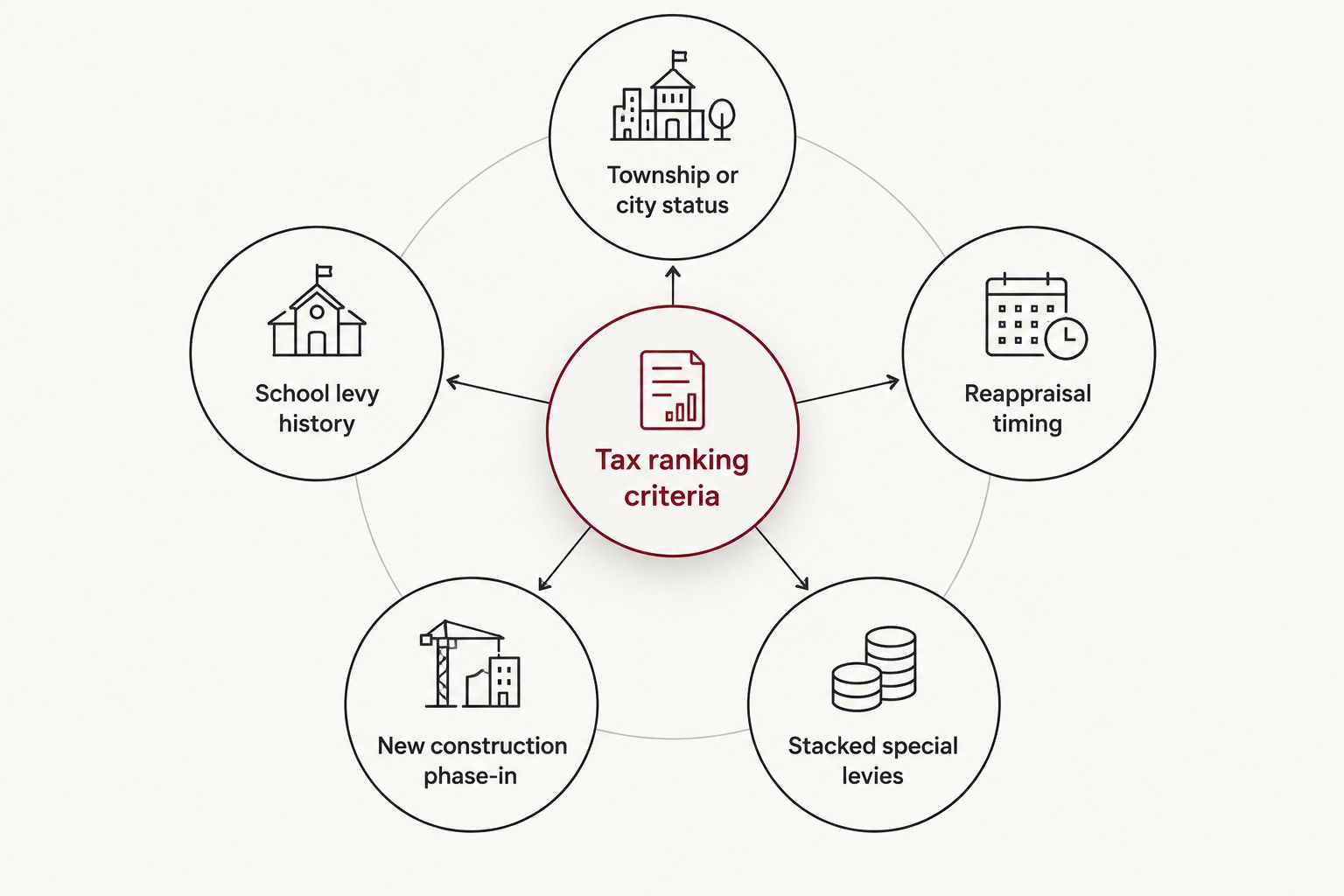
- Township vs. city status. Unincorporated townships skip the municipal income tax and extra city-level levies that incorporated suburbs add on top of county and school rates.
- School district levy history. A district that recently passed a bond issue or operating levy carries a heavier bill than one that hasn't gone to voters in years.
- County reappraisal timing. Hamilton, Butler, Warren, and Clermont counties don't reappraise on the same schedule, so a suburb's rate this year can shift before the next cycle.
- New construction phase-in value. A freshly built home sometimes carries an assessed value that hasn't caught up to a full reappraisal yet, which can mean a lower bill for the first few years.
- Stacked special levies. Fire, EMS, parks, and library levies pile onto the base county and school rate one district at a time, and they add up differently suburb to suburb.
Best Cincinnati suburbs for low property taxes at a glance
| Suburb | County | Best for | Standout feature | Key limitation |
|---|---|---|---|---|
| West Chester Township | Butler | New construction buyers | Township status, no city income tax layered on top | Rising enrollment is pushing school levy talk |
| Liberty Township | Butler | Buyers chasing phase-in savings | New development often lags full reappraised value | Fast growth can trigger a levy vote sooner than older suburbs |
| Fairfield | Butler | First-time buyers wanting value | Established housing stock at lower entry prices | Incorporated city status adds a municipal layer |
| Hamilton | Butler | Urban convenience without downtown rates | Already-reappraised housing keeps assessed values steady | City income tax and municipal levies stack on county millage |
| Loveland | Warren/Clermont | Commuters wanting small-town feel | Straddles two counties, giving buyers options | Rates can differ block to block depending on the county line |
| Mason | Warren | Families prioritizing schools | Consistently strong school district drives resale demand | Voted levies keep the total bill above nearby townships |
1. West Chester Township: best low-tax suburb for new construction buyers
West Chester Township sits in Butler County and stays unincorporated, which means residents skip the separate city income tax that Fairfield and Hamilton residents pay on top of county and school millage. The township has absorbed steady new-home construction along the I-75 corridor over the past decade without folding into a city government structure.
West Chester Township pros:
- No municipal income tax layered on top of county and school rates
- Wide inventory of newer homes near I-75 retail and employers
- Township trustees, not a city council, run most local services
West Chester Township cons:
- Growing enrollment means school levy conversations come up more often
- Newer subdivisions can see assessed values catch up fast after the next reappraisal
West Chester Township verdict: Buy if minimizing total tax exposure while staying close to Cincinnati employers is the priority.

2. Liberty Township: best low-tax suburb for buyers chasing new-build savings
Liberty Township, also in Butler County, is one of the fastest-growing unincorporated areas in the region. Its newer subdivisions often carry assessed values that haven't fully caught up to market price yet, which keeps early tax bills lower than a comparably priced home in an older, already-reappraised suburb. Buyers interested in new construction suburbs near Cincinnati usually start their search here.
Liberty Township pros:
- Township status keeps the same income-tax advantage as West Chester
- New-build phase-in values can lag market price for a few years
- Strong retail and employer growth along the Butler County corridor
Liberty Township cons:
- Rapid growth can prompt levy votes sooner than in slower-growing suburbs
- Limited older housing stock if you want an established neighborhood feel
Liberty Township verdict: Buy if you want new construction and are comfortable with a suburb still building out its infrastructure.
3. Fairfield: best low-tax suburb for first-time buyers
Fairfield is an incorporated city in Butler County, so it carries a municipal layer that West Chester and Liberty Township don't. What it offers instead is established housing stock at a lower entry price point, which matters more than the tax line for a lot of first-time buyers working with a tighter budget in 2026.
Fairfield pros:
- Lower entry prices than the newer townships nearby
- Established neighborhoods with mature landscaping and shorter commutes to city services
- Wide range of starter-home inventory
Fairfield cons:
- Incorporated city status means an added municipal tax layer
- Older housing stock means more variance in home condition
Fairfield verdict: Buy if affordability matters more than shaving the last dollar off your annual tax bill.
4. Hamilton: best low-tax suburb for urban convenience without downtown Cincinnati rates
Hamilton is Butler County's seat and an incorporated city, so it stacks municipal income tax and city levies on top of the county and school rate. Its housing stock has already gone through recent reappraisal cycles, which keeps assessed values from jumping the way a fast-growing new subdivision's would.
Hamilton pros:
- Already-reappraised housing means fewer tax-bill surprises after purchase
- Urban amenities and a walkable downtown core
- Broad price range across neighborhoods
Hamilton cons:
- City income tax and municipal levies add up on top of county millage
- Some neighborhoods carry older infrastructure that needs closer inspection
Hamilton verdict: Hold if you want urban convenience — just budget for the added city layer.
5. Loveland: best low-tax suburb for commuters who want a small-town feel
Loveland splits across Warren and Clermont counties, which means the exact tax bill on a given street depends on which county line the home sits on. That split gives buyers a real choice: compare a Warren County parcel against a Clermont County parcel before writing an offer on the same street.
Loveland pros:
- Small-town character with bike-trail access and a walkable downtown
- Straddling two counties gives buyers a genuine side-by-side comparison
- Popular with commuters who don't need to be inside Cincinnati proper
Loveland cons:
- Rates can differ meaningfully block to block depending on the county
- Limited new-construction inventory compared to Butler County townships
Loveland verdict: Hold and compare the exact parcel's county before assuming a rate.
6. Mason: best suburb for families who prioritize schools over minimizing the tax bill
Mason sits in Warren County and consistently ranks among the strongest school districts in the Cincinnati metro. That reputation is exactly why it doesn't make the cut for lowest tax bill — voted levies that fund the schools keep Mason's total rate higher than nearby townships. Buyers weighing Warren County property tax rules against the best school districts near Cincinnati usually land here anyway, because resale demand tends to hold up better in a strong district.
Mason pros:
- Consistently strong school district supports long-term resale value
- Established retail, parks, and employer base
- Warren County's overall rate structure is lighter than Hamilton County's
Mason cons:
- Voted school levies push the total bill above township neighbors
- Higher demand means less room to negotiate on price
Mason verdict: Wait if minimizing taxes is your top priority — otherwise Buy for the school district alone.
How this ranking works
Every suburb above gets judged against the same five criteria: township or city status, school levy history, county reappraisal timing, new construction phase-in value, and stacked special levies. Suburbs that skip the municipal income tax layer and haven't gone through a recent reappraisal jump rank higher. Suburbs with strong, well-funded schools rank lower on tax bill alone even when they're the smarter long-term buy — that trade-off is exactly what Sandlin Realtors walks buyers through before an offer goes in.
Which suburb should you choose?
Buy West Chester Township if a light tax overlay and new construction both matter to you — it's the closest thing to a default pick for 2026. Buy Liberty Township if you want the same township advantage with more new-build inventory coming online. Hold on Hamilton or Loveland until you've priced out the specific parcel's municipal or county layer. Wait on Mason only if the tax bill outranks school quality on your list — for most families with kids in the district, the schools justify the extra levy. Sandlin Realtors recommends starting the search in whichever township fits the budget first, then checking the levy history before writing an offer.
Get a local tax read before you buy
Sandlin Realtors checks levy history on any Cincinnati suburb you're considering.
FAQ
What is the best Cincinnati suburb for low property taxes in 2026?
West Chester Township carries some of the lightest total tax overlay among Cincinnati suburbs for low property taxes, mainly because it's unincorporated and skips the extra city millage that Fairfield and Hamilton residents pay. Liberty Township runs a close second for the same township-status reason.
Are property taxes lower in townships than cities in Ohio?
Yes, in most cases. Township residents avoid the municipal income tax and extra city-level levies that incorporated suburbs like Fairfield and Hamilton add on top of county and school millage.
How does Ohio calculate property tax?
Ohio counties assess homes at 35% of market value, then apply the local millage rate set by the county, school district, and any voted levies to that assessed value.
Is Mason Ohio a low-tax suburb?
Not really. Mason's schools rank among the strongest in the region, and that reputation comes with voted levies that push its total tax bill higher than township neighbors like West Chester or Liberty Township.
Which county has lower property taxes, Butler or Warren?
Both counties include a mix of townships and cities, so the county line alone doesn't decide the bill. Check whether the specific suburb is incorporated and what school levies have passed recently.
Does new construction mean lower property taxes?
Not automatically, but a newly built home in a growing area like Liberty Township sometimes carries an assessed value that hasn't caught up to a full reappraisal yet, which can mean a lower bill for the first few years.
Can I lower my property tax bill after buying in a Cincinnati suburb?
Owner-occupants may qualify for a homestead or owner-occupancy credit depending on eligibility. Ask the county auditor's office what applies to your specific purchase.
Should I pick a suburb based on property taxes alone?
No. Weigh the tax bill against school quality, commute time, and resale demand, since a slightly higher levy in a strong school district often protects your home's value better over time.
One last thing
Ohio counties don't set property tax rates once and leave them alone. Hamilton, Butler, Warren, and Clermont each run a six-year full reappraisal with a triennial update in between, so the suburb that looks cheapest in 2026 can shift again before 2029. Check the current levy history with the county auditor before you write an offer, not after — Sandlin Realtors runs this check on every Cincinnati-area showing for exactly that reason.