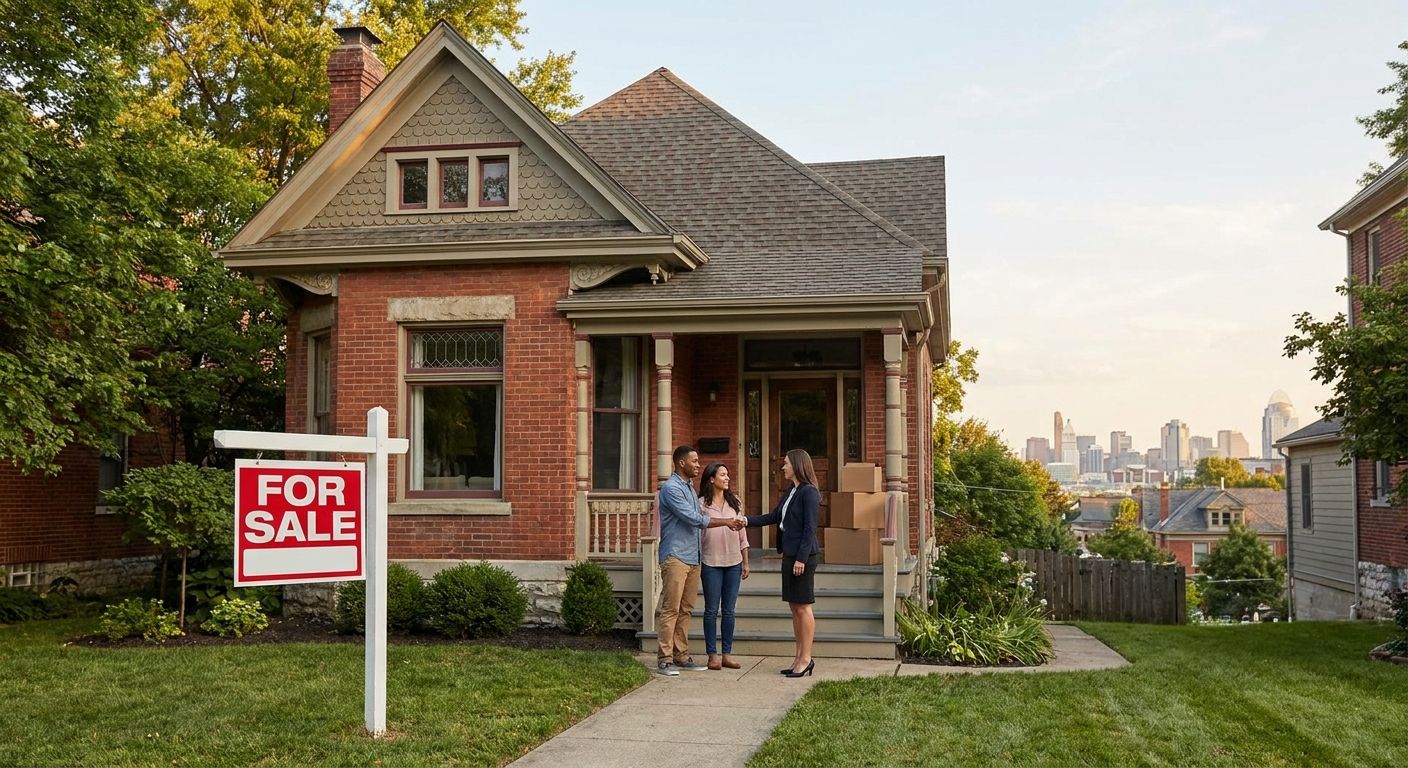
Selling an inherited home in Cincinnati means walking through Ohio probate first (unless the property already sits in a trust or was transferred via survivorship deed), then choosing between a traditional listing, an as-is sale, or a cash buyer — each with different net proceeds and different timelines heading into 2026.
The hidden cost most heirs miss: capital gains tax is calculated on the stepped-up basis (the home's value at the date of death, not what the original owner paid), so a fast, uninformed sale can still trigger a tax bill if you don't document that value correctly.
- Selling an inherited home in Cincinnati starts with Ohio probate, which can take several months depending on the estate.
- Stepped-up basis resets the home's tax value to date-of-death — document it before you list.
- An agent who works probate sales regularly, not a generalist, prevents the most costly delays in 2026.
- As-is sales close faster but typically net less than a prepped, professionally priced listing.
Why this matters
Heirs selling in Cincinnati usually inherit the property with siblings or other co-owners, which means every decision — list price, repairs, timeline — needs agreement before a sign goes in the yard. Add probate court requirements, deferred maintenance from an aging owner, and the emotional weight of clearing out a family home, and the sale gets complicated fast if nobody's steering it.
A local agent who has handled probate and estate sales before knows which title issues to flag early and which repairs actually move the sale price versus which ones just eat time. That's the difference between a smooth 2026 closing and a listing that sits.
How to sell an inherited home in Cincinnati
- Confirm the estate's legal status. Check whether the home is in active probate, already transferred via a transfer-on-death deed, or held in a trust — this determines who can legally sign the listing agreement.
- Get the stepped-up basis documented. An appraisal dated near the time of death establishes the tax basis for capital gains purposes; skip this and you risk overpaying tax on the eventual sale.
- Decide with co-heirs on condition and price strategy. Agree in writing on whether to repair, sell as-is, or price for a quick cash close — disagreements here are the number one cause of stalled inherited-home sales.
- Choose a real estate agent who works Cincinnati probate sales. Ask directly about probate experience; general listing agents often miss court-required disclosures.
- Clear out and stage minimally. You don't need a full renovation — buyers expect some dated finishes in an inherited home, and over-improving rarely returns the investment.
- List, negotiate, and close. Once probate clears title, the sale proceeds like any standard transaction, though closing can still take longer if the court requires final approval of the sale terms.
Probate sale vs. as-is cash sale vs. traditional listing
| Path | Typical timeline | Net proceeds | Best for |
|---|---|---|---|
| Traditional listing (repaired, staged) | Longest of the three | Highest, assuming the market supports the price | Heirs who can wait and want maximum value |
| As-is listing (no repairs, on-market) | Moderate | Middle — priced to reflect condition | Heirs who want market exposure without repair costs |
| Cash/investor sale | Fastest | Lowest, in exchange for speed and certainty | Heirs settling an estate quickly or facing deferred maintenance |
Verdict: if the heirs can hold the property for a few extra weeks, a traditional listing priced correctly and represented by an agent who understands pricing strategy for the Cincinnati-area market nets more than an as-is or cash sale in nearly every case.
Selling through active probate: what changes
When a home is still moving through Ohio probate court, the executor or administrator — not the heirs individually — signs the listing agreement and the purchase contract. The court may also need to approve the final sale price before closing, which adds a step most standard transactions skip.
This is where timelines stretch. Executors who list before probate has cleared title often end up with an accepted offer that sits waiting on a court date, frustrating the buyer and risking the deal falling through. Confirming the estate's probate status before listing — not after an offer comes in — avoids that entirely.
Selling without probate: transfer-on-death and trust properties
If the deceased set up a transfer-on-death (TOD) designation or held the home in a trust, the property usually passes to the named beneficiary outside of probate court. That means the sale can move at a normal residential pace — list, negotiate, close — without the added court approval step.
This is one reason it pays to check the deed and any estate planning documents before assuming a lengthy probate timeline is unavoidable.
Why the timeline and proceeds vary
- Number of heirs. More co-owners means more signatures required and more room for disagreement on price or repairs.
- Condition of the home. Deferred maintenance from an elderly owner often means the buyer pool narrows to renovators or cash buyers, which affects offer strength.
- Whether probate is contested. An uncontested probate moves faster; a contested one can add months before a sale can even be listed.
- Local market conditions in 2026. Days-on-market and buyer demand in the specific Cincinnati neighborhood shape both price and timeline.
- Tax planning decisions. Whether heirs sell immediately or hold the property affects capital gains exposure differently.
- Agent experience with probate transactions. An agent unfamiliar with court requirements can add weeks of avoidable delay.
“The number one cause of a stalled inherited-home sale isn't the market — it's heirs who never agreed on a price strategy before listing.”
Do you have to pay capital gains tax on an inherited home in Cincinnati?
You only owe capital gains tax on the profit above the stepped-up basis — the home's fair market value at the date of death — not on the full sale price. If you sell close to that appraised value, taxable gain is often minimal; the federal long-term capital gains rate tops out at 20% for higher earners, but many heirs owe far less or nothing.
Do all heirs have to agree to sell an inherited home?
Yes, all legal owners typically must agree to list and sell jointly owned inherited property, since each heir's name is on title once probate transfers ownership. When heirs disagree, a partition action through the courts can force a sale, but that route is slower and costlier than reaching agreement directly.
Should you renovate an inherited home before selling it in Cincinnati?
Renovate selectively, not fully — cosmetic updates like paint, flooring, and deep cleaning tend to return more than structural or cosmetic overhauls on an inherited property. A pre-listing prep checklist helps heirs decide which fixes are worth the spend before listing.
How long does it take to sell an inherited home after probate clears?
Once probate clears title, an inherited home sells on a normal residential timeline — typically similar to any other Cincinnati listing, depending on price, condition, and season. Listing during a stronger selling season can shorten that window further.
Joey Sandlin has represented Southern Ohio sellers for over 20 years, including families navigating estate and probate sales across Portsmouth, Scioto County, Wheelersburg, Lucasville, Otway, Rarden, and South Webster — the same high-touch approach applies whether the property sits in one of those communities or in the greater Cincinnati market.
Get guidance on your inherited home sale
Talk through probate status, pricing, and timeline before you list.
FAQ
What's the best way to sell an inherited home in Cincinnati?
The best approach is confirming the estate's probate status first, then listing traditionally once title clears, since a properly priced listing typically nets more than an as-is or cash sale. Working with an agent experienced in probate transactions prevents the most common delays.
Is selling an inherited home as-is better than listing traditionally?
As-is sales close faster but net less than a traditionally listed home in most cases, since buyers price in the assumed repair costs. As-is makes sense when heirs need speed or the property needs extensive work.
How much does it cost to sell an inherited home in Cincinnati?
Costs mirror a standard home sale — agent commission, closing costs, and any repairs — plus potential probate court fees if the estate is still in active probate. Capital gains tax applies only to profit above the stepped-up basis, not the full sale price.
Do you need a lawyer to sell an inherited home in Ohio?
You typically need the estate's executor or administrator to sign transaction documents, and many estates use an attorney to handle probate filings. A real estate agent handles the sale itself, but probate legal steps usually run through an attorney.
Can you sell a house while it's still in probate?
Yes, you can list a home during active probate, but the sale often requires court approval of the final price before closing. Confirming this requirement upfront prevents an accepted offer from stalling.
What happens if heirs disagree on selling an inherited home?
If heirs can't agree, any co-owner can file a partition action asking the court to force a sale, though this route takes longer and costs more than reaching agreement directly. Most heirs resolve disagreements by discussing price strategy before listing.
Does an inherited home need to be appraised before selling?
Yes, an appraisal near the date of death establishes the stepped-up basis used for capital gains tax purposes, and it also helps set a realistic listing price. Skipping this step risks overpaying tax on the eventual sale.
One last thing
Most heirs assume the biggest risk in selling an inherited home is the market — it's actually the paperwork. Estates that document the stepped-up basis and confirm probate status before listing close faster and with fewer surprises in 2026 than estates that list first and sort out the legal details afterward.