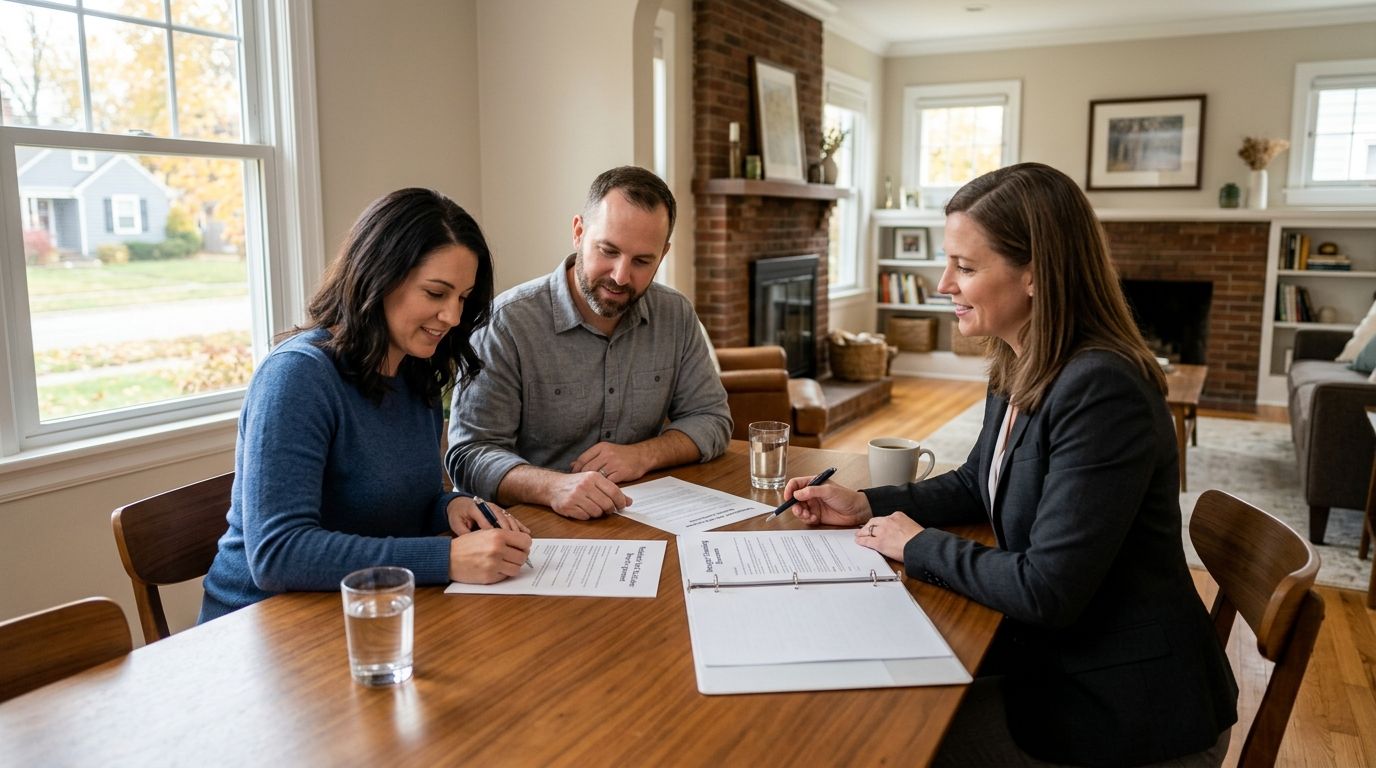
Buying out a co-owner's share of a home in Ohio means paying the departing owner their portion of the equity, then recording a new deed that removes their name from title. The process runs on three tracks working at the same time: agreeing on a value, funding the payout, and clearing the mortgage. The part most people miss is that a deed change and a mortgage release are two separate legal events — the outgoing owner isn't off the loan just because their name comes off the title.
- Buying out a co-owner's share of a home in Ohio requires an agreed valuation, a funded payout, and a recorded deed transfer.
- A cash-out refinance is the most common way to fund a buyout when the remaining owner doesn't have the cash on hand.
- Ohio Revised Code Chapter 5307 lets a co-owner force a sale through a partition action if no buyout agreement is reached.
- A quitclaim deed removes an owner from title but not from the mortgage — the loan needs its own release or refinance.
- Capital gains on the buyout portion can trigger tax under IRC Section 121 once payouts exceed the federal exclusion limits.
Why this matters
Co-ownership disputes over a house rarely resolve themselves, and waiting makes them worse. Interest rates move, home values shift, and unpaid mortgage payments during a standoff hurt both owners' credit.
Sandlin Realtors works with Southern Ohio owners going through exactly this — divorce splits, inherited homes with multiple heirs, and co-investors who want out of a shared property. Getting an accurate, defensible valuation early is what keeps a buyout from turning into a partition lawsuit later in 2026.
How to buy out a co-owner's share of a home in Ohio
The buyout process follows the same sequence whether the co-owners are siblings, ex-spouses, or business partners:
- Get an independent valuation. A licensed appraisal or a comparative market analysis sets the baseline both sides can point to if the deal is ever questioned.
- Calculate each owner's equity stake. Subtract the remaining mortgage balance from the agreed value, then split the equity according to ownership percentage or a separate written agreement.
- Decide how the buyout gets funded. Options are cash, savings, or a cash-out refinance that pulls the payout amount out of the home's equity.
- Draft a written buyout agreement. This document sets the price, the payment timeline, and who covers closing costs and recording fees.
- Refinance or get a lender release. The remaining owner needs the lender to remove the outgoing owner from the mortgage note, not just the deed.
- Record a new deed. A quitclaim deed is the most common instrument used in Ohio to transfer the departing owner's interest, filed with the county recorder.
- Update the title policy. A new title search and updated title insurance protect the remaining owner against claims tied to the prior ownership structure.
“A quitclaim deed changes who owns the home. It does not change who owes the mortgage.”
Buying out a co-owner after divorce in Ohio
Divorce buyouts usually get their price and terms set inside the divorce decree rather than negotiated fresh. The deed transfer and mortgage refinance still have to happen separately from the court paperwork — a decree alone doesn't remove an ex-spouse's name from a loan. Verdict: doable without a lawyer for the real estate steps, but the decree language needs to match the deed exactly.
Buying out a co-owner on an inherited home in Ohio
When siblings or other heirs inherit a home together, each holds a fractional interest as tenants in common unless the will says otherwise. One heir can buy out the others at fair market value, with the payout typically split according to each heir's inheritance share. This scenario is common enough in Southern Ohio that it's worth reading through separately if a probate estate is involved.
Buying out a co-investor's share of a rental or vacation property in Ohio
Investment property buyouts follow the same deed-and-mortgage mechanics but skip the primary-residence capital gains exclusion. Any partnership or operating agreement governing the property usually dictates the valuation method and notice period before a co-investor can force a sale. Verdict: check the partnership agreement first — it often overrides the default Ohio partition rules.
Why the buyout price varies
No two Ohio buyouts land on the same number, even for similar homes. The gap usually comes down to:
- Current mortgage balance and rate. A low locked-in rate makes refinancing to fund the buyout more expensive in relative terms.
- Primary residence vs. rental status. Rentals lose access to the federal capital gains exclusion available on a primary home.
- Existing liens, judgments, or unpaid property taxes. These get settled out of the sale proceeds before either owner sees a payout.
- How ownership percentage was originally recorded. A 50/50 deed splits differently than one reflecting unequal down payment contributions.
- Local market conditions. Values in Portsmouth, Wheelersburg, Lucasville, and the rest of Scioto County move differently than the Cincinnati metro.
- Whether the split is amicable. Contentious buyouts that end up in a partition action add court costs and delay to the final number.
Get a valuation before you negotiate
Joey Sandlin has 20+ years pricing homes across Portsmouth and Scioto County.
Do you need a lawyer to buy out a co-owner in Ohio?
Ohio law doesn't require an attorney to transfer title between co-owners, but a lawyer is worth the cost when the mortgage payoff, tax basis, or a divorce decree is involved. Simple, amicable buyouts between family members sometimes close with just a title company handling the deed and closing documents.
How is the buyout price determined for a shared Ohio home?
The buyout price starts with an agreed home value — from a licensed appraisal or a comparative market analysis — minus the remaining mortgage balance, then split by ownership share. Disagreement over the valuation method is the single biggest reason buyouts stall before they reach a signed agreement.
What happens if a co-owner refuses to sell or agree to a buyout?
A co-owner who won't sell or negotiate a buyout can be taken to court under Ohio Revised Code Chapter 5307, which allows any co-owner to file a partition action. The court can order the property sold and the proceeds divided, which almost always nets less money than a negotiated buyout would have.
FAQ
What's the best way to buy out a co-owner's share of a home in Ohio?
The most reliable path is an independent appraisal, a written buyout agreement, and a lender-approved refinance that removes the departing owner from the mortgage. Skipping the refinance step is the most common mistake — it leaves the outgoing owner legally responsible for the loan.
Is a cash-out refinance better than a home equity loan for a buyout?
A cash-out refinance replaces the existing mortgage entirely, which is usually necessary anyway to remove the departing co-owner's name from the loan. A home equity loan adds a second lien without solving the underlying problem of a shared mortgage obligation.
Do both names have to come off the mortgage in an Ohio buyout?
Yes — recording a new deed only changes ownership on paper, not who the lender holds responsible for the loan. The outgoing owner stays on the hook for missed payments until a refinance or formal lender release happens.
Can a co-owner force a sale in Ohio if no agreement is reached?
Yes, any co-owner can file a partition action under Ohio Revised Code Chapter 5307, and a court can order the home sold with proceeds divided by ownership share. This route almost always costs more and returns less than a negotiated buyout.
Is capital gains tax owed when buying out a co-owner in Ohio?
Capital gains tax can apply to the departing owner's share of the gain, though IRC Section 121 excludes up to $250,000 in gain for a single filer or $500,000 for a married couple on a primary residence. Rental and investment co-ownership buyouts don't get this exclusion.
Does a quitclaim deed alone remove someone from a mortgage?
No — a quitclaim deed only changes who holds title to the property, not who is obligated on the mortgage note. The remaining owner still needs a refinance or a formal lender release to fully clear the departing owner's liability.
How long does an Ohio partition action take?
Timelines vary by county court caseload and whether the case is contested, but partition actions run considerably longer than a negotiated buyout closing. That delay is the main reason most co-owners settle before a court date.
Can siblings buy out an inherited Ohio home from each other?
Yes — heirs holding a home as tenants in common can have one sibling buy out the others at an agreed fair market value. The payout is typically divided according to each heir's inheritance percentage rather than an equal split.
One last thing
The detail that trips up more Ohio buyouts than any other isn't the price — it's the mortgage release. Owners agree on a number, sign a deed, and assume they're done, then find out months later that the departing co-owner is still listed on the loan and their credit is still exposed to missed payments. Confirm the refinance or lender release is actually complete before calling the deal closed, not just the deed recording.