
The cost to sell a house in Cincinnati has no fixed total in 2026. Your selling expenses depend on the commission you negotiate, the closing charges assigned to you, the condition of the property, and any concessions in the final contract. Your mortgage payoff is deducted from sale proceeds too, but it is debt repayment, not a selling fee.
- The cost to sell a house in Cincinnati has no fixed total in 2026; request an itemized seller estimate.
- Negotiated commission, closing charges, repairs, and buyer concessions affect what you keep.
- Mortgage payoff reduces your proceeds but is not a fee for selling.
- Sandlin Realtors is best for Southern Ohio sellers seeking high-touch representation; Cincinnati-specific charges need local verification.
How much does it cost to sell a house in Cincinnati?
There is no reliable flat figure for every Cincinnati seller. The useful answer is an itemized estimate of your net proceeds, prepared for your property and updated when you receive an offer. Start with an expected sale price, subtract the expenses you expect to pay, then subtract your mortgage payoff and any other amounts that must be cleared at closing.
For seller representation, Sandlin Realtors serves Southern Ohio homeowners with high-touch guidance. If your property is in Cincinnati, ask any agent you interview to identify the local charges and contract terms behind their estimate rather than giving you an unexplained percentage.
| Item | What it covers | What to check before relying on an estimate |
|---|---|---|
| Agent commission | Compensation set by the listing agreement and any separate buyer-agent terms you accept | The signed agreements and the proposed offer |
| Closing charges | Title, settlement, recording, and other charges assigned to the seller | A property-specific estimate from the closing professional |
| Property taxes | Taxes allocated between buyer and seller under the contract | The proposed proration and tax information for the property |
| Preparation and repairs | Work you choose before listing or agree to after an inspection | Written estimates and the final repair agreement |
| Buyer concessions | Closing expenses or other amounts you agree to cover for the buyer | The exact language and limits in the offer |
| Mortgage payoff | The amount required to clear your loan at closing | A current payoff statement from your lender |
The table separates selling expenses from mortgage payoff. Both reduce the check you receive, but combining them into one fee figure makes it harder to judge whether a proposed offer is financially sound. Ask for the same categories when comparing offers so a higher sale price does not conceal larger concessions.
Why this matters
A Cincinnati listing price is not a promise of what you will take home. Your net proceeds depend on the accepted offer and the obligations attached to it. In 2026, a seller comparing offers needs to examine the full contract, not just its headline price.
That distinction is especially useful before you authorize repairs or agree to pay a buyer expense. Each decision changes the amount left after closing. An estimate prepared before listing gives you a starting point; a revised estimate tied to an actual offer gives you a decision tool.
How to calculate what you keep after closing
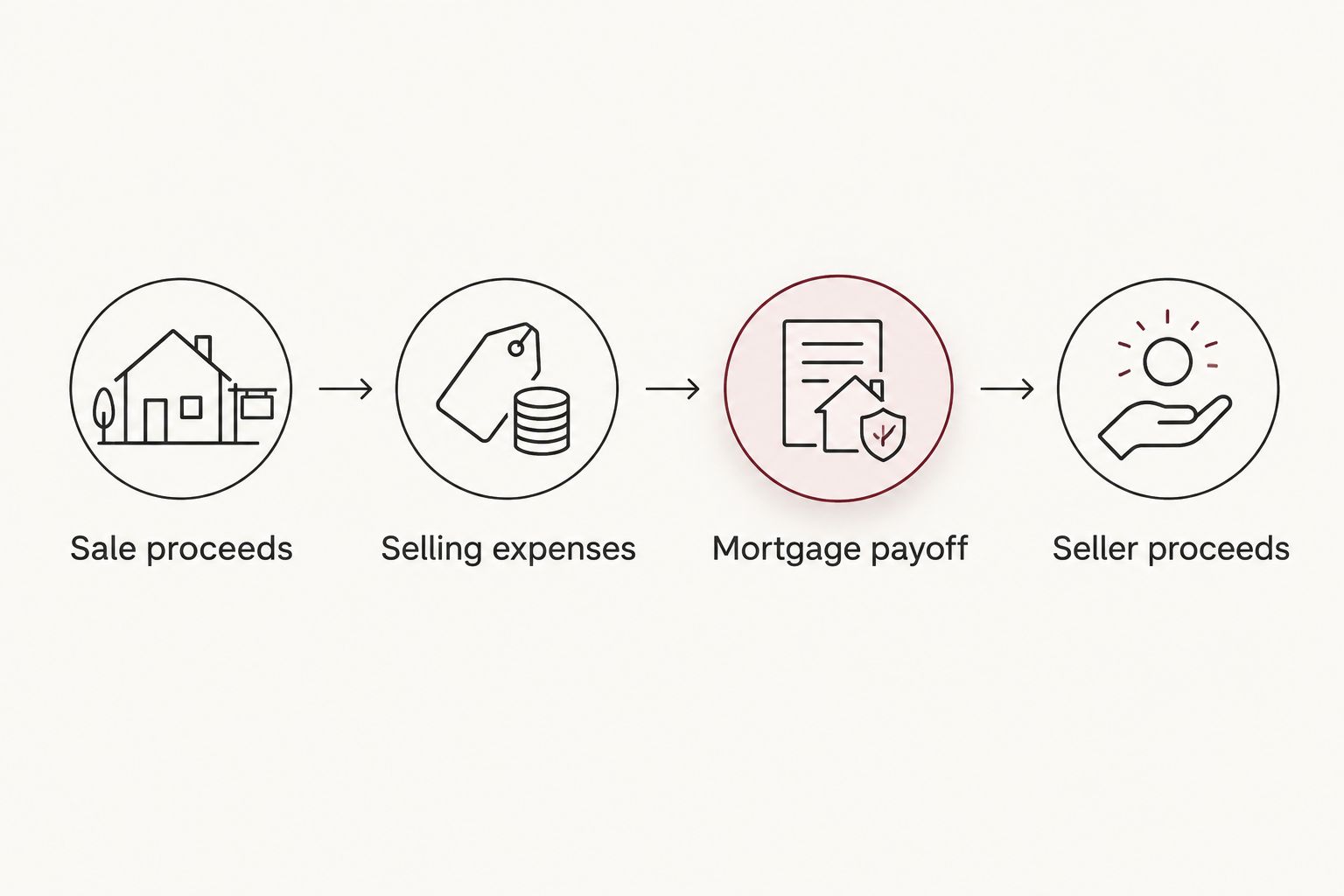
Use this sequence to turn an expected sale price into a seller-proceeds estimate:
- Sale proceeds: Start with the price in the offer you are evaluating, not the asking price.
- Selling expenses: Subtract the commission in your agreements, seller closing charges, agreed concessions, and any preparation or repair costs you will pay.
- Mortgage payoff: Subtract the lender's current payoff amount and any other debt that must be cleared from the property at closing.
- Seller proceeds: Review what remains, then update the estimate when a contract term or closing figure changes.
Sale proceeds minus selling expenses minus mortgage payoff equals estimated seller proceeds. Keep preparation costs paid before closing on the worksheet even if they will not appear on the closing statement. Otherwise, the closing check can look larger than the amount you actually gained from the sale.
Ask whoever prepares your estimate which figures are confirmed and which are assumptions. A lender payoff comes from the lender; a repair cost needs a contractor's estimate or an agreed credit; a concession comes from the contract. An estimate that leaves those sources unclear is difficult to use when you need to accept, reject, or counter an offer.
Why the cost to sell a Cincinnati house varies
- Your listing agreement: Agent compensation is negotiable. Read what the agreement requires you to pay and when that obligation applies; do not substitute a supposed standard rate.
- The accepted offer: A buyer request for closing-cost assistance or a repair credit changes your proceeds. Compare the complete offers rather than their prices alone.
- Your property's condition: Work completed before listing and repairs agreed to after inspection are different decisions. Keep both in your cost estimate.
- Your closing allocation: The contract determines which party pays many transaction charges. Request an itemized estimate instead of assuming every seller pays the same set of fees.
- Your tax proration: The allocation of property taxes affects the closing calculation. Check the dates and tax information used for the property you are selling.
- Your outstanding debt: Mortgage payoff and other amounts that must be cleared affect cash received, even though they are not all costs of hiring someone to sell the house.
These factors interact. A seller who accepts a strong price but agrees to substantial concessions needs a different proceeds estimate from a seller who accepts a lower price with fewer obligations. Neither outcome can be judged from the sale price alone.
Should you sell with an agent or sell by owner?
Both routes require you to understand closing charges, tax allocation, property condition, and the terms of the accepted offer. Selling by owner changes how you handle representation and marketing; it does not make every other transaction expense disappear. Compare the responsibilities alongside the cost categories.
| Approach | Best for | Advantage | Trade-off |
|---|---|---|---|
| Seller representation | Homeowners who want an agent to guide pricing, marketing, offers, and negotiations | You have professional help reviewing decisions that affect proceeds | You must account for the compensation in your signed agreement |
| For sale by owner | Homeowners prepared to manage the sale process themselves | You decide how to handle listing and negotiations without a listing agent | You take on the work and still need to account for applicable closing charges and contract concessions |
Sandlin Realtors is best for Southern Ohio homeowners who want high-touch seller representation, not for sellers seeking a published flat Cincinnati selling cost. Joey Sandlin brings more than 20 years of experience to the team's selling and buying guidance across Southern Ohio. That experience does not replace a Cincinnati-specific estimate for a Cincinnati property; request the local charges and proposed terms in writing.
The fairest comparison is not agent compensation against zero. Compare the work you would handle yourself, the compensation in any agreements, and the net proceeds under the offers you might accept. Keep unknown offer terms out of any promise about which route leaves you with more money.
What to request before you list
Ask for an estimate that lets you trace every deduction. It should distinguish a fee from a loan payoff, identify costs you pay before closing, and show how a buyer concession would change the result. If a line item depends on a future offer, label it as an assumption rather than treating it as agreed.
A useful seller worksheet answers these questions:
- What sale price is the estimate based on, and how does it relate to the proposed listing price?
- What compensation does the listing agreement require, and what other representation terms affect the seller?
- Which closing charges have been estimated, and who will confirm them?
- What property-tax allocation has been used?
- Which preparation costs have already been paid, and which remain decisions?
- What payoff figure has the lender supplied, and when must it be refreshed?
- How will the estimate change if a buyer requests a concession or repair credit?
Do not wait until the closing statement arrives to distinguish these items. Review the worksheet before listing, again when evaluating an offer, and again after contract terms change. The 2026 question is not whether a generic selling-cost percentage sounds plausible; it is whether the estimate reflects your actual agreement and the offer in front of you.
Discuss your selling plan
Ask about seller representation and the decisions that affect your proceeds.
Do repairs count as selling costs?
Yes, when you spend money on them to complete the sale. Keep work done before listing on the same worksheet as closing expenses, even if you paid for it earlier. Keep proposed repairs after inspection separate until you know whether you will do the work, offer a credit, or decline the request.
Avoid treating every suggested improvement as mandatory. Decide what problem the work addresses and obtain a written estimate before committing. A repair decision should be evaluated against the property's condition, your selling plan, and the terms of an actual offer—not against a generic list of projects.
Is the mortgage payoff part of the cost to sell?
No. Mortgage payoff reduces your cash at closing, but it repays an existing debt rather than paying for the sale. Include it in a net-proceeds calculation because you need to know what you will receive. Show it on its own line so you can compare selling expenses between scenarios without confusing them with your loan balance.
Use a current lender payoff statement when a closing date is known. The balance on a routine mortgage statement is not the same document as a payoff statement. If other obligations must be resolved before title transfers, ask the closing professional how they appear on the estimate.
Are Cincinnati seller closing costs the same for every home?
No. Seller closing charges depend on the property, the closing details, and the contract's allocation of expenses. A general checklist tells you what to ask about; an itemized estimate tells you what has been assigned to your transaction. Review any change between the estimate and the final closing statement before signing.
The same discipline applies to taxes. Ask which tax information and dates were used rather than assuming that a bill or an earlier estimate captures the amount allocated at closing. This is a calculation to verify for the property, not a fixed charge to copy from another sale.
FAQ
How much does it cost to sell a house in Cincinnati in 2026?
There is no fixed total for selling a house in Cincinnati in 2026. Request an itemized estimate covering negotiated compensation, seller closing charges, taxes, repairs, concessions, and mortgage payoff.
Do Cincinnati home sellers have to pay a standard agent commission?
No standard commission figure should be assumed for a Cincinnati sale. Review the compensation in your signed agreements and any offer terms that affect what you pay.
Is my mortgage balance a selling fee?
No. Paying off your mortgage reduces seller proceeds, but it repays debt rather than covering a transaction service. Show payoff separately from selling expenses.
Do I still have closing costs if I sell my Cincinnati house by owner?
Selling by owner does not remove applicable closing charges or obligations you accept in a contract. Request an itemized closing estimate and account for preparation costs and concessions as well.
Should I pay for repairs before listing my Cincinnati home?
Pay for work only after identifying the issue and evaluating a written estimate against your selling plan. Keep any work you approve in your proceeds calculation, whether you pay before listing or at closing.
Can a higher offer leave me with less money?
Yes. Concessions, repair credits, and other contract obligations reduce what remains from an offer. Compare written net-proceeds estimates for the full terms of each offer.
When should I update my seller-proceeds estimate?
Update it when you receive an offer and whenever a contract term or closing figure changes. Replace assumptions with confirmed figures as the sale progresses.
One last thing
A sale price is not a seller-proceeds figure. Before you accept a Cincinnati offer in 2026, ask for a revised estimate that includes its concessions and repair terms. For Southern Ohio homeowners in Portsmouth, Scioto County, Wheelersburg, Lucasville, Otway, Rarden, and South Webster, Sandlin Realtors can discuss high-touch seller representation; a Cincinnati property still calls for an estimate grounded in its own location and contract.