
Cincinnati medical staff home buying means matching a purchase to a hospital shift schedule instead of a standard commute, with the goal of cutting drive time on the days a 12-hour shift runs long. Nurses, residents, and attending physicians search differently than a typical buyer: proximity to a specific campus, parking, and resale timing around a residency contract all move to the top of the list. This guide breaks down where medical staff buy near Cincinnati's major hospitals, how to shop for a home that fits a rotating schedule, and where Sandlin Realtors' guidance fits into the process.
- Homes for sale in Cincinnati near major hospitals for medical staff cluster around Clifton, Mount Auburn, Norwood, and Hyde Park.
- Condos and townhomes near UC Medical Center and Christ Hospital shorten the commute on rotating night shifts.
- Nurses and medical residents can qualify for buying programs that lower cash needed at closing.
- A pre-approved, written offer wins in Cincinnati's inner-ring market in 2026 -- casual interest does not.
- Sandlin Realtors: best for out-of-state medical relocators who need a fast, locally guided home search.
Why this matters for Cincinnati medical staff
A 12-hour shift that ends at 7am is a different commute problem than a 9-to-5 drive. Traffic patterns shift, on-call callbacks happen at odd hours, and a 25-minute drive during the day can stretch past 40 minutes during a shift-change rush hour. Staff working at UC Medical Center, Cincinnati Children's, Christ Hospital, TriHealth's Good Samaritan campus, or Mercy Health locations tend to search in a tight radius around their assigned campus rather than the wider metro.
Residency and fellowship timelines add another wrinkle. A three-year residency means some buyers need a home that resells cleanly on a fixed schedule, not one that requires years to build equity. Others are staying permanently and want a neighborhood suited to commuting downtown or to a specific hospital corridor without giving up a yard or a school district.
Map your commute radius before you look at listings
Start with the hospital campus, not the neighborhood name. A five-mile radius from UC Medical Center covers Clifton, Mount Auburn, Corryville, and parts of Avondale -- all walkable or a short drive to the medical campus. A radius from Christ Hospital in Mount Auburn pulls in Hyde Park and Mount Lookout. Norwood and Oakley sit closer to TriHealth's Good Samaritan and Bethesda North campuses.
- Draw the radius during a normal shift-change window, not midday
- Check whether the route crosses the Ohio River or a major interstate merge
- Confirm overnight parking rules if the home has street parking only
- Test the drive on a weekday morning and a weekday evening
- Note distance to a second hospital if you rotate between campuses
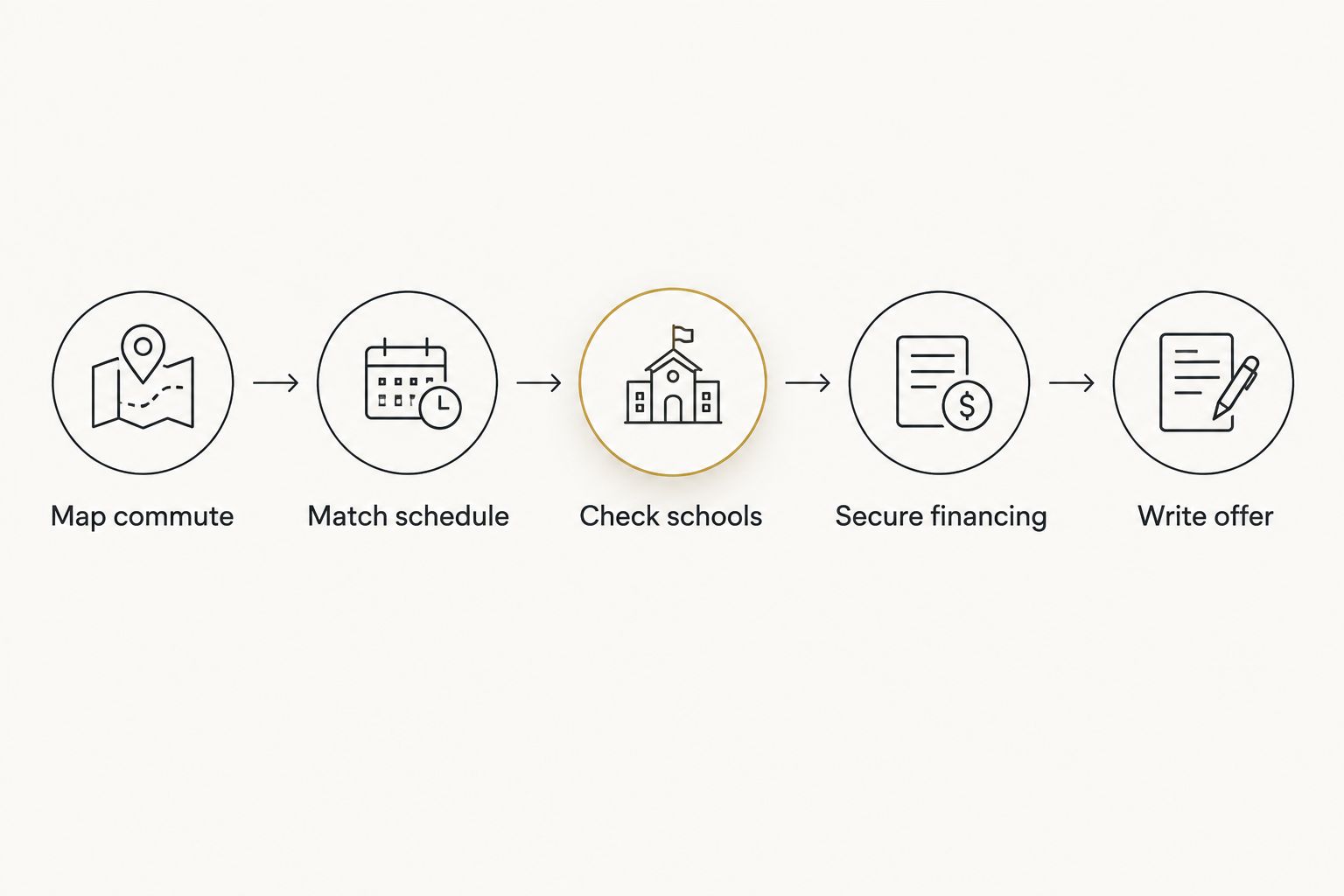
Match the home to your work schedule, not just your budget
A rotating-shift household needs a home that runs on autopilot when nobody's around to mow the lawn or call a plumber. Condos and townhomes near hospital corridors solve that trade-off for single shift workers, while single-family homes in inner-ring suburbs suit staff who want yard space and still keep a commute under 15 minutes.
- Low-maintenance exteriors (brick, vinyl, no wood siding that needs repainting)
- HOA-covered landscaping and snow removal for winter night shifts
- Secure entry or a garage for late-night arrivals
- A quiet bedroom away from street noise for day sleepers
- Enough storage for scrubs, equipment bags, and on-call gear

Check the school district if kids are part of the plan
Staff planning to stay past a residency or fellowship should treat school zoning as a search filter, not an afterthought. Boundaries shift home value even when the house itself hasn't changed, and the best school districts near Cincinnati don't always sit closest to the hospital campuses.
- Confirm the exact elementary, middle, and high school assignment before writing an offer
- Ask whether the district has open enrollment for out-of-boundary families
- Compare district boundaries against your realistic commute radius
- Factor in before/after-school care if shifts run early or late
Explore home buying programs built for medical professionals
Nurses, in particular, have access to buying assistance that generalist buyers don't know exists. Reviewing home buying programs for nurses in Cincinnati before house-hunting can change which neighborhoods are realistic on day one.
- Down payment assistance tied to healthcare or public-service employment
- Reduced mortgage insurance requirements through certain lender programs
- Employer relocation stipends for staff moving for a new position
- First-time buyer programs stacked with a nurse-specific incentive
Line up financing that understands non-traditional income
Travel nurse contracts, resident stipends, and fellowship pay don't always look like a standard W-2 to an underwriter. Getting pre-approved with a lender who has handled medical income before saves weeks once a listing goes live, and reviewing the best mortgage lenders for first-time buyers is worth doing before you tour a single house.
- Ask specifically whether the lender has closed loans on residency or fellowship income
- Get pre-approval in writing, not a verbal estimate
- Confirm how contract or 1099 income from travel assignments is treated
- Lock a rate hold that covers your expected closing window
Write an offer that wins in a fast-moving market
Inner-ring Cincinnati neighborhoods near major hospitals move fast, and a pre-approval letter without a strong offer structure still loses. Studying how to write a competitive offer in the Cincinnati market before submitting matters as much as the commute analysis.
- Submit pre-approval, not pre-qualification, with every offer
- Shorten inspection contingency windows where the home condition supports it
- Include an escalation clause capped at your real budget ceiling
- Time the offer around your actual move date, not a rigid deadline
Talk to Sandlin Realtors about hospital-area homes
Get local guidance on commute-friendly neighborhoods near Cincinnati's hospital campuses.
Comparing housing options near Cincinnati's hospital corridors
| Option | Best for | Key limitation |
|---|---|---|
| Condo or townhome near a hospital campus | Single shift workers who want a walk-to-work commute | HOA fees and limited private storage |
| Single-family home in an inner-ring suburb | Staff who want yard space with a commute under 15 minutes | Older housing stock often needs an inspection-driven repair budget |
| New construction in an outer suburb | Dual-income medical households commuting to two different campuses | Adds drive time during shift-change traffic |
| House-hack duplex near a hospital corridor | Residents building equity while offsetting the mortgage with rental income | Landlord duties stack on top of clinical hours |
Homes for sale in Cincinnati near major hospitals for medical staff cluster hardest around Clifton, Mount Auburn, Norwood, and Hyde Park -- pick the campus first, then the neighborhood.
Common mistakes medical staff make in this search
- Ignoring night-shift commute safety. A route that's fine at 8am can feel very different driving home alone at 3am.
- Skipping HOA rules on parking and overnight guests. Some buildings restrict street parking exactly when a night-shift worker needs it most.
- Underestimating resale timing. A three-year residency and a home that needs five years to build equity don't match.
- Waiting on pre-approval. In a fast-moving inner-ring market, a verbal estimate arrives too late to compete on a listing.
- Buying too far from a second rotation site. Staff who rotate between two hospital systems sometimes lock in a location that only works for one.
FAQ
What's the best neighborhood in Cincinnati for hospital staff to buy in 2026?
Clifton and Mount Auburn sit closest to UC Medical Center and Cincinnati Children's, while Hyde Park and Norwood work better for staff at Christ Hospital or the TriHealth campuses. The right pick depends on which hospital campus you're assigned to.
Is a condo or a single-family home better near a Cincinnati hospital?
A condo or townhome suits a single shift worker who wants low maintenance and a short walk to campus. A single-family home in an inner-ring suburb fits better once yard space or a second income earner enters the picture.
What loan programs exist for nurses and medical residents buying in Cincinnati?
Several down payment assistance and reduced-insurance programs are built around healthcare and public-service employment. Reviewing them before house-hunting changes which neighborhoods are realistic on day one.
How close should a medical professional live to their hospital?
Close enough that a shift-change commute stays predictable, typically within a five-mile radius for staff working overnight or on-call rotations. Test the drive during an actual shift-change window before deciding.
Do Cincinnati school districts matter if I don't have kids yet?
Yes, if you plan to stay past a residency or fellowship. School boundaries affect resale value even for buyers without children currently enrolled.
Can a travel nurse or contract physician qualify for a Cincinnati mortgage?
Yes, but the lender needs experience underwriting contract or 1099 medical income. Ask directly whether they've closed loans on residency, fellowship, or travel-assignment pay before applying.
What's the biggest mistake medical staff make buying near a hospital?
Skipping pre-approval before house-hunting. Inner-ring Cincinnati listings near major hospitals move fast in 2026, and a verbal estimate arrives too late to compete against a written, pre-approved offer.
Should I wait until residency ends to buy a home in Cincinnati?
Not necessarily -- a home with a clean resale timeline can work during a fixed-length residency. The mismatch to avoid is buying a property that needs years to build equity when your contract runs three.
One last thing
The neighborhoods closest to UC Medical Center and Cincinnati Children's -- Clifton and Mount Auburn -- carry some of the oldest housing stock in the search radius, which means the inspection contingency matters more there than in a newer outer-suburb listing. Buyers who shorten that contingency to win a bidding war on an older home without budgeting for repairs are the ones who call an agent again six months later for the wrong reasons. Build the repair budget into the offer, not into a regret.